TAMUCC clinical hours, program by program
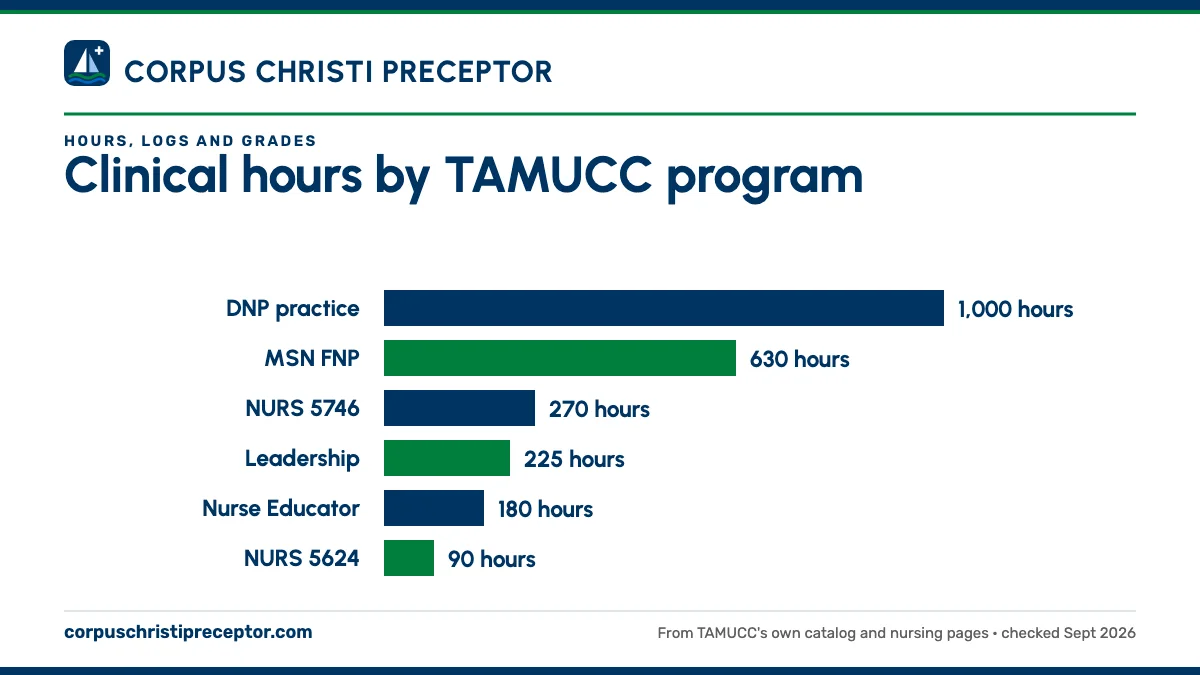
Clinical hours at TAMUCC depend on the program: 630 over four courses for the MSN Family Nurse Practitioner, while the DNP requires 1,000 post-baccalaureate practice hours with up to 500 carried in from your MSN, and the MSN Nurse Educator asks for 180 field hours. Leadership in Nursing Systems is the odd one out: the catalog says 180 and the MSN handbook says 225. The planner below lays out each program's courses; this guide covers the sources behind the numbers and the conditions every hour must meet.
Get your placement plan
Tell us your TAMUCC program and where you live. A placement advisor replies with the preceptor and site options that fit your TAMUCC course.
Pick your TAMUCC program
Your clinical courses and hours, who can precept you, where, and when to start looking. From TAMUCC's own catalog and nursing pages.
- Who precepts
- NPs, MDs or DOs with national board certification and two years of independent practice
- Where
- Texas primary care, with 75 hours each in pediatrics, women's health and geriatrics
- Start looking
- Months ahead: a new affiliation agreement can take up to 3 months
- Who precepts
- A practice organization's Letter of Support and a community facilitator (who gives access, not supervision)
- Where
- The organization where your DNP project and practice experiences run
- Start looking
- Spring cohorts; practice hours logged each term
- Who precepts
- A preceptor in academic or clinical teaching
- Where
- A Texas school of nursing, staff development or clinical teaching setting
- Start looking
- Before the capstone practicum; hours finish before the last week of the semester
- Who precepts
- A nurse leader who can host your capstone project
- Where
- A Texas health care organization
- Start looking
- Before the capstone, taken with NURS 5163
Which TAMUCC document sets your number
Four TAMUCC documents carry hour figures, and each has its own job. The 2026-27 catalog lists program totals and course descriptions. The MSN Student Handbook and the DNP Student Handbook, both last updated July 2026, set program rules. The FNP Student Clinical Guide, revised January 2026, runs the working clinical process for FNP students.
Your admission date also matters. TAMUCC posts the July 2026 MSN handbook for students admitted in Fall 2026 or later and keeps the July 2024 edition online for earlier cohorts. For the FNP total, the sources agree: 630 hours appears in the catalog, on page 26 of the MSN handbook and in the clinical guide.
When a figure here differs from what your course shell shows, your course faculty and your cohort's handbook decide. FNP students can take hour questions to the FNP Clinical Coordinator.
Where TAMUCC's own figures disagree
Two numbers in TAMUCC's published materials do not line up, and a third is missing where you would expect it. None of them changes this semester's work, but each is worth settling in writing before you plan a placement.
| Item | One source says | Another source says | Who settles it |
|---|---|---|---|
| Leadership in Nursing Systems field hours | 2026-27 catalog: a minimum of 180 hours of field experience | MSN Student Handbook (July 2026): 225 clinical hours, in place since 2017 | MSN Academic Program Coordinator and your course faculty |
NURS 5746 credits | 2026-27 catalog: 7 credits | Spring 2025 and Spring 2026 syllabi: 6 semester hours | CONHS Graduate Advisor and your Degree Planner |
| FNP Post-Master's Certificate hours | Catalog certificate page: no total printed | Its four clinical courses add up to 630 | FNP Clinical Coordinator |
The Leadership gap has a likely explanation in the course descriptions. NURS 5360 Health Care Financial Management includes 45 hours of laboratory time, NURS 5362 carries a clinical laboratory component, and the NURS 5469 capstone lists 135 clinical hours. Counting the NURS 5362 lab across a full term brings the sum to 225, the handbook's figure, though that total is arithmetic rather than a TAMUCC statement. Planning around the larger number is the safer course until your coordinator confirms which applies to your cohort.
The NURS 5746 credit difference leaves its 270 clinical hours untouched, and both the catalog and the handbook still total the FNP at 49 credits.
Conditions attached to every clinical hour
Totals change by program, but TAMUCC's guide and handbooks attach the same conditions to each hour. The short version:
- Paperwork first. For FNP students, hours earned before an active affiliation agreement and a completed Preceptor Agreement Packet are not counted.
- Patient care only. Only time actively engaged in patient care belongs on the log; what counts as clinical hours sorts the gray areas.
- Inside the semester. Each course's minimum is met during that course and nothing carries forward; see no rollover and extensions.
- Logged and signed. FNP encounters go into Typhon, and a Clinical Hours Log is signed at the end of each term; see Typhon case logs.
- In Texas. Under the MSN handbook, clinical work in every MSN track happens at Texas sites.
- Accurate. Both graduate handbooks count falsifying hours as a conduct violation.
FNP and certificate hours
The FNP's 630 hours run through four courses, NURS 5624 first and NURS 5746 last, in a fixed order since every course unlocks the one after it. Inside the total sit three population minimums, pediatrics, women's health and geriatrics, each met with 75 hours or with 150 encounters documented in Typhon. The 630-hour breakdown takes each course and minimum in turn.
The FNP Post-Master's Certificate keeps the same four clinical courses, so certificate students plan for the same load even though the catalog's certificate page prints no total. The capstone, NURS 5746, requires a B or better, which puts the largest block of hours in the course with the tightest grade rule. All four courses run through the same agreement, packet and clearance steps, so every new preceptor adds paperwork lead time.
DNP practice hours
TAMUCC's DNP asks for 1,000 post-baccalaureate practice hours on both tracks. Appropriate field or clinical hours from your MSN count toward that total, up to 500, and the DNP handbook documents them through a Practice Hours Verification Form. The remainder comes from practice experiences during the program, in courses such as NURS 6304 and the track courses, NURS 6321 for Nurse Practitioner students and NURS 6331 for Executive Leadership.
Per-course targets are kept inside the DNP's learning-management site rather than in any public document, which is why the planner shows DNP courses without hour figures. The DNP Chair approves practice experiences and oversees the logging, the syllabi name Typhon as the platform, and the handbook notes that some students retake NURS 6195 to finish their hours. DNP practice hours has the full picture.
Nurse Educator and Leadership field hours
Both MSN role tracks keep field hours in Texas and put most of them in a precepted capstone near the end. The catalog describes the Nurse Educator's 180 hours as a virtual health assessment experience plus a teaching capstone in an academic or clinical setting. NURS 5459 holds 135 of those hours with a preceptor, roughly nine a week according to its syllabus, and all of them have to be done by the start of the semester's final week.
Leadership in Nursing Systems divides its hours among a finance lab based on case studies, a set of leadership exposure experiences, and a capstone project. The capstone, NURS 5469 Patterns of Care Delivery, is taken alongside NURS 5163 Project Management for Nurse Leaders, and its 135 clinical hours carry the same before-the-last-week deadline. Both capstones need a B or better for credit.
Programs where TAMUCC assigns the clinicals
The Traditional and eLine BSN work differently from everything above. TAMUCC's Nursing Education Department assigns BSN clinicals itself, in the Corpus Christi area, and eLine students travel there for them at their own expense. The eLine program page puts each clinical course at between 90 and 135 hours, and the catalog does not total them for the program. BSN students still keep compliance current, since the catalog ties progression to immunizations, BLS CPR and hospital orientation.
Registered nurses entering through the RN-MSN or RN-Bridge options take leveling courses first, including NURS 4560, which carries a lab component. After that they follow the rules of their MSN track, which means a student-found Texas preceptor for the FNP, Educator or Leadership hours listed above.
Why TAMUCC students choose us to plan their hours
Hours come from placements, and placements are what we build. Tell us your program and your next clinical course, and your placement advisor searches for Texas preceptors near you whose practice fits it: a pediatric-heavy clinic when NURS 5644 comes up, a women's health practice for NURS 5645, and a high-volume family practice able to carry the capstone's 270 hours.
We gather your preceptor's CV, license and certification documents, along with who signs for the site and whether its agreement is current, so the affiliation agreement and Preceptor Agreement Packet can clear before your first scheduled day. If a preceptor steps away mid-semester, we line up a replacement so your hours keep moving. Read how it works, then send us your course in the form below.
Questions TAMUCC students ask
Does the FNP Post-Master's Certificate need the same 630 hours?
In practice, yes. The certificate uses the same four clinical courses as the MSN FNP, NURS 5624 through NURS 5746, and those courses carry 90, 135, 135 and 270 hours. Because the catalog's certificate page does not print a total, confirm your plan with the FNP Clinical Coordinator before your first clinical term.
Does TAMUCC's Leadership in Nursing Systems MSN need 180 or 225 hours?
TAMUCC publishes both figures. The 2026-27 catalog lists a minimum of 180 field hours, while the July 2026 MSN Student Handbook lists 225 clinical hours and dates that number to 2017. Ask the MSN Academic Program Coordinator which one applies to your cohort, and keep the answer in writing.
Can hours from my MSN count toward TAMUCC's DNP?
Up to 500 of them can. The DNP handbook lets relevant MSN field or clinical hours count toward the 1,000-hour requirement, verified through a Practice Hours Verification Form. The cap is 500, so the rest of your hours come from DNP practice experiences that your DNP Chair approves.
How many practice hours does the DNP Executive Leadership track need?
The same 1,000 post-baccalaureate hours as the Nurse Practitioner track, with the same 500-hour allowance from an MSN. NURS 6331, the Executive Leadership track course, requires clinical experiences, and its syllabus has them recorded in Typhon. If a site becomes unavailable, the DNP handbook expects you to find another.
Do TAMUCC BSN students find their own clinical sites?
No. For the Traditional and eLine BSN, TAMUCC assigns clinicals in the Corpus Christi area. The student-led search for a preceptor belongs to the graduate programs: the MSN FNP, the FNP Post-Master's Certificate, the DNP, and the Educator and Leadership MSN tracks.
Related pages
Last checked 2026-09-26
We check these pages against TAMUCC's catalog, FNP clinical guides, MSN and DNP handbooks and college pages. Your course, your clinical faculty member and the handbook for your cohort have the final word.
TAMUCC makes the preceptor search yours. Let us run it for you in Texas.
Tell us your TAMUCC program, your next clinical course and where in Texas you can drive. We find preceptors who fit the course and gather what the affiliation agreement and the Preceptor Agreement Packet need, early enough for both to clear.
- Preceptors matched to the course: pediatrics for
NURS 5644, women's health forNURS 5645, broad primary care forNURS 5746 - CV, license, board certification and the site's agreement status ready for TAMUCC's paperwork
- In Corpus Christi, the Valley, San Antonio, Houston, Austin, Dallas-Fort Worth and across Texas
Start your placement plan
Your program, city and next clinical semester is all we need to begin.