How a TAMUCC FNP clinical placement comes together, start to finish
TAMUCC's January 2026 FNP Student Clinical Guide sets one fixed order for every rotation: clear CastleBranch, get into Typhon, line up a qualified Texas preceptor, confirm the site's affiliation agreement, complete the Preceptor Agreement Packet, then wait for your clinical faculty member to clear you. Rush a stage and the hours you log will not count. Here is the full path once, in sequence, with a link to the deeper guide for each stage.
Get your Texas preceptor lined up
Tell us your course and where you live in Texas. Your placement advisor replies with the next steps.
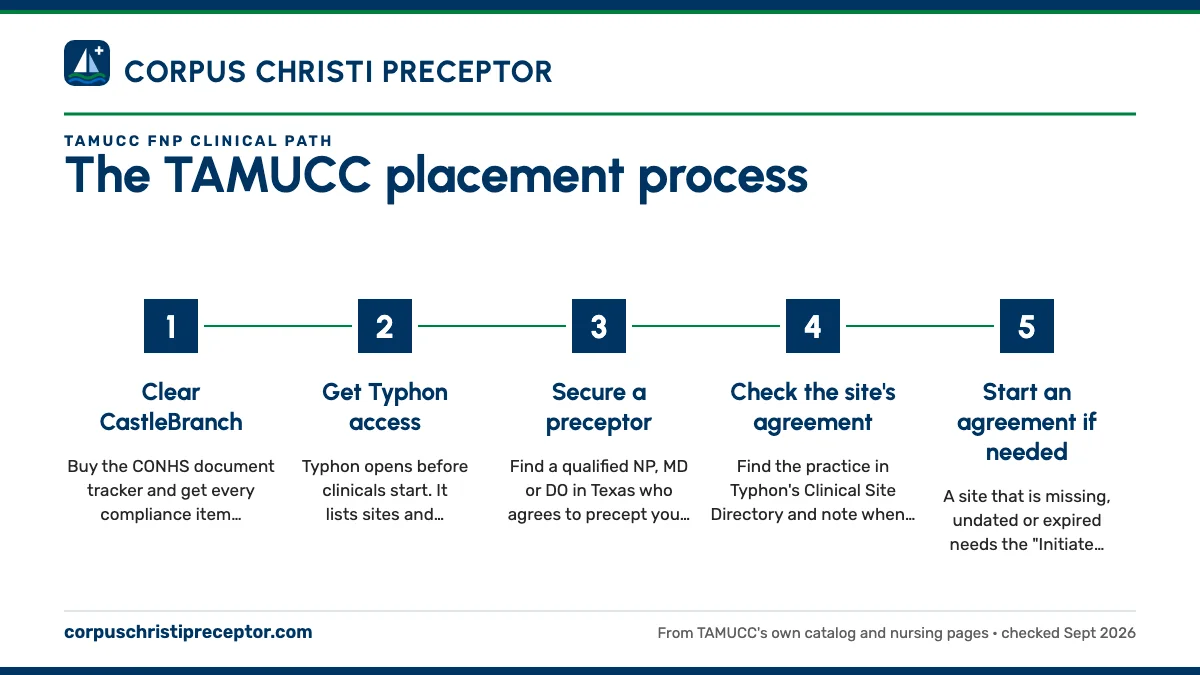
The eight stages at a glance
TAMUCC's flowsheet, Attachment 2 of the FNP Student Clinical Guide, runs in a straight line. Each stage depends on the one before it, so the order matters as much as the tasks themselves.
- Clear CastleBranchBuy the CONHS document tracker and get every compliance item accepted before clinicals, then keep it current each semester.
- Get Typhon accessTyphon opens before clinicals start. It lists sites and preceptors earlier TAMUCC students used, and later holds your encounter logs.
- Secure a preceptorFind a qualified NP, MD or DO in Texas who agrees to precept you for this course. Under TAMUCC's rules the search is yours.
- Check the site's agreementFind the practice in Typhon's Clinical Site Directory and note when its contract begins and ends.
- Start an agreement if neededA site that is missing, undated or expired needs the "Initiate Affiliation Agreement" DocuSign form.
- Complete the packetOne Preceptor Agreement Packet for each preceptor, every semester, uploaded to Canvas once signed.
- Get clearedYour assigned clinical faculty member reviews your plan and schedule and clears you to begin.
- Log hours and close outRecord encounters in Typhon through the term, then submit the hours log and evaluations through DocuSign.
Stages one and two: compliance and Typhon come first
TAMUCC requires every College of Nursing and Health Sciences student to purchase and complete a CastleBranch tracker holding the background check, drug test and health documents. The FNP guide expects it cleared before clinicals and refreshed each semester, and it is strict about lapses: if an item expires mid-term, you stop attending clinical until the record is current again. Put the renewal dates for your TB test, flu shot and CPR card on a calendar before the term starts.
Typhon Group access is set up "prior to the start of clinicals," and it does two jobs. Early on, it is TAMUCC's record of sites and preceptors that past students used, which is where many searches begin; the guide to Typhon's Clinical Site Directory explains how to read it. Once hours begin, Typhon is where every patient encounter gets logged.
Stage three: the preceptor search
This is the stage TAMUCC hands entirely to you. The guide's exact wording, and why it matters, is covered in finding your own preceptor; the practical side follows here.
TAMUCC notes that most FNP students secure a preceptor through their personal network. When that falls short, the guide recommends scheduling an in-person meeting to make the request, with your CV and the course objectives in hand so the provider sees exactly what the semester involves. Before you ask, check the provider's license on the state's public verification site, the Board of Nursing for NPs or the Medical Board for physicians, as the guide directs.
Three filters narrow the field quickly. TAMUCC accepts nurse practitioners and physicians (MD or DO) who hold board certification and have practiced independently for at least two years. Your manager or a relative is ruled out, and your own employer works only under narrow conditions. And the site has to be in Texas, since TAMUCC's MSN handbook keeps every clinical hour inside the state.
Stages four to six: the agreement and the packet
Two separate documents must be in place before a precepted hour counts. First comes the site-level contract, the affiliation agreement. Search for the practice in Typhon's Clinical Site Directory: if it is missing, shows no contract dates or shows an expired contract, a new agreement is needed, and you begin it through the "Initiate Affiliation Agreement" DocuSign form. TAMUCC's estimate runs as long as three months, and it warns that big health systems move slower; timing and mid-term expirations are covered in affiliation agreements.
The second document is preceptor-level. Each semester, every preceptor you work with completes a Preceptor Agreement Packet in DocuSign, with CV information and a license copy no older than 30 days. It reaches administration first, so your preceptor sees the signature request a day or two later. Once it is signed, you upload it to Canvas for your clinical instructor. The Preceptor Agreement Packet guide has the details.
TAMUCC's flowsheet is blunt about timing: "Any hours accumulated before obtaining the necessary documentation will not count." An active agreement and a completed packet come before hour one.
Stage seven: clinical faculty clearance and your schedule
TAMUCC assigns each FNP student a clinical faculty member, full-time or adjunct, based on where you will do clinicals, and the guide states that faculty requests cannot be accommodated. You submit your intended schedule. TAMUCC expects most clinical time on weekdays during business hours, roughly 8 to 5, and your plan has to fit your faculty member's calendar as well.
The instruction here is direct: students "must not begin clinical" until their assigned clinical faculty member clears them. This is also the point where your site and preceptor are approved for the course. Assignment, scheduling and clearance are explained in clinical faculty and clearance.
During the term your faculty member also makes at least one evaluative site visit, so let your preceptor and the practice know to expect one.
Stage eight: hours across four courses, then the closing forms
The 630 FNP hours are spread over four clinical courses taken in sequence, and each course's minimum must be met inside its own semester. Hours cannot roll over, and TAMUCC credits only time spent in direct patient care. The 630-hour breakdown covers the pediatrics, women's health and geriatrics minimums.
| Course | Focus in TAMUCC's guides | Clinical hours |
|---|---|---|
NURS 5624 Advanced Health Assessment and Differential Diagnosis | Early clinical experience | 90 |
NURS 5644 Management of Acute and Chronic Illness I | Pediatrics | 135 |
NURS 5645 Management of Acute and Chronic Illness II | Women's health | 135 |
NURS 5746 Integrated Clinical Practice: FNP | Late clinical, capstone, B or better | 270 |
Four DocuSign forms close each course: the Clinical Hours Log, carrying three signatures (yours, your preceptor's and the FNP Clinical Coordinator's) and producing your preceptor's hours certificate, the Preceptor Evaluation of Student, the Student Evaluation of Preceptor and the Student Evaluation of Clinical Site. Then the cycle restarts with a new packet, a refreshed CastleBranch record and a new clearance for the next course.
Where our placement desk takes over
Most of this path belongs to TAMUCC and to you, but stage three is where semesters are won or lost, and it is the stage our service is built for. Your placement advisor hunts for a Texas preceptor close to home whose practice suits the course in front of you: a patient panel heavy with children for NURS 5644, steady women's health visits for NURS 5645, a broad family practice for the 270 hours of NURS 5746.
We then carry the match through stages four to six. Before you open DocuSign, you have the preceptor's CV, a current license copy and proof of board certification, the site's agreement status, and the name of the site's signer if a new agreement is needed. That lets the agreement clock start early and the packet go out complete. If a preceptor drops mid-term, a replacement search starts straight away. Your clinical faculty member still gives the clearance; we make the file they review complete and rule-ready from the start. How it works lays out each step, or start with the form below.
Questions TAMUCC students ask
How early should a TAMUCC FNP student start the placement process?
TAMUCC sets no public date for naming a preceptor, so the contract timeline becomes your deadline. Signing a new site can stretch to three months, big hospital systems often longer, and hours before the contract is live will not count. Counting back three months from a January 19 spring start lands in mid-October. Ask your course faculty whether your cohort has an internal cutoff.
Can I begin clinical hours while my paperwork is still being signed?
No. Three conditions come first: a live contract with the site, a finished packet from the preceptor, and a go-ahead from your clinical faculty member. Patients you see before that point add nothing to your course total, however many there are, so hold your start date until all three are confirmed.
Which steps repeat every semester at TAMUCC?
Three things recur each term: a new packet signed by each preceptor, even one you worked with before; an up-to-date CastleBranch record; and clearance from your clinical faculty member for the new course. The affiliation agreement repeats only when a site is new to TAMUCC or its contract has lapsed. The hours log and evaluations close out each course.
Does the FNP Post-Master's Certificate use the same clinical process?
Certificate students take the identical four clinical courses, NURS 5624 through NURS 5746, and the FNP Student Clinical Guide is written for FNP students, so the same stages apply. The certificate's program page carries no placement wording of its own. If anything about your cohort differs, the FNP Clinical Coordinator is the person to confirm it with.
Is the process the same for DNP, Nurse Educator and Leadership students?
The 2026-27 catalog also makes those students responsible for finding sites or preceptors, but TAMUCC publishes a step-by-step process only for the FNP. DNP students need written support from the organization where they practice, plus a local facilitator who opens doors without supervising, as covered under DNP practice hours. Educator and Leadership students follow their course syllabus and faculty.
Related pages
Last checked 2026-09-26
We check these pages against TAMUCC's catalog, FNP clinical guides, MSN and DNP handbooks and college pages. Your course, your clinical faculty member and the handbook for your cohort have the final word.
TAMUCC makes the preceptor search yours. Let us run it for you in Texas.
Tell us your TAMUCC program, your next clinical course and where in Texas you can drive. We find preceptors who fit the course and gather what the affiliation agreement and the Preceptor Agreement Packet need, early enough for both to clear.
- Preceptors matched to the course: pediatrics for
NURS 5644, women's health forNURS 5645, broad primary care forNURS 5746 - CV, license, board certification and the site's agreement status ready for TAMUCC's paperwork
- In Corpus Christi, the Valley, San Antonio, Houston, Austin, Dallas-Fort Worth and across Texas
Start your placement plan
Your program, city and next clinical semester is all we need to begin.