Your TAMUCC clinical faculty member and the clearance to start
Every TAMUCC FNP student is paired with a clinical faculty member, chosen by location rather than by request. That faculty member approves your site and preceptor, fits your clinical days to their own schedule and gives the clearance that has to come before your first precepted hour. Here is how the assignment works and what must be finished before clearance arrives.
Get your placement plan
Tell us your TAMUCC program and where you live. A placement advisor replies with the preceptor and site options that fit your TAMUCC course.
What your clinical faculty member decides
Of all the people in TAMUCC's clinical process, your clinical faculty member has the most direct say over your rotation. The FNP Student Clinical Guide gives the role three decisions before you start: whether the site is acceptable, whether the preceptor is acceptable, and whether you may begin. A Fall 2023 NURS 5645 syllabus puts the first two in a single line: "Clinical site and preceptor approval by the clinical faculty member."
The catalog makes the same point from the course side. Its FNP course descriptions require laboratory hours to be completed "in appropriate settings approved by clinical faculty," and the FNP Preceptor Guide tells preceptors they are selected and approved by the nursing program. The division of labor is plain: you find the preceptor, and TAMUCC's faculty decide whether that person and that setting fit the course.
Once you are underway, the same faculty member makes at least one evaluative visit to your site and grades the clinical portion as satisfactory or unsatisfactory. An unsatisfactory clinical fails the whole course regardless of your other grades. The visit and the closing paperwork have their own guide on site visits and evaluations.
How TAMUCC matches students with clinical faculty
TAMUCC assigns each FNP student a full-time or adjunct clinical faculty member based on location. The FNP guide explains the thinking in its own words: "We try to assign local faculty to local students and utilize our adjunct faculty located in the various large cities around Texas." A student rotating in Houston or McAllen may therefore work with an adjunct based in that region rather than with someone on the Island campus.
Personal preference plays no part. The guide states that faculty requests are not accommodated, so you cannot ask for an instructor you liked in an earlier course or a colleague who teaches for the program. Location is the deciding factor, which is one more reason to settle where you will train well before the semester opens.
Other tracks spread this oversight differently. The MSN handbook gives the MSN Academic Program Coordinators oversight of clinical practice experiences, and each DNP student's Scholarly Project Committee Chair signs off on every practice experience. The clinical roles guide maps each of those titles to its job.
The schedule you submit
Clearance depends partly on a calendar. TAMUCC asks each FNP student to submit an intended clinical schedule, and the guide sets two limits on it. Clinical hours generally run Monday to Friday between 8 am and 5 pm, and they must also fit your clinical faculty member's schedule, not only your preceptor's.
A useful schedule shows the weekdays you will be at the site, the preceptor's clinic hours on those days, and start and finish dates that sit comfortably inside the term. TAMUCC's graduate nursing courses run across full 16-week terms: Fall 2026 runs from August 24 to December 10, with the last class day on December 2, and every required hour has to be done within the course timeline.
If your preceptor works a compressed week or an unusual shift pattern, raise it with your clinical faculty member before the preceptor commits to dates, not after the packet is signed.
What has to be finished before clearance
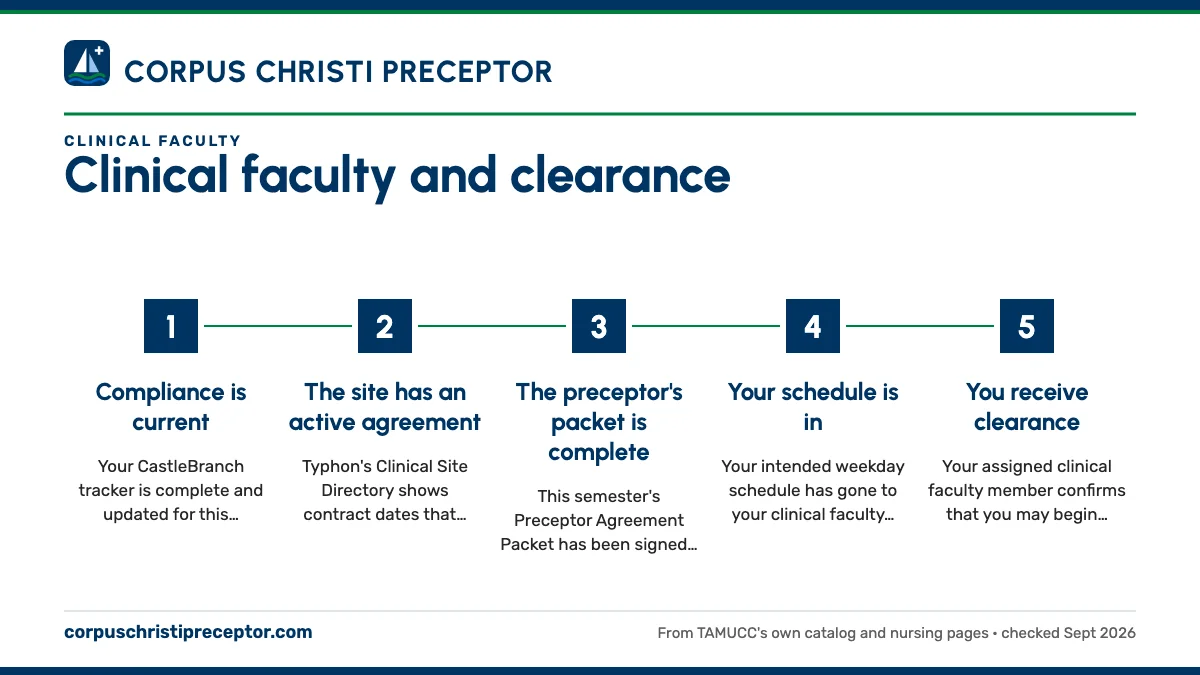
Clearance is the final gate, so the other pieces should already be complete when you ask for it. TAMUCC counts no precepted hour earned before the site's agreement and the preceptor's packet exist, which makes the order of these steps as important as the steps themselves.
- Compliance is currentYour CastleBranch tracker is complete and updated for this semester. An item that lapses mid-term stops your clinical attendance until it is fixed; see CastleBranch compliance.
- The site has an active agreementTyphon's Clinical Site Directory shows contract dates that cover your semester, or a new agreement has been signed by all parties. The affiliation agreements guide covers the request.
- The preceptor's packet is completeThis semester's Preceptor Agreement Packet has been signed through DocuSign with the preceptor's CV and a recent license copy, then uploaded to Canvas for your clinical instructor to verify.
- Your schedule is inYour intended weekday schedule has gone to your clinical faculty member and fits both your preceptor's calendar and theirs.
- You receive clearanceYour assigned clinical faculty member confirms that you may begin. Your first counted hour comes after this point.
The guide's wording on that last step is blunt: "Students must not begin clinical until they have received clearance to begin clinical by their assigned clinical faculty." Treat any planned first day as provisional until that confirmation arrives.
Time at a site before the agreement is active and the packet is complete will not count toward the course, however useful the experience felt.
Keeping your clearance through the semester
Clearance can be paused partway through a term. The most common cause is paperwork: a CastleBranch item such as an annual TB test or a CPR card expiring mid-semester stops clinical attendance until the record is updated, so check every expiry date before the term starts.
The second cause is conduct. TAMUCC's FNP guide allows faculty to remove a student from the clinical setting at any time for unsafe care or unprofessional behavior, and if the problem cannot be corrected in the clinical time that remains, the clinical grade is recorded as unsatisfactory.
The third is attendance. Your faculty member relies on the schedule you submitted, and the FNP guide treats an unannounced absence during a faculty visit as grounds for formal discipline. Tell your faculty member before any change, including a switch to a new preceptor, who needs a packet of their own and clearance before the next hour; the backup preceptors guide covers that situation.
Why TAMUCC students choose us for this stage
Clearance moves fastest when everything your clinical faculty member reviews is complete and correct on the first pass, and that is the part of the process we are built around. We search for a Texas preceptor who meets TAMUCC's FNP standard, near where you live and in a setting that suits your course, then assemble the preceptor's CV, license and board certification details and the site's agreement status before anything goes to TAMUCC.
We also plan the clinical schedule with your preceptor around TAMUCC's weekday norm and the full-term calendar, so the dates you submit are dates the preceptor has already agreed to. The approval itself belongs to your clinical faculty member, and everything we send along is built to satisfy TAMUCC's rules on the first review. Tell us your course and your city with the form below, or read how it works.
Questions TAMUCC students ask
Can I choose my TAMUCC clinical faculty member?
No. TAMUCC assigns a full-time or adjunct clinical faculty member based on location, and the FNP Student Clinical Guide says requests for a particular instructor are not accommodated. If your clinical location changes after the assignment is made, tell the program promptly, since location is what the match is built on.
Can I see patients at my site while my paperwork is still pending?
Not for credit. TAMUCC counts precepted hours only after the site has an active affiliation agreement, the preceptor's packet for that semester is complete, and your clinical faculty member has cleared you. Anything earlier does not count, so set your first clinical day after clearance rather than hoping to backdate hours later.
Do I need new clearance every semester?
Plan on it. TAMUCC requires a fresh Preceptor Agreement Packet every semester for every preceptor, even one you worked with before, and your CastleBranch record is updated each semester as well. Each new clinical course therefore starts with paperwork that your clinical faculty member reviews before you begin.
Who will my clinical faculty member be if I train far from Corpus Christi?
Often someone closer to you. TAMUCC's FNP guide says it tries to pair local faculty with local students and draws on adjunct faculty in large Texas cities. Because MSN clinicals must take place in Texas, that faculty pool covers the state rather than only the Coastal Bend; see Texas-only clinicals.
Can my TAMUCC clinical hours fall on weekends?
TAMUCC describes clinical hours as generally Monday to Friday, 8 am to 5 pm, and requires them to fit your faculty member's schedule. The word generally suggests exceptions can happen, but your clinical faculty member is the one to approve any, so ask before building weekend days into a plan with your preceptor.
Related pages
Last checked 2026-09-26
We check these pages against TAMUCC's catalog, FNP clinical guides, MSN and DNP handbooks and college pages. Your course, your clinical faculty member and the handbook for your cohort have the final word.
TAMUCC makes the preceptor search yours. Let us run it for you in Texas.
Tell us your TAMUCC program, your next clinical course and where in Texas you can drive. We find preceptors who fit the course and gather what the affiliation agreement and the Preceptor Agreement Packet need, early enough for both to clear.
- Preceptors matched to the course: pediatrics for
NURS 5644, women's health forNURS 5645, broad primary care forNURS 5746 - CV, license, board certification and the site's agreement status ready for TAMUCC's paperwork
- In Corpus Christi, the Valley, San Antonio, Houston, Austin, Dallas-Fort Worth and across Texas
Start your placement plan
Your program, city and next clinical semester is all we need to begin.