The 630 clinical hours in TAMUCC's FNP program
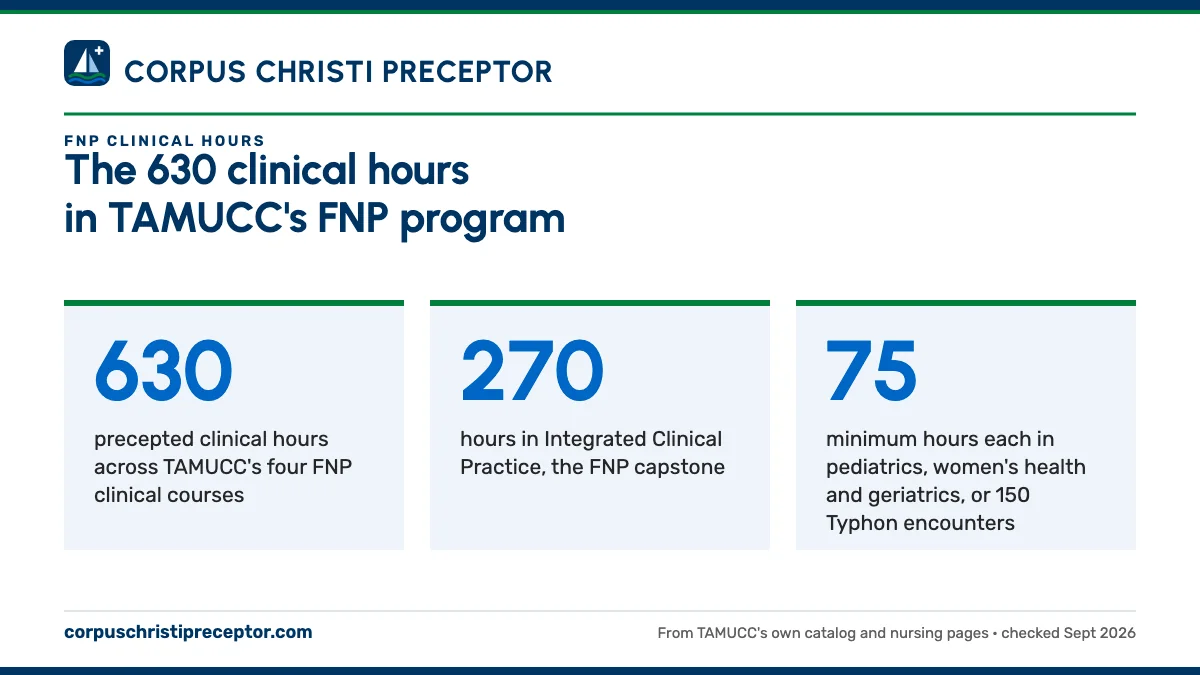
TAMUCC's MSN Family Nurse Practitioner program requires 630 precepted clinical hours: 90 in NURS 5624, 135 in NURS 5644, 135 in NURS 5645 and 270 in NURS 5746. Within those hours you also need at least 75 hours, or 150 encounters documented in Typhon, in each of pediatrics, women's health and geriatrics. Here is how the pieces fit together and what each course asks of a preceptor.
Get your placement plan
Tell us your TAMUCC program and where you live. A placement advisor replies with the preceptor and site options that fit your TAMUCC course.
How the 630 hours divide
The split is deliberately uneven. The early course is the shortest, the two middle courses each carry a population focus in TAMUCC's guides, and the capstone alone holds 270 hours, three times the first course. The catalog and the FNP Student Clinical Guide give identical per-course figures, and the MSN handbook carries the same 630 total.
| Course | Catalog title | Stage and focus in TAMUCC's FNP guides | Clinical hours |
|---|---|---|---|
NURS 5624 | Advanced Health Assessment and Differential Diagnosis | Early clinical experience | 90 |
NURS 5644 | Management of Acute and Chronic Illness I | Mid-clinical, pediatrics | 135 |
NURS 5645 | Management of Acute and Chronic Illness II | Mid-clinical, women's health | 135 |
NURS 5746 | Integrated Clinical Practice: FNP | Late clinical, capstone | 270 |
| Total | Four courses | 630 |
Each course is the prerequisite for the next, so the order is fixed and a pause in one course holds up the rest. The course guides cover each one in depth, from NURS 5624 at the start to the NURS 5746 capstone at the end.
The pediatrics, women's health and geriatrics minimums
The FNP Student Clinical Guide sets a floor for three populations across the program: 75 clinical hours in each, or 150 encounters for each documented in Typhon. You meet each floor by either route. The guide expects about two patients an hour, which is why 75 hours and 150 encounters are treated as matching amounts.
The minimums sit inside the 630, not on top of it. Pediatric encounters build most naturally in NURS 5644 and women's health encounters in NURS 5645, since those are the focus TAMUCC's guides assign each course. The guide also counts prior encounters toward the dedicated rotation, so children or older adults you see during NURS 5624 help.
Geriatrics has no course of its own. Neither guide gives it a course focus, although a 2023 NURS 5645 syllabus listed geriatrics among that course's broader areas. Ask every prospective preceptor how many older adults they see, because no course schedules this population for you.
The capstone: 270 hours and a B or better
NURS 5746 Integrated Clinical Practice: FNP holds the largest block of hours and requires a B or better to earn credit. A failing clinical grade fails the whole course, whatever the exam scores, so the capstone preceptor is the most consequential match of the program. The guides label it the late clinical stage.
One figure is inconsistent in TAMUCC's own files. The 2026-27 catalog lists NURS 5746 at 7 credits, while the Spring 2025 and Spring 2026 syllabi list 6 semester hours. The 270 clinical hours are identical in every source, and the catalog and handbook still total the program at 49 credits; your Degree Planner and the CONHS Graduate Advisor settle the credit question.
Because the capstone packs three times the hours of NURS 5624 into a term of the same length, look for a preceptor who can host you most weeks of the semester, and keep a second one in reserve. The backup preceptors guide explains why TAMUCC's own guide recommends it.
Conditions every FNP hour has to meet
An hour only lands in the 630 if it clears TAMUCC's conditions. Miss any one of them and the time falls outside the total, however much you learned. In brief, each hour:
- Comes after the site's affiliation agreement is active and that preceptor's packet for the current semester is complete.
- Comes after your assigned clinical faculty member has cleared you to begin.
- Is spent actively engaged in patient care, which leaves out breaks and time away from the clinic (what counts).
- Falls inside the course's own semester, generally on weekdays between 8 am and 5 pm.
- Takes place at a Texas site with a preceptor who meets TAMUCC's FNP standard (preceptor requirements).
- Is logged in Typhon and ends up on the Clinical Hours Log your preceptor signs at the end of the term.
Certificate students carry the same four courses
The FNP Post-Master's Certificate is the MSN FNP's 37-credit role block without the 12-credit MSN core, and it keeps every clinical course. Its catalog page lists NURS 5624, NURS 5644, NURS 5645 and NURS 5746 but prints no hour total; add the course figures and you reach 630.
Certificate students need a current Texas nursing license and go through the same agreement, packet and faculty-clearance steps as MSN students. One label differs between sources: the certificate's program page says On Campus, while the catalog calls it an online offering. The clinical hours are the same under either label. Confirm your total and population minimums with the FNP Clinical Coordinator before the first clinical term, and see the certificate guide for admission and start-term details.
How we plan all four rotations
The best time to think about 630 hours is before the first 90. Your placement advisor maps the sequence with you: a solid primary care preceptor for NURS 5624, a practice with a strong pediatric panel for NURS 5644, a women's health setting for NURS 5645, and a high-volume family practice with room for 270 hours in NURS 5746. We check the older-adult mix at every stop so the geriatrics minimum builds as you go.
Every preceptor we bring meets TAMUCC's FNP standard: an NP, MD or DO with national board certification and at least two years of independent practice. We prepare the CV, license and certification details and the site's agreement status each semester, because TAMUCC requires a fresh packet every term even for a returning preceptor. Start with how it works, or use the form below.
Questions TAMUCC students ask
Do the 75-hour population minimums add to TAMUCC's 630 hours?
No. The pediatrics, women's health and geriatrics floors are met within the 630 hours rather than in addition to them. Each can be satisfied with 75 clinical hours in that population or 150 encounters documented in Typhon, and TAMUCC's guide lets encounters from earlier rotations count toward the dedicated one.
Can one preceptor cover more than one TAMUCC FNP course?
A preceptor can return. TAMUCC requires a new Preceptor Agreement Packet every semester for every preceptor, including repeat ones, so returning preceptors are clearly expected. Fit still matters: NURS 5644 has a pediatrics focus and NURS 5645 a women's health focus, so check a returning preceptor's patient mix against each course.
What grade do I need in NURS 5746?
A B or better. The catalog makes NURS 5746 Integrated Clinical Practice a B-or-better course, and an unsatisfactory clinical grade fails it outright regardless of exam scores. With 270 hours at stake, a well-matched preceptor and a backup are worth arranging early. See grades and progression.
Can I finish TAMUCC FNP hours sooner by doing extra in one course?
No. TAMUCC's guide says each course's minimum is achieved during that course and cannot be rolled over, so extra hours in NURS 5644 do not reduce what NURS 5645 needs. Plan each semester's hours on their own terms, finishing by the last day of class.
How many patients a day will I see in a TAMUCC FNP rotation?
TAMUCC's FNP guide expects about two patients an hour. At that pace an eight-hour clinic day comes to roughly 16 encounters, which is how 75 hours and 150 encounters line up for the population minimums. Actual volume depends on the practice, which is one reason we check a preceptor's patient load before matching.
Related pages
Last checked 2026-09-26
We check these pages against TAMUCC's catalog, FNP clinical guides, MSN and DNP handbooks and college pages. Your course, your clinical faculty member and the handbook for your cohort have the final word.
TAMUCC makes the preceptor search yours. Let us run it for you in Texas.
Tell us your TAMUCC program, your next clinical course and where in Texas you can drive. We find preceptors who fit the course and gather what the affiliation agreement and the Preceptor Agreement Packet need, early enough for both to clear.
- Preceptors matched to the course: pediatrics for
NURS 5644, women's health forNURS 5645, broad primary care forNURS 5746 - CV, license, board certification and the site's agreement status ready for TAMUCC's paperwork
- In Corpus Christi, the Valley, San Antonio, Houston, Austin, Dallas-Fort Worth and across Texas
Start your placement plan
Your program, city and next clinical semester is all we need to begin.