What counts as a clinical hour at TAMUCC
At TAMUCC, a clinical hour is time in the clinical setting spent actively engaged in patient care: seeing patients, talking through their care with your preceptor and charting in the EHR. Lunch and time outside the clinic stay off the log, and so does anything before your agreement, packet and faculty clearance are in place. Here is how to sort the hours before you record them.
Get your placement plan
Tell us your TAMUCC program and where you live. A placement advisor replies with the preceptor and site options that fit your TAMUCC course.
TAMUCC's definition, word for word
The FNP Student Clinical Guide (January 2026) defines clinical time as "time spent in the clinical setting actively engaged in patient care." Two conditions live in that sentence. You are physically at the clinical site, and the time is about patients.
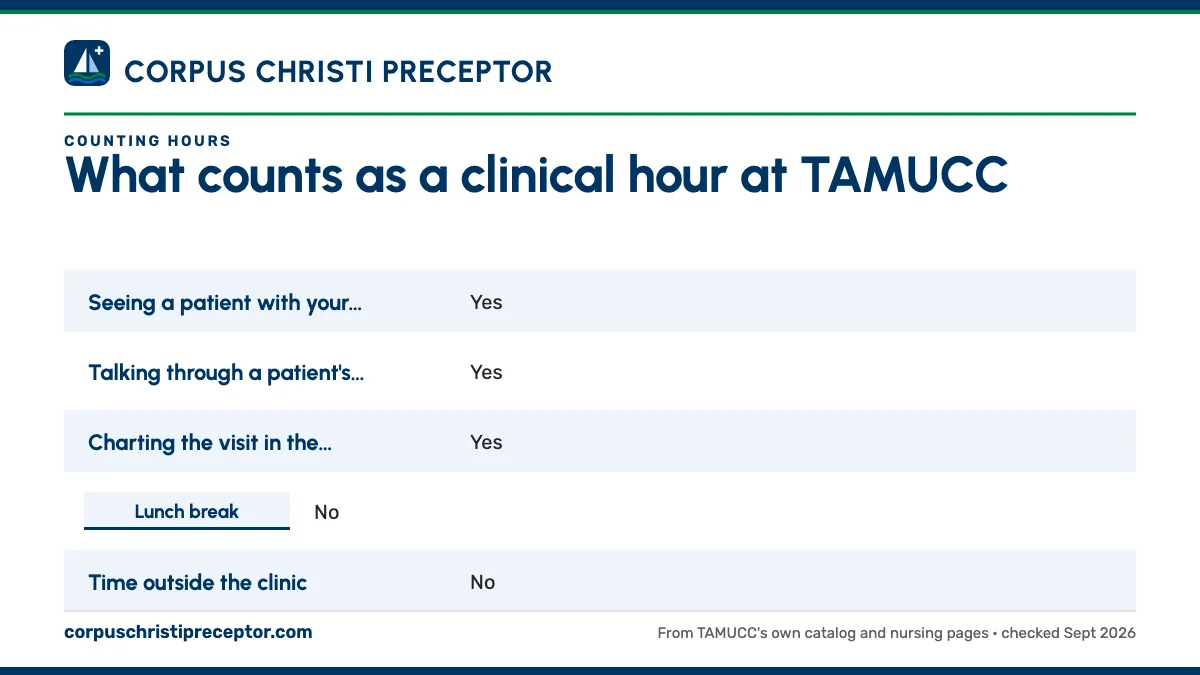
The guide then spells out what the definition covers. Direct time with a patient counts. Discussing a patient's care with your preceptor counts, which takes in the case conversation after a visit as well as the plan you build together. Documenting in the site's electronic health record counts too, because charting is part of the care. The guide is equally clear about what falls outside: lunch breaks and time outside the clinic.
The definition is written for FNP students, and it is the one this guide applies unless a section says otherwise. The other graduate programs set their field hours through the catalog and course syllabi, covered further down.
On the log or off it
Most clinic time sorts easily once you apply the patient-care test. This table runs the common cases through TAMUCC's wording and rules.
| Time spent | Counts? | Reason |
|---|---|---|
| Seeing a patient with your preceptor | Yes | Direct patient care |
| Talking through a patient's plan with your preceptor | Yes | The guide includes discussing care |
| Charting the visit in the EHR | Yes | The guide includes documentation |
| Lunch break | No | Named as excluded |
| Time outside the clinic | No | Not in the clinical setting |
| Clinic days before the agreement and packet are complete | No | Earlier hours are not accepted |
| Days while a CastleBranch item is expired | No | You must stop attending until it is updated |
When an activity sits between these rows, such as a slow afternoon with no patients on the schedule, ask your clinical faculty member before you log it. The test is always active engagement in patient care, and your preceptor reviews and authenticates what you document.
Paperwork that has to come before the first hour
Clinic time turns into clinical hours only once three things are in place. The site needs an active affiliation agreement with TAMUCC, your preceptor needs a completed Preceptor Agreement Packet for the current semester, and your assigned clinical faculty member must clear you to begin. TAMUCC's flowsheet states that hours accumulated before that documentation exists will not count.
The same test applies each time something changes. A new preceptor mid-semester needs their own packet, and a new site needs its own agreement, before time there counts. If a site's agreement is due to expire during the term, the Affiliation Agreement Liaison needs to hear about it early. The guides to affiliation agreements and the Preceptor Agreement Packet walk through each form.
A willing preceptor is not enough: time logged before the agreement is active and this semester's packet is signed does not count, however good the experience.
Weekday scheduling and the faculty visit
TAMUCC's FNP guide describes clinical hours as generally falling Monday through Friday, 8 am to 5 pm. You submit an intended schedule to your clinical faculty member, and it has to fit that faculty member's availability as well as your preceptor's, because faculty make at least one evaluative site visit during the course. TAMUCC assigns clinical faculty by location and does not take requests for a particular faculty member, so the schedule bends to the one you are given.
That visit is why the schedule you submit carries weight. If faculty arrive on a scheduled day and you are absent without notice, TAMUCC says formal disciplinary action follows and you are at risk of dismissal. Keep the schedule current whenever it changes, and clear evening or weekend shifts with faculty before you count on them. The site visit guide explains the visit itself.
Hours versus encounters for the population minimums
Hours are one currency and encounters are another. For pediatrics, women's health and geriatrics, TAMUCC accepts either 75 clinical hours in that population or 150 encounters documented in Typhon, and its guide expects about two patients an hour. A quiet clinic day still produces clinical hours if you spend it in patient care, but it adds few encounters, so the encounter route favors busy practices. Encounters also carry across the program in one respect: TAMUCC's guide counts prior encounters toward the dedicated rotation.
Record each encounter in Typhon the same day while details are fresh. The 630-hour breakdown shows how the minimums spread across the four FNP courses, and the Typhon logging guide covers the record itself, including the hours log your preceptor signs.
Field and practice hours outside the FNP
The other graduate programs describe their hours through the catalog and course syllabi rather than a clinical guide. Nurse Educator field hours include a virtual health assessment experience and a teaching practicum with a preceptor in an academic or clinical setting. Leadership in Nursing Systems hours include a health care finance lab built on case study analysis, leadership exposure experiences and a capstone project.
DNP practice hours follow the DNP handbook. Hours at your own workplace can count if they meet the course learning objectives and avoid a conflict of interest, and the community facilitator you name opens doors to the site but does not supervise you. Across every MSN track, clinical work stays in Texas, and inflating hours is a conduct violation under both handbooks.
Placements built for hours that count
The surest way to log real clinical hours is a preceptor with steady weekday patient flow and paperwork finished before day one. That is the placement we build. Your placement advisor looks for Texas preceptors whose clinic schedules match TAMUCC's weekday pattern and whose panels include the populations you still need.
We prepare the preceptor's CV, license and board certification details and confirm the site's agreement status early, so the affiliation agreement and packet can clear before your start date and every clinic day you work is a day TAMUCC recognizes. If a preceptor drops mid-term, we find a replacement and gather the new packet details so fresh hours can start counting. See how it works, or tell us your course and start date in the form below.
Questions TAMUCC students ask
Do clinical hours at my own job count at TAMUCC?
They can, within limits. The FNP guide allows a clinical at your employer only when your preceptor has no part in your employment evaluation and the clinical takes place on a different unit from the one you work on. The time must still meet the patient-care test and the agreement and packet rules. See workplace clinical rules.
Can I do TAMUCC clinical hours on weekends?
TAMUCC's FNP guide says hours generally fall Monday through Friday between 8 am and 5 pm and must fit your clinical faculty member's schedule. If your preceptor works weekends or evenings, raise it with your faculty member before building your schedule around it, since faculty need to be able to visit.
What happens if a CastleBranch item expires during the semester?
TAMUCC requires you to stop attending clinical until the expired item is updated. Days missed while you wait cannot be logged, and the semester's last class day does not move, so review expiration dates before each term starts. The flu vaccine, for example, is due by October 1 every year.
Does observation-only time count as clinical hours?
TAMUCC's test is active engagement in patient care. Time spent only watching, without taking part in the visit or the plan, is hard to fit within that wording. If a day is mostly observation, ask your clinical faculty member how to handle it before you record the hours, since your preceptor also reviews your documentation.
Do hours at a second site count if my first preceptor already signed?
Only once that second site has its own active affiliation agreement and the preceptor there has a completed packet for the semester. TAMUCC's rule applies to each site and each preceptor separately, so a signed packet for one clinic covers only that preceptor.
Related pages
Last checked 2026-09-26
We check these pages against TAMUCC's catalog, FNP clinical guides, MSN and DNP handbooks and college pages. Your course, your clinical faculty member and the handbook for your cohort have the final word.
TAMUCC makes the preceptor search yours. Let us run it for you in Texas.
Tell us your TAMUCC program, your next clinical course and where in Texas you can drive. We find preceptors who fit the course and gather what the affiliation agreement and the Preceptor Agreement Packet need, early enough for both to clear.
- Preceptors matched to the course: pediatrics for
NURS 5644, women's health forNURS 5645, broad primary care forNURS 5746 - CV, license, board certification and the site's agreement status ready for TAMUCC's paperwork
- In Corpus Christi, the Valley, San Antonio, Houston, Austin, Dallas-Fort Worth and across Texas
Start your placement plan
Your program, city and next clinical semester is all we need to begin.