Earning TAMUCC clinical hours at the place you work
TAMUCC lets FNP students earn precepted hours at their own employer, but only when two conditions hold together: the person precepting you plays no role in rating your job performance, and the clinical sits on a unit other than the one that employs you. Workplace supervisors and family members cannot precept you anywhere. This guide explains how those rules play out and what paperwork your employer still needs.
Get your placement plan
Tell us your TAMUCC program and where you live. A placement advisor replies with the preceptor and site options that fit your TAMUCC course.
TAMUCC's two-part test
The rule appears on page 6 of TAMUCC's January 2026 FNP Student Clinical Guide. Hours at the organization that pays you are permitted "ONLY if" your preceptor has no hand in evaluating you as an employee "AND" your clinical happens on a unit separate from your job. The capital letters are TAMUCC's, and they carry the point: both conditions must be true at the same moment, and satisfying one of them is not enough.
The same page names two people who may never precept a TAMUCC FNP student, wherever the clinical happens: a workplace supervisor and a family member. The FNP Preceptor Guide repeats both exclusions for preceptors reading from their side of the arrangement.
The reasoning is easy to follow. A preceptor signs your Clinical Hours Log and completes the Preceptor Evaluation of Student at the end of each semester. TAMUCC's exclusions keep that sign-off separate from your paycheck and from your family, so the record your clinical faculty member sees is an independent one.
Who cannot precept you
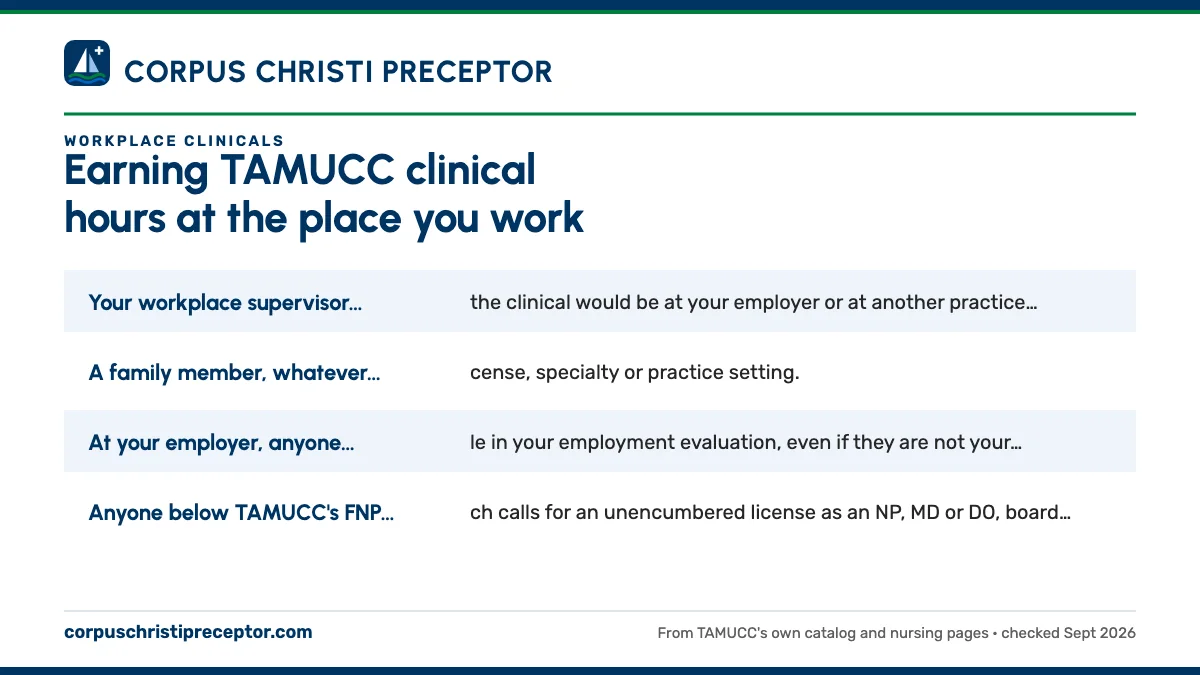
- Your workplace supervisor, whether the clinical would be at your employer or at another practice where that person also works.
- A family member, whatever their license, specialty or practice setting.
- At your employer, anyone with a role in your employment evaluation, even if they are not your direct manager.
- Anyone below TAMUCC's FNP bar, which calls for an unencumbered license as an NP, MD or DO, board certification in family practice or a closely related field, and two or more years of practicing independently. The preceptor requirements guide covers that bar in full.
Some relationships sit close to the line: an in-law, a longtime family friend, your manager's manager, or a physician who weighs in on your annual review. If any of those describes a possible preceptor, lay out the relationship for your clinical faculty member before the preceptor packet goes out, not after hours have been logged.
What counts as a different unit
The second condition concerns where you stand during the clinical, not only who precepts you. Suppose you work nights as an RN in a hospital emergency department. A family practice clinic owned by the same health system would usually read as a different unit, while the emergency department on your days off is plainly the same unit, even with a different nurse practitioner beside you. Your clinical faculty member makes the call, so confirm your reading before anyone signs anything.
The unit also has to suit the course. TAMUCC requires a practice setting appropriate for FNP role preparation, and the FNP courses expect a particular mix of patients: a pediatric focus in NURS 5644, a women's health focus in NURS 5645, and across the program 75 hours or 150 logged encounters for pediatrics, the same for women's health and the same again for geriatrics. An adult inpatient unit elsewhere in your hospital may pass the different-unit test and still give you few of those patients; the 630-hour guide sets out the minimums.
On clinical days you are a student, not staff. The FNP guide calls for a school ID badge identifying you "as a Registered Nurse and TAMU-CC CONHS graduate student," which helps coworkers see which role you are in. As a student you are covered by the university's professional liability coverage, bought through fees at registration; the liability coverage guide explains it.
Your employer still needs the full paperwork
Being on the payroll does not give TAMUCC a contract with your employer. Look the organization up in Typhon's Clinical Site Directory first. A listing with current contract dates means an affiliation agreement is in place; a missing listing, blank dates or an expired contract means a new agreement has to be requested, and TAMUCC warns that large health systems are the slowest to sign. The affiliation agreements guide walks through that request.
Your preceptor at work completes a Preceptor Agreement Packet each semester like any other TAMUCC preceptor, and nothing you do there counts as a precepted hour until the site's contract is live and that packet is signed. Your clinical faculty member then clears the site, the preceptor and your start.
Many Texas health systems also run student offices with rules of their own. At CHRISTUS Health, every clinical education arrangement rests on a written, signed Clinical Education Affiliation Agreement finished ahead of the starting term, and its Santa Rosa facilities in San Antonio also expect a student to have a preceptor in hand before registering. Check your own system's student page even if you already carry its employee badge.
DNP, Nurse Educator and Leadership students
The two-part test comes from the FNP guide. The DNP Student Handbook (July 2026) takes a broader view, accepting workplace practice hours so long as they serve the course objectives and steer clear of any conflict of interest. DNP students also name a community facilitator, someone who helps with access to sites and resources without acting as a supervisor, and each practice experience needs sign-off from the chair of the student's DNP Scholarly Project Committee.
Students on the MSN's educator and leadership paths have no published workplace rule from TAMUCC. Both catalog pages make students responsible for choosing agencies and preceptors, so ask your course faculty whether a practicum at your employer is acceptable before you approach anyone there, and keep the FNP test in mind as a sensible benchmark.
Why working nurses choose us
A workplace clinical can look like a shortcut until the unit, the preceptor or the patient mix falls short. We treat your employer as one option among several. If it can meet both of TAMUCC's conditions and your course's focus, we help you line up the right unit and preceptor there; if it cannot, we search your part of Texas for a preceptor and site outside your employer that suit the course and your work schedule.
Whichever route fits, your placement advisor gathers the documents TAMUCC will ask for: the preceptor's CV, license and board certification, where the site stands in Typhon's directory, and who at the organization signs contracts if one has to be started. The decision to clear you stays with TAMUCC's clinical faculty, and the file they open is already in order. Send us your employer, unit and course through the form on this page, or see how it works.
Questions TAMUCC students ask
Do my regular RN shifts count toward TAMUCC FNP clinical hours?
No. Clinical hours are precepted student time in the FNP role, counted only once the site's contract is live and your preceptor's semester packet is signed, and at your employer they must fall on a different unit from your job. Shifts on your own unit fail that condition, and paid RN work is not precepted FNP practice.
Can a physician at my hospital who does not supervise me be my preceptor?
Possibly. The clinical must happen on a unit other than your own, the physician must have no role in your employment evaluation, and they must clear TAMUCC's bar for physicians: an unencumbered MD or DO license, family-practice or related board certification, and two years practicing independently. Your clinical faculty member approves the final choice.
Can my spouse or parent precept me if they are a nurse practitioner?
No. TAMUCC's FNP guides bar family members from precepting, whatever their credentials or setting. Look for a preceptor with no personal or employment tie to you. If a relationship is borderline, such as an in-law or a close family friend, describe it to your clinical faculty member before any paperwork is sent.
Does my own employer need an affiliation agreement with TAMUCC?
Yes, exactly like any other clinical site. Search the Typhon Clinical Site Directory for your employer and read the contract dates. If the listing is missing or the contract has lapsed, TAMUCC's agreement request has to be started, and large systems can take months to sign, so check early.
Is the workplace rule different for TAMUCC DNP students?
Yes. Rather than the FNP guide's different-unit test, the DNP handbook judges a workplace arrangement on two points: whether it serves the course objectives and whether it avoids a conflict of interest. Because the chair of your Scholarly Project Committee approves each practice experience, describe the arrangement to the chair first. See DNP practice hours.
Related pages
Last checked 2026-09-26
We check these pages against TAMUCC's catalog, FNP clinical guides, MSN and DNP handbooks and college pages. Your course, your clinical faculty member and the handbook for your cohort have the final word.
TAMUCC makes the preceptor search yours. Let us run it for you in Texas.
Tell us your TAMUCC program, your next clinical course and where in Texas you can drive. We find preceptors who fit the course and gather what the affiliation agreement and the Preceptor Agreement Packet need, early enough for both to clear.
- Preceptors matched to the course: pediatrics for
NURS 5644, women's health forNURS 5645, broad primary care forNURS 5746 - CV, license, board certification and the site's agreement status ready for TAMUCC's paperwork
- In Corpus Christi, the Valley, San Antonio, Houston, Austin, Dallas-Fort Worth and across Texas
Start your placement plan
Your program, city and next clinical semester is all we need to begin.