TAMUCC's DNP for practicing nurse practitioners
The Nurse Practitioner track of TAMUCC's Doctor of Nursing Practice is a 40-credit, online, part-time doctorate for NPs who already hold a Texas APRN license. Its clinical side is measured differently from the MSN: 1,000 post-baccalaureate practice hours, up to 500 of them carried in from your master's, tied to a practice organization and a DNP project. This guide covers admission, the courses, the hours and the host site you secure.
Find a practice site for your DNP
Tell us your project idea and where you live. Your placement advisor starts looking for a host.
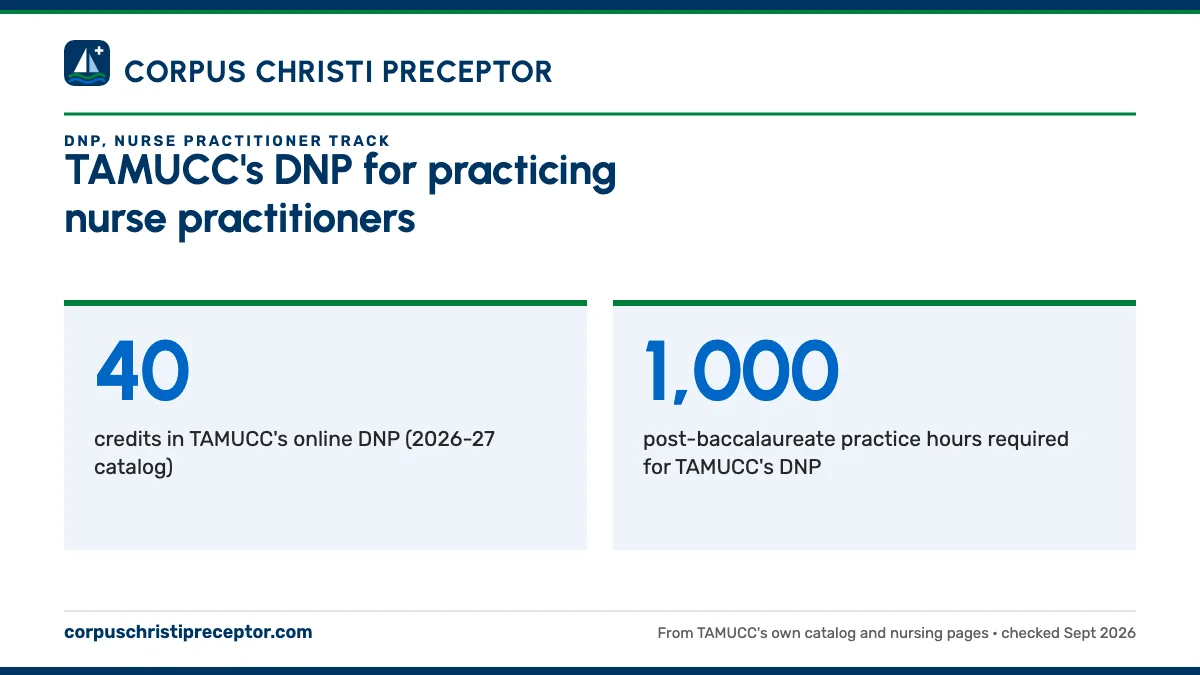
The NP track at a glance
TAMUCC describes its DNP as an online, part-time, post-master's clinical doctorate, run by the Nursing Practice Department. The Texas Higher Education Coordinating Board authorized it in 2014, and the first cohort with a nurse practitioner focus began in 2016. The catalog calls this track the Nurse Practitioner Specialty; the program page and handbook call it the Nurse Practitioner (NP) Track.
| Item | What TAMUCC publishes |
|---|---|
| Credits | 40: 33 core, 3 in the NP specialty course, 4 in the DNP Project Seminar |
| Practice hours | 1,000 post-baccalaureate, up to 500 from your MSN |
| Delivery | Online and part-time; the catalog notes travel may be required |
| Cohorts | Start in Spring semesters each year |
| Campus events | DNP Day in fall semesters, plus periodic campus events |
| Time limit | 7 years |
| Program length | Not published |
The DNP web page gives July 31 as the date for complete applications, and once enrolled you stay registered for at least 3 credits every fall and spring. The Executive Leadership track shares the same core and the same hour total.
Admission: the Texas APRN license and the rest
This track is for practicing nurse practitioners. Both the catalog and the program page require a Texas APRN license, and the July 2026 DNP handbook adds national certification as a nurse practitioner. You also need an MSN from an accredited school.
Items TAMUCC lists for DNP applicants
- A 3.0 GPA, measured in your graduate nursing program per the catalog, or over your last 60 graduate credit hours per the web page
- Two references and a résumé
- An interview as part of admission
- Drug screening with a ten-panel test
- Proof of health insurance, kept current for the whole program
Two wordings differ. On the RN license, the catalog accepts a Texas or compact license while the handbook says Texas, and the two GPA rules measure different spans of coursework. Ask the DNP program which reading applies to your file. The Texas license page covers the APRN requirement, and the insurance page covers the coverage rule.
Courses: the core, the NP specialty and the project
Thirty-three core credits carry the doctoral content: health policy and economics, epidemiology and statistics, genomics, informatics, system behavior and the translation of theory into practice. Several reach into the field. NURS 6303 and NURS 6306 may require field-based activities, NURS 6304 Application of Evidence in Practice I requires them, and NURS 6307 Application of Evidence in Practice II has clinical practice experiences available.
The track's own course is NURS 6321 Application of Advanced Principles for Clinical Nursing Practice, a three-credit course with an individualized clinical focus on designated populations. Its Fall 2025 syllabus mentions preceptor attestation, so ask the course faculty early what that involves for you.
The project threads through the rest of the program: NURS 6308 DNP Project Proposal, which includes the comprehensive exam, NURS 6393 The DNP Project and Biostatistics, NURS 6311 DNP Project Report, and NURS 6195 DNP Project Seminar, a one-credit course taken in each of the last four semesters.
Practice hours: 1,000 in total, up to 500 from your MSN
TAMUCC counts practice hours from the baccalaureate onward, and the DNP needs 1,000 of them. Up to 500 can come from suitable field or clinical hours in your MSN, verified on TAMUCC's Practice Hours Verification Form, which leaves at least 500 to earn during the doctorate.
Those hours are logged on the clinical experience platform, which the DNP syllabi identify as Typhon, and your DNP Scholarly Project Committee Chair must approve every practice experience. Per-course targets are posted only inside the DNP learning site, in a Clinical Practice Hours Tool, so read them there once you have access. If a semester ends short, students may need to repeat NURS 6195 to finish the hours.
The DNP practice hours guide covers the verification form, logging and the chair's role in detail.
Your practice organization, Letter of Support and facilitator
Practice hours happen inside a real organization, and TAMUCC leaves the choice to you: the catalog's sentence about students identifying and selecting agencies or preceptors applies to the DNP as well. Before hours begin, the organization hosting you has to put its backing in writing with a Letter of Support.
You also name a facilitator in your community. The handbook draws the role precisely: a facilitator opens access to sites and resources, while supervision is explicitly not part of the job. Supervision and approval stay with TAMUCC faculty and your project chair.
The handbook lets you count hours at your own workplace, provided they serve the learning objectives and stay clear of any conflict of interest, which can suit an NP whose project grows out of daily practice. If a site becomes unavailable, the handbook requires you to find another, and a student with no alternative inside the program sequence must take a leave of absence. Faculty and the chair may help but are not required to find the site.
Location, licensing and grades
Unlike the MSN handbook, the DNP handbook sets no rule confining practice hours to Texas. What ties this track to Texas is the license: admission requires you to be licensed to practice as an NP in Texas. Before you plan hours at a site in another state, ask your chair how that fits your license, your Letter of Support and your project.
Doctoral grading runs tighter than the MSN's. One C sends you back to retake the course before anything built on it, a second grade at C level or lower anywhere in the program triggers enforced withdrawal, and you graduate only with at least a B in each course. Falsified clinical hours are grounds for dismissal. The grades and progression page compares the MSN and DNP rules.
Why DNP students choose our placement desk
A DNP search is a different job from an FNP rotation hunt. You need an organization willing to host a project, sign a Letter of Support and give you access for several semesters, and in NURS 6321 a clinician for the preceptor attestation its syllabus mentions. Your placement advisor searches for practice organizations near you that fit your project topic and your patient population, and approaches them with a clear account of what TAMUCC asks of a host.
We gather what a host wants to see before it signs a Letter of Support, suggest facilitator candidates who can open doors, and stay on call to find a new site if one becomes unavailable mid-sequence. Approval of each practice experience rests with your chair, and our job is to hand the chair a complete, rule-ready package. Learn how it works, or tell us about your project in the form below.
Questions TAMUCC students ask
Do I need national NP certification to apply to TAMUCC's DNP?
For the Nurse Practitioner track, the catalog and program page ask for a Texas APRN license, and the July 2026 DNP handbook also lists national certification as a nurse practitioner. Texas APRN licensure itself rests on national certification, so a licensed Texas NP will generally hold it already. Confirm with the DNP program if yours is pending or lapsed.
Can my MSN clinical hours count toward the TAMUCC DNP?
Yes, within a limit. Qualifying field or clinical hours earned in your master's program can cover as many as 500 of the DNP's 1,000 practice hours. They are verified through the Practice Hours Verification Form, and the rest are earned during the doctorate, logged on the clinical experience platform and approved by your chair.
Can I complete DNP practice hours where I work?
Yes, with conditions. The DNP handbook accepts hours at your place of employment if they advance the course objectives and involve no conflict of interest. Every practice experience needs your DNP Scholarly Project Committee Chair's approval, so walk the chair through the setup, including your facilitator, before logging anything there.
When do TAMUCC DNP cohorts start?
DNP cohorts start in Spring semesters each year, according to the DNP handbook, and the program web page lists July 31 as the date for complete applications. Confirm the decision timeline for your cycle with the DNP program, and use the months before your first Spring to line up a practice organization.
Is TAMUCC's DNP completely online?
Coursework is online and part-time, though the catalog says some travel may be required. The handbook expects DNP students at DNP Day in fall semesters and at other periodic campus events, with dates announced ahead of time. It does not say where DNP Day is held, so ask the program early if travel takes planning.
How many practice hours does each DNP course need?
TAMUCC posts per-course targets in a Clinical Practice Hours Tool inside the DNP learning site, not on a public page. The public figures are the 1,000-hour total and the 500-hour limit on MSN hours. Once you have course access, read the tool and map your practice time with your chair semester by semester.
Related pages
Last checked 2026-09-26
We check these pages against TAMUCC's catalog, FNP clinical guides, MSN and DNP handbooks and college pages. Your course, your clinical faculty member and the handbook for your cohort have the final word.
TAMUCC makes the preceptor search yours. Let us run it for you in Texas.
Tell us your TAMUCC program, your next clinical course and where in Texas you can drive. We find preceptors who fit the course and gather what the affiliation agreement and the Preceptor Agreement Packet need, early enough for both to clear.
- Preceptors matched to the course: pediatrics for
NURS 5644, women's health forNURS 5645, broad primary care forNURS 5746 - CV, license, board certification and the site's agreement status ready for TAMUCC's paperwork
- In Corpus Christi, the Valley, San Antonio, Houston, Austin, Dallas-Fort Worth and across Texas
Start your placement plan
Your program, city and next clinical semester is all we need to begin.