The DNP Executive Leadership track at TAMUCC
TAMUCC's Executive Leadership track is the DNP route for nurse leaders rather than nurse practitioners: the same 40-credit online doctorate and the same 1,000 practice hours, with executive practice in place of the NP clinical course. Your practice happens inside a health care organization you secure, backed by its Letter of Support. This guide explains who qualifies, what the executive practice experiences involve and how the hours add up.
Find a host organization for your DNP
Tell us your leadership focus and where you live. Your placement advisor starts the outreach.
What the Executive Leadership track is
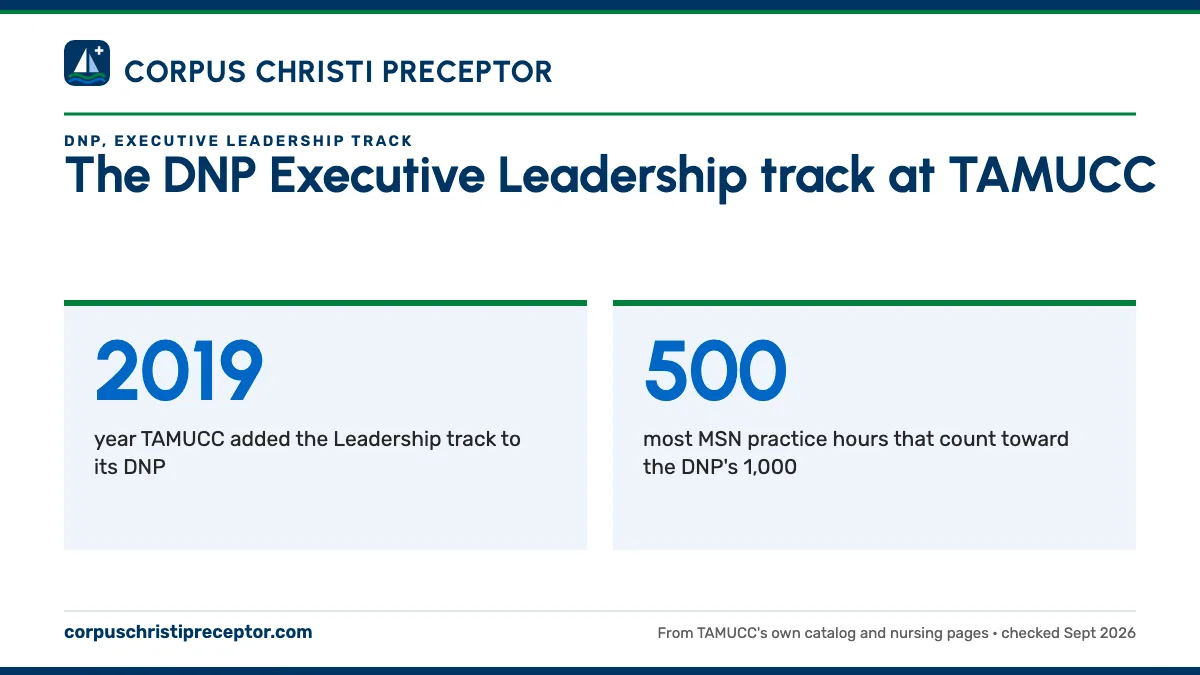
The catalog names this track the Nurse Executive Specialty; the program page and DNP handbook call it the Executive Leadership (ExL) Track. TAMUCC added it to the DNP in 2019, three years after its first nurse practitioner cohort.
It shares nearly everything with the Nurse Practitioner track: the 33-credit core, four semesters of project seminar and the practice-hour total. What changes is the three-credit specialty course and the kind of organization where your practice hours happen, with leadership and systems work taking the place of advanced clinical practice with a patient population.
Delivery is online and part-time, cohorts begin each Spring, and the program has a seven-year limit. The catalog warns that travel may be required, and the handbook expects you at DNP Day in the fall and at other campus events announced in advance.
Who qualifies for the track
No APRN license is needed here; that requirement belongs to the NP track. The admission list centers instead on your RN license and your preparation in administration.
What TAMUCC asks of Executive Leadership applicants
- An unencumbered RN license: the catalog accepts Texas or compact, while the DNP handbook says a Texas license
- An MSN with an administration focus or equivalent; the program page names the MBA, MHA and MPA as equivalents
- A 3.0 GPA, which the catalog measures in your graduate nursing program and the web page across your last 60 graduate credit hours
- Two references, a résumé and an admission interview
- A ten-panel drug screen and proof of health insurance for the life of the program
Where two TAMUCC sources word a rule differently, the DNP program's admission review settles it, so ask before you apply if your license or academic background sits near the line. The Texas license guide sets out the RN license rules in more depth.
Executive practice experiences in NURS 6331
The specialty course is NURS 6331 Advanced Principles for Executive Practice, worth three credits, and the catalog states outright that clinical experiences are required. The Fall 2025 syllabus has students log those hours in Typhon, the same platform TAMUCC's FNP students use, over a course delivered in 15 weeks.
The standard for whoever guides your executive practice is not published the way the FNP preceptor rules are, and neither are per-course hour targets. Both sit with the program: the Clinical Practice Hours Tool on the DNP course site sets the targets, and your chair approves each experience before it counts.
Field work also turns up across the core. The catalog marks field-based activities as required in NURS 6304 and as possible in NURS 6303 System Behavior and Impact on Health Care and NURS 6306 Informatics and Technology for Advanced Practice, and it lists clinical practice experiences as available in NURS 6307. A host organization that can support all of these, not only NURS 6331, spares you a mid-program move.
Counting the 1,000 practice hours
Every TAMUCC DNP student needs 1,000 practice hours counted from the baccalaureate forward, and appropriate field or clinical hours from an MSN program can supply up to 500 of them. Whether a given master's qualifies is the program's call, made through the Practice Hours Verification Form.
Leaders who came through TAMUCC's Leadership in Nursing Systems MSN completed field hours that TAMUCC's sources count as 180 or 225, depending on which one you read, so have the program verify your transcript before you plan the rest. The rule speaks of hours from an MSN program, so if your administrative preparation came through an MBA, MHA or MPA, ask how the program treats it.
Hours you earn in the doctorate go onto the clinical experience platform with your DNP Scholarly Project Committee Chair's approval, and a short semester can mean repeating NURS 6195. The DNP practice hours guide covers verification and logging in full.
Your host organization, Letter of Support and facilitator
The search belongs to the student in the DNP, as in every TAMUCC graduate program: the catalog makes you responsible for identifying the agencies where your field experiences happen. For this track that means an organization, such as a hospital, health system, clinic network or public agency, whose leaders will host your practice and your project.
The organization issues a Letter of Support, and you name a facilitator there who gives you access to its sites and resources without supervising you. Supervision and sign-off stay with TAMUCC faculty and your chair.
Your own employer is an obvious first place to look. TAMUCC permits practice hours at your workplace when they meet the learning objectives and avoid a conflict of interest, so a project inside your own department deserves an early conversation with your chair.
Losing a host midway is the risk to plan for. The DNP handbook makes finding a replacement your responsibility and sends students who cannot find one within the sequence on a leave of absence; faculty and your chair can assist, though identifying a site or topic is not their duty.
Location and the DNP's grade rules
No Texas-only sentence appears in the DNP handbook, and the catalog's wording lets this track admit a compact RN license. Because the handbook asks for a Texas license and the chair approves every experience, talk to your chair before building a project around an organization outside Texas. Once you are on site, the host's own rules bind you too: the handbook treats removal from a practice site for breaking its policies as a professional-conduct violation.
Grades follow the doctorate's stricter rule. Any C is repeated before you can take a course that depends on it, a second C or below in any course leads to enforced withdrawal, and graduation needs a B or better across the board. Logging hours that did not happen can end the program. The grades and progression page has the full comparison with the MSN.
Why Executive Leadership students choose our placement desk
Executive practice depends on access near the top of an organization, which is harder to win with a cold email than a clinic rotation. Your placement advisor searches for health care organizations near you whose nurse leaders can host executive practice experiences and a project in your area of interest, whether that is quality, workforce, finance or informatics.
We prepare a clear request for the host, with the details its leaders need to issue a Letter of Support, help you identify a facilitator inside the organization, and stay on call if a host steps back mid-sequence. Your chair approves each experience; we make sure what reaches the chair is complete and fits TAMUCC's rules. See how it works or start with the form below.
Questions TAMUCC students ask
Does an MBA or MHA qualify me for TAMUCC's Executive Leadership DNP?
TAMUCC's DNP page asks Executive Leadership applicants for an MSN with an administration focus or equivalent, and it names the MBA, MHA and MPA as equivalents. How that applies to your own transcripts is an admission decision, so share your credentials with the DNP program and ask before applying if your preparation is mixed.
Do I need an APRN license for the Executive Leadership track?
No. The APRN license is a Nurse Practitioner track requirement. Executive Leadership applicants need an unencumbered RN license, which the catalog allows to be Texas or compact while the DNP handbook says Texas. If your license comes from another compact state, ask the program which wording governs your admission.
What are executive practice experiences in the TAMUCC DNP?
They are the required clinical experiences in NURS 6331 Advanced Principles for Executive Practice, logged in Typhon, alongside field work in other DNP courses. TAMUCC keeps per-course hour targets in the Clinical Practice Hours Tool on the DNP course site, and your chair approves each experience before its hours count.
Can I do DNP leadership hours at the hospital where I work?
Yes, when the hours meet the learning objectives and avoid a conflict of interest, according to the DNP handbook. Your DNP Scholarly Project Committee Chair approves every practice experience, so explain your role, your reporting line and your proposed facilitator to the chair before logging any hours at your employer.
Can my MSN leadership field hours count toward the DNP?
TAMUCC counts appropriate field or clinical hours from an MSN program toward the 1,000, up to 500, once the program verifies them. Graduates of TAMUCC's Leadership in Nursing Systems MSN have 180 or 225 field hours, depending on the source. Ask the program to verify your hours before you plan the rest of the doctorate.
Related pages
Last checked 2026-09-26
We check these pages against TAMUCC's catalog, FNP clinical guides, MSN and DNP handbooks and college pages. Your course, your clinical faculty member and the handbook for your cohort have the final word.
TAMUCC makes the preceptor search yours. Let us run it for you in Texas.
Tell us your TAMUCC program, your next clinical course and where in Texas you can drive. We find preceptors who fit the course and gather what the affiliation agreement and the Preceptor Agreement Packet need, early enough for both to clear.
- Preceptors matched to the course: pediatrics for
NURS 5644, women's health forNURS 5645, broad primary care forNURS 5746 - CV, license, board certification and the site's agreement status ready for TAMUCC's paperwork
- In Corpus Christi, the Valley, San Antonio, Houston, Austin, Dallas-Fort Worth and across Texas
Start your placement plan
Your program, city and next clinical semester is all we need to begin.