Grades, progression and dismissal in TAMUCC nursing
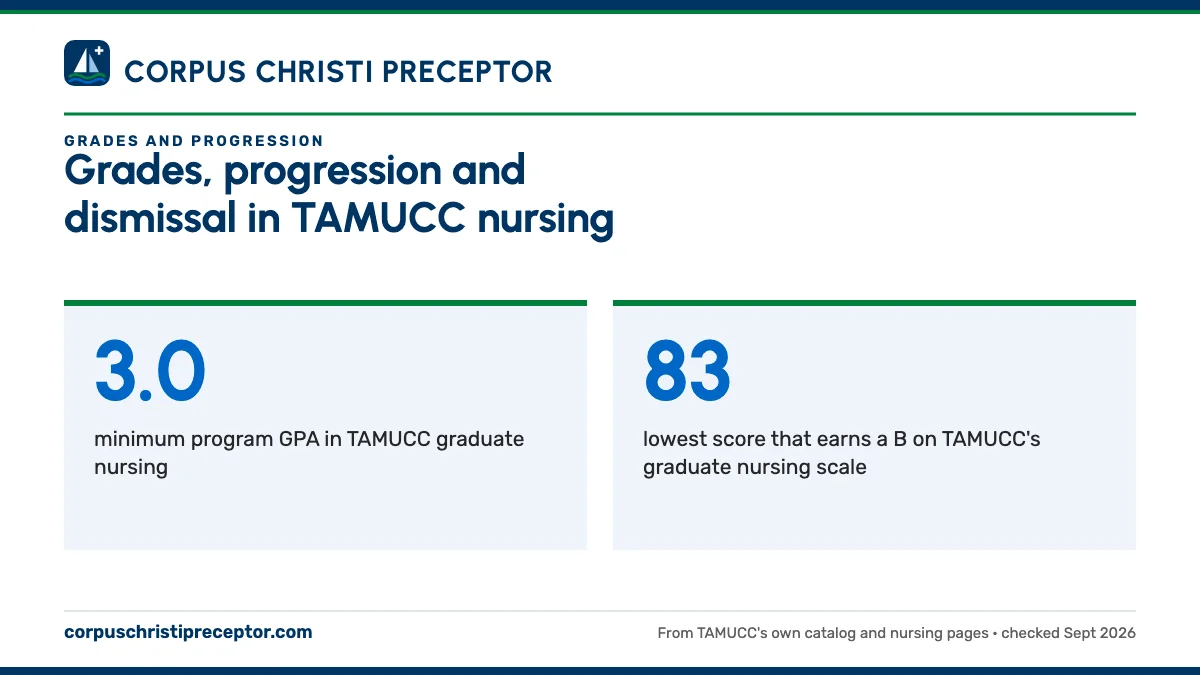
TAMUCC's graduate nursing programs require a 3.0 program GPA, a B or better in the three capstone courses, and a passing clinical grade in every clinical course, because a clinical failure fails the whole course. In the MSN, two course failures lead to dismissal; the DNP goes further and makes any C a repeat. The MSN handbook words its C rule two different ways, and this guide shows both.
Get your placement plan
Tell us your TAMUCC program and where you live. A placement advisor replies with the preceptor and site options that fit your TAMUCC course.
The grading scale and the 3.0 floor
The MSN Student Handbook (July 2026) uses a scale on which a B starts at 83, not 80. That matters most in courses that require a B: an 81 or 82 is a C at TAMUCC. Keep the cutoffs in mind when you read a syllabus, because course points convert to letters at these lines.
| Grade | Score |
|---|---|
| A | 90 to 100 |
| B | 83 to 89 |
| C | 75 to 82 |
| D | 67 to 74 |
| F | 66 and below |
Your program GPA must stay at or above 3.0 under both the catalog and the handbook. Students admitted conditionally carry an extra condition from the start: they must post a B or higher in each of the first four MSN courses they take. Admission and progression questions go to the CONHS Admission Progression and Academic Standards (APAS) Committee, named on the FNP catalog page.
Courses that need a B or better
Three graduate courses set a B floor in the catalog, and each is the capstone with the heaviest precepted load in its track:
NURS 5746Integrated Clinical Practice: FNP, with 270 clinical hours.NURS 5459, the Nurse Educator's education practicum, with 135 practicum hours alongside a preceptor.NURS 5469Patterns of Care Delivery, the Leadership in Nursing Systems capstone, with 135 clinical hours.
All three capstones fall at or near the end of their programs, so a C there can hold up graduation until the course comes around again. In each of these, a C earns no credit, even though most other MSN courses only require a repeat for a D, F or W. The FNP Post-Master's Certificate shares NURS 5746, so the rule applies to certificate students too. The course guides go further, starting with the NURS 5746 capstone.
Why a clinical failure fails the whole course
TAMUCC's FNP guide gives clinical performance the last word: "an unsatisfactory/failure in the clinical portion of each course will supersede that grade and result in failure of the entire course." The clinical portion is marked satisfactory or unsatisfactory by your clinical faculty member, and strong exam scores cannot lift an unsatisfactory clinical.
Faculty may also pull a student from the clinical setting whenever care or conduct is unsafe. When the issue cannot be fixed within the clinical hours left in the course, the result is an unsatisfactory clinical grade and a failed course. An unannounced absence discovered on a faculty site visit is handled as a disciplinary matter with dismissal at stake, and the handbooks list removal from a site for breaking agency policy as a professional-conduct violation.
Repeats and dismissal in the MSN
The July 2026 MSN handbook requires any course ending in D, F or W to be repeated, and you cannot move past a prerequisite until it is passed; an incomplete blocks progression the same way. The dismissal line itself is short: students who incur two course failures will be dismissed.
Enforced withdrawal is where the handbook disagrees with itself. One list triggers it on a D or F in the same course twice, a second grade of D or below, or a third C or below. A second list in the same handbook says a second grade of C or below. If you already have one C on your record, ask your MSN Academic Program Coordinator which reading applies before you start the next clinical course, and students admitted before Fall 2026 should also check the July 2024 edition that governs their cohort.
The MSN handbook states its C rule two ways, a second C or a third C. With a C already on your record, get the coordinator's answer in writing.
The DNP's stricter rule
The DNP Student Handbook (July 2026) treats a C much as the MSN treats a D. A C must be repeated, and until it is, you cannot progress to courses that depend on it. One more C or lower, in any course, triggers enforced withdrawal, and graduation requires a B or better across the board. Course faculty and the DNP Chair may help you look for a site, but the handbook says they are not required to identify one.
Practice hours carry their own weight. Falsifying clinical hours is grounds for dismissal. If your practice site falls through, finding a new one is on you, and if nothing turns up within the program sequence, the handbook calls for a leave of absence. The DNP practice hours guide explains how those hours are approved and recorded.
Why one grade can cost a year
Under the MSN handbook each course runs only once a calendar year, so a repeated clinical course may not return until the same term the following year, and every course behind it in the prerequisite chain waits too. Re-entry after a gap depends on space, and the MSN must be finished within seven years. The DNP handbook also requires continuous enrollment, with a minimum of 3 credits in every fall and spring term.
Public syllabi complicate the once-a-year line: TAMUCC posted NURS 5624 syllabi for both Spring 2025 and Fall 2025. Treat the handbook as the rule and your Degree Planner as your schedule, and ask the CONHS Graduate Advisor before assuming a course will run next term. Your first clinical course and delayed graduation cover planning around it.
Progression in the BSN
TAMUCC's pre-licensure BSN, in both the Traditional and eLine tracks, runs on different numbers. The undergraduate catalog requires a C or better in every nursing course and an upper-division nursing GPA of at least 2.25. A course below C must be repeated and may be repeated only once, and two grades below C, or failing the same course twice, leads to dismissal.
Compliance is part of progression here too. The catalog calls compliance with immunizations, BLS CPR and hospital orientation essential to progress, and students who fall out of compliance may be disenrolled. BSN clinicals are assigned by the program, so these rules sit apart from the preceptor search graduate students run; the Traditional BSN guide has the program details.
How a strong placement protects your clinical grade
Clinical grades rest on the placement: a preceptor who teaches, a site with the right patients, and a schedule your clinical faculty member can visit. That is what we match for. Your placement advisor looks for Texas preceptors who meet TAMUCC's standards and bring the commitment to teaching and evaluation TAMUCC asks of them, in a practice that fits the course you are taking. We also line up a backup early, the step TAMUCC's own guide recommends.
We prepare the paperwork details early so you start on time, and when a preceptor has to withdraw partway through the term we get a replacement moving quickly, so a scheduling collapse does not turn into a clinical grade. See how it works, or send your course details through the form below.
Questions TAMUCC students ask
Is a C passing in TAMUCC's MSN program?
In most MSN courses a C does not have to be repeated, but it counts against you. The handbook's enforced-withdrawal rules turn on a second or third C or below, depending on which list you read, and NURS 5746, NURS 5459 and NURS 5469 need a B for credit. In the DNP, any C must be repeated.
What happens if I pass the exams but fail clinical?
You fail the course. TAMUCC's FNP guide makes the clinical grade override the didactic grade, so an unsatisfactory clinical evaluation means failing the whole course whatever your exam average. The course then has to be repeated, and in the MSN a second course failure leads to dismissal.
What GPA do I need to stay in a TAMUCC graduate nursing program?
A 3.0 program GPA, set in both the catalog and the MSN handbook. Watch the grade in every course, not only the clinical ones, since didactic courses feed the same GPA. Conditional admits face an added test in their first four MSN courses, where each grade must be a B or higher, and the capstones need a B regardless of GPA.
Does TAMUCC's DNP allow a C?
Not without a repeat. The DNP handbook requires any C to be repeated before you move on to courses that depend on it, and a further C or lower anywhere in the program forces withdrawal. The DNP also requires a B or better in every course.
Can I retake a failed clinical course next semester?
Possibly not. The MSN handbook offers each course once a year and makes re-entry depend on space, so a repeat may be a year away. Some courses have appeared in more than one term in public syllabi, so ask the CONHS Graduate Advisor for the options open to you.
Related pages
Last checked 2026-09-26
We check these pages against TAMUCC's catalog, FNP clinical guides, MSN and DNP handbooks and college pages. Your course, your clinical faculty member and the handbook for your cohort have the final word.
TAMUCC makes the preceptor search yours. Let us run it for you in Texas.
Tell us your TAMUCC program, your next clinical course and where in Texas you can drive. We find preceptors who fit the course and gather what the affiliation agreement and the Preceptor Agreement Packet need, early enough for both to clear.
- Preceptors matched to the course: pediatrics for
NURS 5644, women's health forNURS 5645, broad primary care forNURS 5746 - CV, license, board certification and the site's agreement status ready for TAMUCC's paperwork
- In Corpus Christi, the Valley, San Antonio, Houston, Austin, Dallas-Fort Worth and across Texas
Start your placement plan
Your program, city and next clinical semester is all we need to begin.