TAMUCC's Traditional BSN: campus study and clinicals assigned in Corpus Christi
The Traditional BSN is the face-to-face track of TAMUCC's pre-licensure nursing program, taught on the Island campus with clinicals the department assigns in the Corpus Christi area. As an undergraduate, you receive your clinical sites rather than searching for them. That changes if you continue to a TAMUCC MSN, where the preceptor search becomes yours, and that is where our service fits.
Planning a TAMUCC MSN after your BSN?
Tell us your graduation term and the MSN track you have in mind. We plan the preceptor search ahead of you.
What the Traditional track is
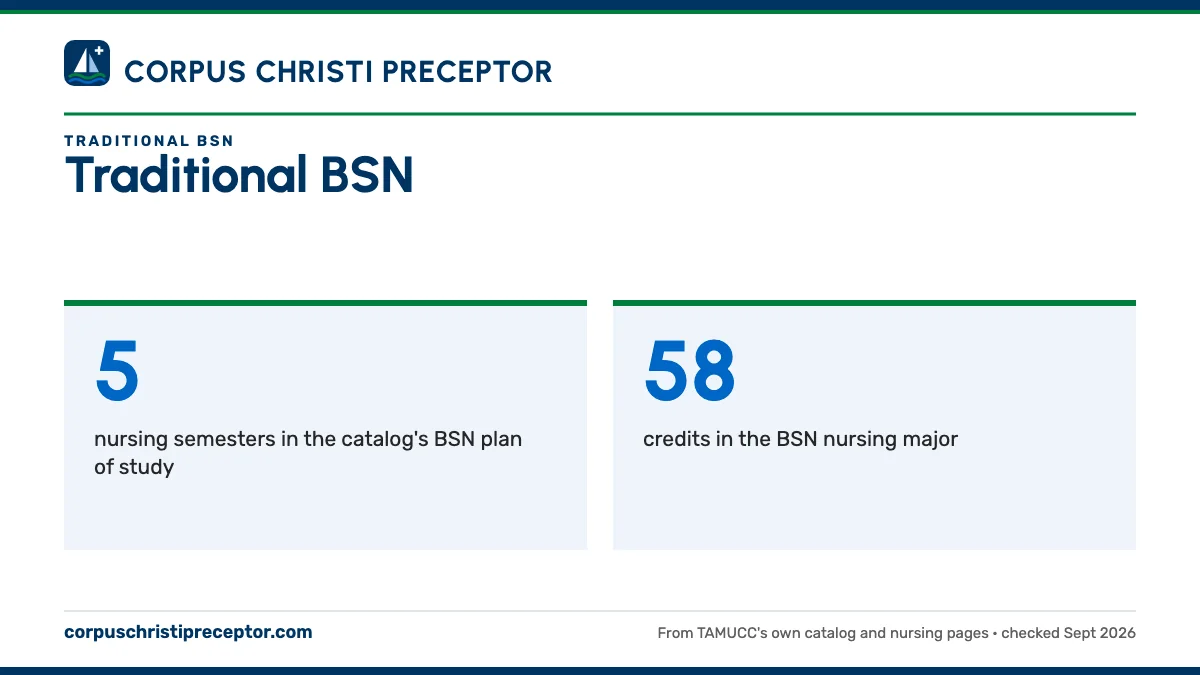
The 2026-27 catalog lists one pre-licensure BSN with two tracks, Traditional and eLine. Traditional is the face-to-face version, taught on TAMUCC's Island campus in Corpus Christi, while the eLine BSN moves the coursework online. Both share the catalog's 58-credit nursing major.
The catalog's plan of study runs five nursing semesters: fall, spring and summer of the third year, then fall and spring of the fourth. General education and prerequisite courses come first, which is why the program total is much larger than the major.
TAMUCC's own figures for that total differ. The catalog gives 120 to 122 credits, with its plan-of-study grid adding up to 122, while the Traditional program page says 115 to 117. The two sources also cite different editions of the AACN Essentials and different first-year seminar courses. Treat the catalog as the governing document and confirm your program plan with the Nursing Education Department.
How Traditional clinicals are assigned
Undergraduate clinicals work the opposite way from TAMUCC's graduate programs. According to the Nursing Education Department, the program itself decides where each student goes, and every site sits in or around Corpus Christi. Your hospital or agency is handed to you.
Several classmates can land at the same hospital. The CONHS Student Handbook, reviewed in February 2024, suggests organizing car-pooling when that happens, a practical step for anyone crossing the city for early shifts.
Each nursing course in the catalog carries a lecture:lab pair of weekly hours, and TAMUCC converts every lab hour into three contact hours. So a course printed with three lab hours, such as Fundamentals of Nursing Care, works out to roughly nine contact hours a week in lab or clinical settings.
Some clinical learning happens on campus. The Simulation and Clinical Learning Center on the second floor of Island Hall has two 10-bed skills labs, an eight-room simulated inpatient unit called Islander Regional Hospital, obstetric and pediatric labs, a critical care lab with a ventilator, and a home care apartment.
Clinical courses in the nursing major
Fundamentals and Health Assessment open the first nursing semester, and Professional Transitions closes the program as the capstone. In the catalog grid, the third-year summer holds Nursing Care of Adults II, so clinical work continues through that summer rather than pausing.
The remaining nursing courses, NURS 3150, NURS 3318, NURS 4318 and NURS 4150, are lecture only. TAMUCC does not publish clinical hours course by course for the Traditional track; the eLine page gives 90 to 135 hours for each clinical course in that track.
| Course | Title | Credits | Weekly lecture:lab |
|---|---|---|---|
NURS 3435 | Health Assessment | 4 | 3:4 |
NURS 3614 | Fundamentals of Nursing Care | 6 | 3:3 |
NURS 3548 | Nursing Care of Children and their Families | 5 | 3:2 |
NURS 3550 | Nursing Care of Parents/newborns | 5 | 3:2 |
NURS 3628 | Nursing Care of Adults I | 6 | 3:3 |
NURS 4564 | Nursing Care of Psychiatric Clients | 5 | 3:2 |
NURS 4628 | Nursing Care of Adults II | 6 | 3:3 |
NURS 4660 | Nursing Care of Community Health Clients | 6 | 3:3 |
NURS 4370 | Nurse Coordinating Care | 3 | 2:1 |
NURS 4470 | Professional Transitions (capstone) | 4 | 2:2 |
Keeping your clinical eligibility
Grades decide who moves forward. Every nursing course needs at least a C, and your nursing GPA in upper-division work has to hold at 2.25 or above. Any nursing course that ends below C gets one retake, no more; a second sub-C grade anywhere in the major, or a second failure of one course, means dismissal. Unsafe or unprofessional conduct can also end enrollment with no prior warning.
Compliance carries equal weight. TAMUCC's catalog names three items, immunizations, BLS CPR and hospital orientation, as requirements for moving ahead, and a student who lets one lapse can be disenrolled. Every CONHS student keeps a CastleBranch tracker; the CastleBranch guide and the immunizations and drug screen guide explain what goes into it.
A lapsed immunization or BLS card can pull you out of clinical and put progression at risk. Renew items before their expiry dates, not after.
Admission and start terms
The Traditional track admits in spring, summer and fall. TAMUCC's application-dates graphic, labeled April 2025, sets these windows:
| Entry term | Applications open | Applications due |
|---|---|---|
| Spring | April 15 of the prior year | July 31 of the prior year |
| Summer | October 1 of the prior year | December 1 of the prior year |
| Fall | December 15 of the prior year | February 15 |
The graphic predates the current catalog year, so confirm the dates on the Nursing Education Department page before you plan around them.
Academically, TAMUCC looks for at least a 2.65 overall across your latest 60 hours, with the same 2.65 floor for science courses. The entrance exam is changing: HESI A2 (Reading 75, Critical Thinking 700, Composite 70) applies through Summer 2027, and the TEAS (Total 60, Reading 77) applies from the Fall 2027 cycle. Before an offer is final you clear a background check run for the Texas Board of Nursing. TAMUCC lists no separate accelerated BSN, so post-baccalaureate students apply through this pre-licensure route.
Thinking about an MSN after your BSN
If a TAMUCC MSN is in your future, know now that the rules flip. At the graduate level the student chooses the agency and the preceptor, all clinical training stays in Texas, and the FNP program requires 630 precepted hours with clinicians who meet TAMUCC's criteria. Read what finding your own preceptor involves before you apply.
Your BSN rotations are a sensible place to start preparing. The nurse practitioners, physicians and nurse leaders you meet at assigned sites are the kind of contacts graduate students rely on; TAMUCC's own FNP guide expects personal networks to be the first place most students look.
When you reach the MSN, we take the search from there. Your placement advisor finds Texas preceptors who meet TAMUCC's requirements for each clinical course, prepares the CVs, licenses and agreement details TAMUCC's faculty review, and stays on call through every term. The MSN FNP overview and our process page show what lies ahead, and the form on this page reaches your placement advisor.
Questions TAMUCC students ask
Do TAMUCC Traditional BSN students find their own clinical placements?
No. The Nursing Education Department assigns clinical placements for the pre-licensure BSN, and all clinical components take place in the Corpus Christi area. Students receive their hospital or agency from the program. The self-directed preceptor search applies to TAMUCC's graduate programs, not to the BSN.
Can I complete Traditional BSN clinicals in my hometown?
Not under TAMUCC's current rule. The program places every BSN student at sites around Corpus Christi, so plan to live within reach of the city for all five nursing semesters. Graduate study works differently: MSN clinicals happen in Texas communities where students live, where possible, at sites the student selects.
Does TAMUCC offer an accelerated BSN for students who already hold a bachelor's?
TAMUCC lists no accelerated BSN and no second-bachelor's track. Students who already hold a bachelor's apply to the pre-licensure BSN through the Traditional or eLine track, meeting the same GPA, exam and background check requirements as everyone else.
In which states can a TAMUCC BSN graduate seek licensure?
Per TAMUCC's Nursing Education Department, the BSN satisfies licensure education requirements in all U.S. states but California, and Puerto Rico and the U.S. Virgin Islands are excluded as well. If you plan to work outside Texas, check that state's board of nursing too. The licensure disclosure guide explains TAMUCC's statements.
Is TAMUCC's BSN accredited?
Yes. According to TAMUCC, CCNE accredits its nursing programs from the BSN through the DNP, along with the post-graduate APRN certificate. TAMUCC's own pages give conflicting dates for the most recent review, so check the current status through the nursing accreditation guide and TAMUCC's accreditation page.
Related pages
Last checked 2026-09-26
We check these pages against TAMUCC's catalog, FNP clinical guides, MSN and DNP handbooks and college pages. Your course, your clinical faculty member and the handbook for your cohort have the final word.
TAMUCC makes the preceptor search yours. Let us run it for you in Texas.
Tell us your TAMUCC program, your next clinical course and where in Texas you can drive. We find preceptors who fit the course and gather what the affiliation agreement and the Preceptor Agreement Packet need, early enough for both to clear.
- Preceptors matched to the course: pediatrics for
NURS 5644, women's health forNURS 5645, broad primary care forNURS 5746 - CV, license, board certification and the site's agreement status ready for TAMUCC's paperwork
- In Corpus Christi, the Valley, San Antonio, Houston, Austin, Dallas-Fort Worth and across Texas
Start your placement plan
Your program, city and next clinical semester is all we need to begin.