Immunizations, TB, CPR, drug screen and background check at TAMUCC
TAMUCC's nursing programs apply the Texas DSHS immunization rule for health-professions students, add yearly TB and flu items, require a current CPR card, and screen every student for drugs and criminal history. Most of it is settled once; a handful of items renew every year. TAMUCC's own pages disagree on two details, the drug screen panel and the accepted CPR provider, and this guide lays out both sides.
Get your placement plan
Tell us your TAMUCC program and where you live. A placement advisor replies with the preceptor and site options that fit your TAMUCC course.
The Texas rule behind TAMUCC's vaccine list
TAMUCC's vaccine list rests on state law. The FNP catalog page cites 25 TAC §97.64, the Texas Department of State Health Services rule for students in health-related programs, and the MSN and DNP handbooks name §97.64 and §97.65 together. The FNP Student Clinical Guide then turns the rule into a working checklist, Attachment 1, which you satisfy through CastleBranch.
Because the source is a state rule, the list is not something an individual faculty member or preceptor can relax. Anything you are unsure about, such as an old record in a different format, is a question for the college before the semester, not for the site on your first day.
This page covers what each item asks for. How the tracker works, when records renew and what happens if one lapses is in the CastleBranch guide.
Vaccines and titers: what counts as proof
Most immunization items are one-time proofs. Once a titer or a completed series is on file, it generally stays there for the rest of the program. The exceptions are the flu vaccine, which is yearly, and the Tdap or Td booster, whose 10-year window can close partway through a long part-time program.
| Immunization | Accepted proof | Where TAMUCC states it |
|---|---|---|
| Hepatitis B | A three-dose series or a titer showing immunity; the combined Twinrix series is allowed | FNP guide, Attachment 1 |
| Hepatitis A | A vaccine series or serologic confirmation of immunity, before courses with clinical laboratory experiences | FNP program page |
| Varicella | Two doses or a titer | FNP guide, Attachment 1 |
| MMR | Proof that matches your birth year | FNP guide, Attachment 1 |
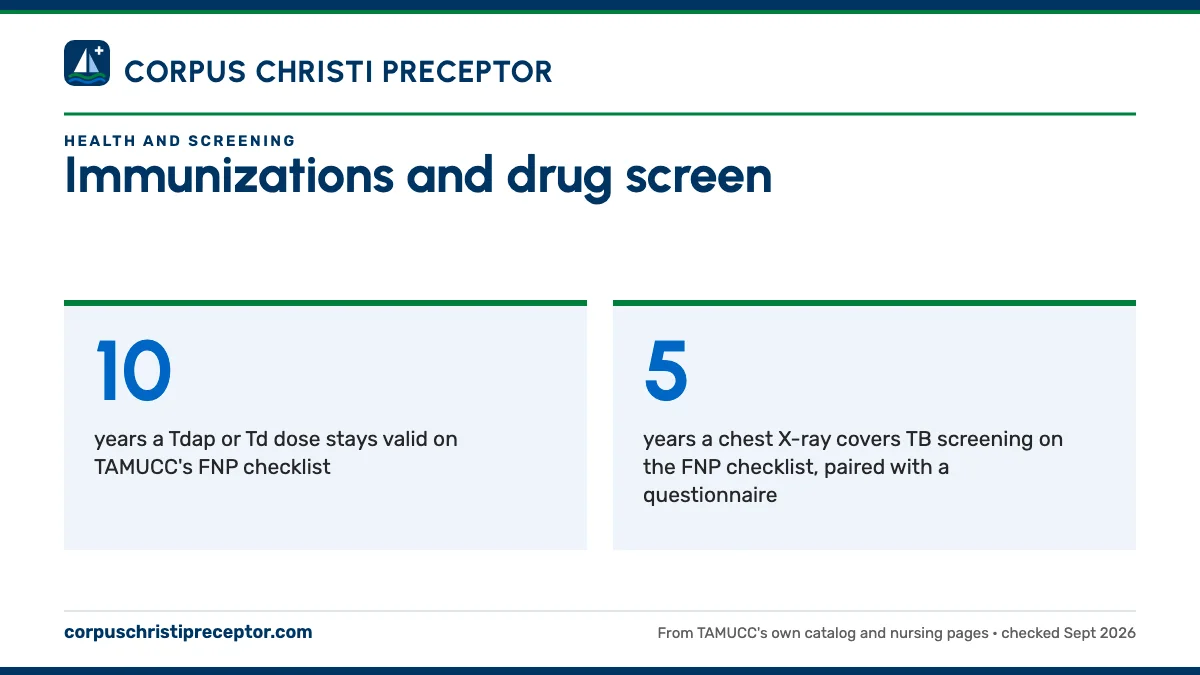
| Tdap or Td | A dose within the past 10 years | FNP guide, Attachment 1 |
| Influenza | The current season's vaccine, every year by October 1 | FNP guide, Attachment 1 |
Titers help when paper records are thin. The checklist accepts a titer in place of documented doses for hepatitis B and varicella, and the program page accepts serologic proof for hepatitis A, so a blood test can stand in for a vaccination history you cannot reconstruct.
TB screening and the flu shot: the two yearly items
Tuberculosis screening offers the most routes. The FNP checklist accepts a yearly skin test or a yearly blood test, QuantiFERON or T-SPOT. A third route is a chest X-ray, which covers five years when you pair it with a questionnaire.
Whichever route you choose, its renewal date travels with you. A skin test done in March comes due again the following March, which can land in the middle of a spring rotation. Testing a little early, just before a term begins, moves the next due date clear of the course.
The flu vaccine is due by October 1 each year. The fall 2026 term opens on August 24, so that deadline arrives about five weeks into the course. Put it on your calendar before classes start, and upload the record as soon as you have it.
CPR: which card TAMUCC accepts
The FNP checklist asks for current American Heart Association CPR. Past that point, TAMUCC's sources split. Most program web pages, including the FNP, Leadership, Nurse Educator and DNP pages, name American Heart Association CPR Type C alone. The graduate catalog and the MSN program page accept either the AHA course or the American Red Cross Healthcare Provider course, and the MSN and DNP handbooks list both.
The AHA healthcare provider course is the option every TAMUCC source accepts. The college is itself an American Heart Association Training Site for BLS, run through its Simulation and Clinical Learning Center on the Island campus. A CPR card that expires mid-term pauses clinicals just like an expired vaccine, so note its date with the others.
The drug screen: five panel or ten panel
On this item TAMUCC's documents conflict outright. The graduate catalog, the DNP program page, the MSN and DNP handbooks and the FNP Student Clinical Guide all call for a 10-panel urine drug screen, and the handbooks describe it as a non-chain-of-custody screen done on admission. The FNP, MSN, Leadership and Nurse Educator program web pages describe a five-panel screen instead.
The clinical guide and the handbooks are the documents that govern your clinicals, which makes the 10-panel screen the sensible one to plan around. The FNP guide lets you order it through CastleBranch or a private lab. If you already completed a five-panel screen because a program page described one, ask the program whether it will stand before you assume it counts.
Sites can add a layer. The handbooks note that some agencies may require additional drug screens, and a hospital's own screen is a condition of that placement, separate from TAMUCC's. Inside the college, the CONHS Faculty and Staff Handbook has the data specialist route any positive result to an administrator.
TAMUCC's program web pages say five panel; the FNP guide, the handbooks and the catalog say 10 panel. Plan on the 10-panel screen and confirm with your program before ordering.
The criminal background check
Graduate students order the background check through CastleBranch after admission, and the MSN and DNP handbooks say it generally happens within the first semester. BSN applicants meet a check earlier: the pre-licensure admission rules call for a Texas Board of Nursing background check before acceptance.
Clinical sites can go further than TAMUCC. The handbooks state that an agency may require a repeat check and that the college cannot waive that requirement. If a site runs its own check, build it into your timeline next to the affiliation agreement, since TAMUCC tells students to allow as long as three months for one to be signed.
One more item is verified at the source rather than by copy: your RN license. The checklist wants a Texas Board of Nursing verification, not a photocopy, and the Texas RN license guide explains which license each TAMUCC program expects.
How we help TAMUCC students start clinicals on time
Health items are yours to complete, and they are simple once the dates are mapped. Where students lose time is the gap between TAMUCC's checklist and a site's own requirements, found only after a preceptor has already said yes. We close that gap. When we find you a Texas preceptor and site, we collect the site's onboarding list, including any extra drug screen, repeat background check or orientation, so it runs alongside the affiliation agreement and the Preceptor Agreement Packet instead of after them.
Our placement desk keeps TAMUCC's term dates in view too, so the preceptor's availability, your renewal dates and the course calendar line up before day one. Learn how our process works, or use the form below to share your course and city.
Questions TAMUCC students ask
Can I use a titer instead of repeating a vaccine series?
For hepatitis B and varicella, yes: TAMUCC's FNP checklist accepts a titer showing immunity in place of documented doses, and the program pages accept serologic confirmation for hepatitis A. MMR proof follows your birth year and the Tdap or Td booster must fall within 10 years, so those two work differently. Your health care provider can tell you which test suits your history.
Do DNP students take a drug screen too?
Yes. TAMUCC's DNP program page lists a ten-panel drug screen among admission requirements for both DNP tracks, together with proof of health insurance throughout the program. The DNP handbook repeats the 10-panel, non-chain-of-custody standard, and practice sites may ask for their own screen on top. More on that program sits on the DNP Nurse Practitioner track page.
Are Traditional and eLine BSN students held to the same health rules?
BSN students meet the same core categories, and the catalog links progression to staying compliant on vaccines, BLS CPR and hospital orientation; falling out of compliance can lead to disenrollment. The program itself assigns BSN clinical sites around Corpus Christi, so BSN students skip the preceptor search. The Traditional BSN guide covers that track in full.
Who reviews my immunization records at TAMUCC?
CastleBranch stores and tracks the documents, and the college's Student Success Data Specialist administers the tracker for CONHS. Clearance for each rotation comes from your assigned clinical faculty member once compliance, the site agreement and the preceptor packet are all in place. For a question about one record, start with the data specialist; the clinical roles guide lists who handles what.
Do I need a second CPR course if my card is from the Red Cross?
Possibly. The catalog, the MSN program page and the handbooks accept the American Red Cross Healthcare Provider course, but the FNP guide and most program pages name American Heart Association CPR only. Check with your program coordinator or the FNP Clinical Coordinator before your record is reviewed, and choose the AHA course at your next renewal so the question never returns.
Related pages
Last checked 2026-09-26
We check these pages against TAMUCC's catalog, FNP clinical guides, MSN and DNP handbooks and college pages. Your course, your clinical faculty member and the handbook for your cohort have the final word.
TAMUCC makes the preceptor search yours. Let us run it for you in Texas.
Tell us your TAMUCC program, your next clinical course and where in Texas you can drive. We find preceptors who fit the course and gather what the affiliation agreement and the Preceptor Agreement Packet need, early enough for both to clear.
- Preceptors matched to the course: pediatrics for
NURS 5644, women's health forNURS 5645, broad primary care forNURS 5746 - CV, license, board certification and the site's agreement status ready for TAMUCC's paperwork
- In Corpus Christi, the Valley, San Antonio, Houston, Austin, Dallas-Fort Worth and across Texas
Start your placement plan
Your program, city and next clinical semester is all we need to begin.