TAMUCC's online MSN Family Nurse Practitioner program
TAMUCC's MSN Family Nurse Practitioner is a 49-credit online program that admits new students each Fall and builds to 630 precepted clinical hours across four courses. The lectures come to you; the clinical half happens at Texas sites, with preceptors you line up yourself, one semester at a time. This guide lays out the program and shows how our Texas preceptor search fits around it.
Find your FNP preceptor in Texas
Tell us your clinical course and your city. Your placement advisor starts the search.
The TAMUCC FNP program in one table
TAMUCC runs the Family Nurse Practitioner MSN through the Nursing Practice Department of the College of Nursing and Health Sciences. The program is designed as a part-time path so working nurses can keep a full-time job, and TAMUCC describes it as offered completely online.
New students enter only in the Fall, under rolling admission. Your exact semester-by-semester sequence sits in your Degree Planner rather than on a public page, so the table below sticks to what TAMUCC does publish.
| Item | What TAMUCC publishes |
|---|---|
| Credits | 49: a 12-credit MSN core plus 37 role-specialization credits |
| Clinical hours | 630 in four precepted courses |
| Delivery | Online coursework, with periodic campus events announced to students |
| Start term | Fall only, rolling admission |
| Time limit | 7 years under the recency of credit rule |
| Clinical location | Texas sites, where possible in the community where you live |
| Program length | Not published; your Degree Planner holds the plan |
Sources split on one course. The catalog gives NURS 5746 seven credits, and the syllabi from its two latest spring offerings give it six. The program total of 49 is unchanged in the catalog and handbook alike, so ask your advisor about the split only if a credit count matters to you.
The coursework before and around your clinicals
Twelve of the 49 credits form the MSN core that TAMUCC's master's tracks share: NURS 5310 Science in Nursing, NURS 5314 Research Methods in Advanced Nursing Practice, NURS 5315 Health Policy and Cultural Diversity, and NURS 5316 Introduction to Advanced Practice Role Development.
The role block then adds four three-credit didactic courses. NURS 5326 Advanced Physiology with Pathophysiological Applications comes before NURS 5322 Advanced Pharmacological Concepts, and NURS 5323 Finance for the Nurse Practitioner and NURS 5341 Wellness and Health Promotion round out the set.
None of these courses carries clinical hours, which makes them the right semesters to start the preceptor search. Starting during the core gives a brand-new site contract the lead time it needs: by TAMUCC's own estimate, collecting every signature can take a full quarter of a year, and large health systems run slower. The first clinical course guide explains how the sequence opens.
Four clinical courses, 630 hours
The clinical half of the program runs through four courses, each a prerequisite for the next. The hours climb as you go, and the capstone at the end counts only with a grade of B or higher.
| Course | Focus in the FNP guides | Clinical hours |
|---|---|---|
NURS 5624 Advanced Health Assessment and Differential Diagnosis | Early clinical experience | 90 |
NURS 5644 Management of Acute and Chronic Illness I | Pediatrics | 135 |
NURS 5645 Management of Acute and Chronic Illness II | Women's health | 135 |
NURS 5746 Integrated Clinical Practice: FNP | Late clinical, capstone | 270 |
Across all four courses TAMUCC also sets a floor for three populations: pediatric, women's health and geriatric patients. Each of the three needs 75 hours on site, or else 150 encounters on record in Typhon. The 630-hour breakdown shows how students meet those minimums, and each course has its own guide, ending with the 270-hour capstone.
Texas sites for every clinical hour
TAMUCC's MSN Student Handbook keeps all clinical training inside Texas, and the FNP track falls under it. You can study from anywhere, yet each precepted hour has to be earned at a Texas site. The Texas-only clinicals page explains the rule for students near a state line or planning a move.
Licensing lines up with that. To be admitted you need an unencumbered RN license from Texas, or a multistate compact license carrying the privilege to practice in Texas. Applicants still waiting on Texas licensure can start conditionally, provided the license is in hand by the close of the first semester and a waiver request is on file.
Faculty are placed with geography in mind. TAMUCC aims to match students with faculty in their own area and keeps adjunct faculty in the state's large cities, so a student training in Houston, San Antonio or Dallas-Fort Worth may be paired with faculty based in that city.
Who finds your preceptor, and what TAMUCC supplies
The search is yours. Under TAMUCC's FNP Student Clinical Guide, lining up the site, the preceptor and every preceptor agreement falls to the student, and the guide says that coming up empty is not grounds for extra time. That holds for all four clinical courses.
TAMUCC does supply the structure around the search. Typhon holds a record of the sites and preceptors past TAMUCC students trained with, along with whether each site's agreement is current. A clinical faculty member, assigned by where you train, clears you to start and makes at least one evaluative visit. The university contracts with each site through an affiliation agreement you request.
Your preceptor has to clear a bar set higher than the Texas Board of Nursing's rule. TAMUCC accepts nurse practitioners and physicians (MD or DO) whose license is active and unencumbered, who are nationally board certified in family practice or a related field, and who have practiced independently for two years or more. Your own supervisor at work and relatives are excluded. The preceptor requirements page covers the edge cases.
What has to be in place before hour one
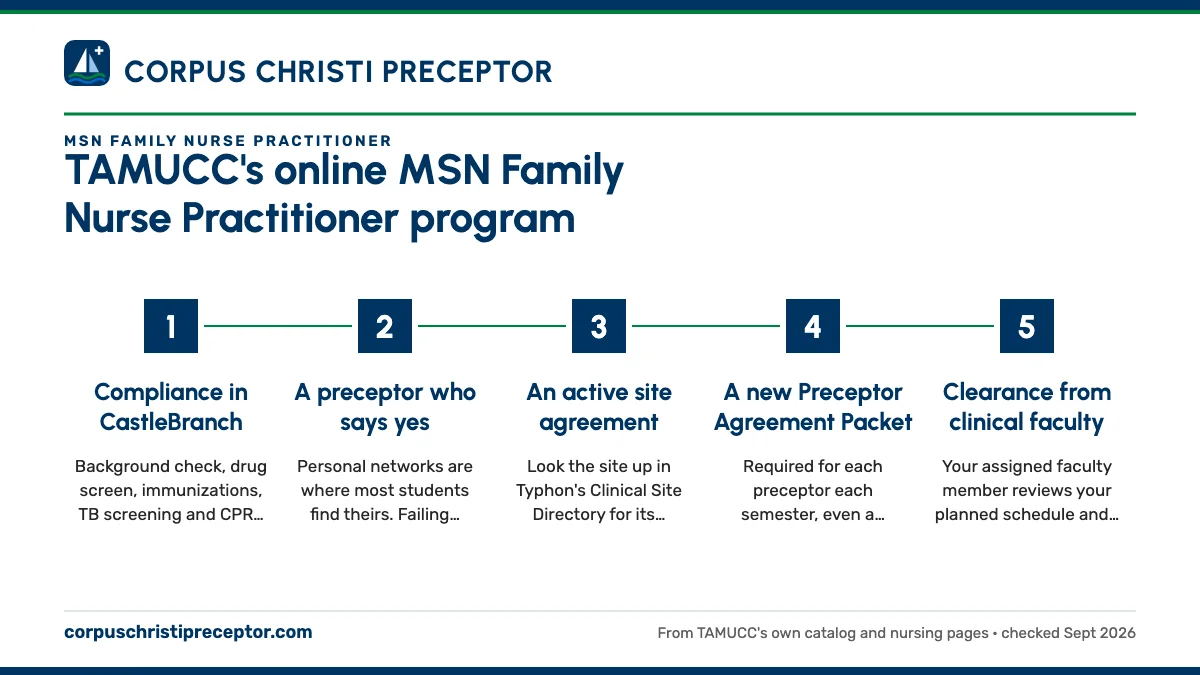
Five pieces must line up each semester before a single hour counts toward the 630. The affiliation agreement guide covers the piece that takes longest.
- Compliance in CastleBranchBackground check, drug screen, immunizations, TB screening and CPR are uploaded to CastleBranch ahead of clinicals and refreshed every semester. If anything expires, clinicals pause until it is current.
- A preceptor who says yesPersonal networks are where most students find theirs. Failing that, TAMUCC recommends asking face to face, bringing your CV and the objectives for the course.
- An active site agreementLook the site up in Typhon's Clinical Site Directory for its contract start and expiration dates. If nothing is on file, you open the "Initiate Affiliation Agreement" DocuSign form, and the contract may take months.
- A new Preceptor Agreement PacketRequired for each preceptor each semester, even a returning one, with an up-to-date CV and a copy of the license no older than 30 days, then uploaded to Canvas after signing.
- Clearance from clinical facultyYour assigned faculty member reviews your planned schedule and gives the go-ahead. Time at the site before that go-ahead, or before the agreement and packet are finished, is not credited.
Grades and pacing that shape the clinical sequence
TAMUCC holds graduate students to a 3.0 program GPA, and NURS 5746 carries its own B-or-better requirement. Clinical performance carries its own weight: an unsatisfactory clinical grade overrides whatever you earned in the didactic part and fails the course outright.
The MSN handbook adds that two course failures lead to dismissal, though its lists of enforced-withdrawal triggers disagree on whether a second or a third C sets that off. Read the handbook for your cohort and ask your advisor which reading applies. The grades and progression page sets the rules side by side.
Timing matters as much as grades. According to the handbook, each course runs one time per calendar year, but TAMUCC's public syllabi include NURS 5624 sections from Spring 2025 and from Fall 2025, so confirm any term pattern before relying on it. Either way, a missed or dropped clinical term can push graduation back, and hours stay inside their own semester rather than carrying forward.
Why TAMUCC FNP students choose our placement desk
Our service is built around this program. Your placement advisor looks for a Texas preceptor and site close to home that suit the course you are about to start: early assessment and diagnosis work for NURS 5624, children and families in NURS 5644, women's health in NURS 5645, and a varied family practice for the 270 hours of NURS 5746.
We also assemble what TAMUCC's forms call for: the preceptor's CV, current license and board certification, where the site stands on its agreement in Typhon, and the person authorized to sign if an "Initiate Affiliation Agreement" form has to be opened, giving the contract the best chance to clear well inside TAMUCC's three-month window. What reaches your clinical faculty is complete and matched to TAMUCC's rules on the first pass.
If a preceptor drops partway through a semester, your advisor remains on call and goes straight to work on a replacement. Read how it works, then send your course and city through the form below.
Questions TAMUCC students ask
Can I start TAMUCC's MSN FNP in the spring?
No. TAMUCC admits new FNP students in the Fall semester only, under rolling admission. If you miss a Fall start, the next entry point is the following Fall. The months before your first term are a good time to settle your Texas license and start listing possible preceptors.
How long does the TAMUCC FNP program take?
TAMUCC publishes no fixed number of semesters. The program is built for part-time study alongside work, the clinical courses follow prerequisite order, and the handbook schedules each course once per calendar year. Your Degree Planner shows your personal sequence, and the recency of credit rule sets a seven-year ceiling on completing the MSN.
Is NURS 5746 six or seven credits?
It depends on the document. The 2026-27 catalog shows NURS 5746 Integrated Clinical Practice: FNP as a seven-credit course, and the syllabi for its two most recent spring offerings show six semester hours. Either way the catalog and MSN handbook put the program at 49 credits and the course at 270 clinical hours; your advisor can confirm the credit figure for your cohort.
Can I do FNP clinicals in another state if I live outside Texas?
Not under TAMUCC's rules. The MSN handbook confines clinical education to Texas, so a site across the state line adds nothing toward the 630. TAMUCC publishes no residency rule for enrolling, but each clinical term means training at a Texas site with a qualifying preceptor, while holding an RN license valid for practice in Texas.
Does the TAMUCC FNP qualify me for certification in other states?
According to TAMUCC's professional licensure disclosure, the MSN satisfies the educational requirements for FNP certification throughout the United States with four exceptions: California, the District of Columbia, Puerto Rico and the U.S. Virgin Islands, for which TAMUCC has made no determination. Check the board rules wherever you plan to practice before relying on the disclosure.
Does TAMUCC find FNP preceptors for students?
Under TAMUCC's FNP guide, securing the site and the preceptor is the student's job, and the catalog says the same of field experiences. TAMUCC provides Typhon's record of past sites, a clinical faculty member and the affiliation agreement process. Your placement advisor takes on the search itself, matched to your course and your part of Texas.
Related pages
Last checked 2026-09-26
We check these pages against TAMUCC's catalog, FNP clinical guides, MSN and DNP handbooks and college pages. Your course, your clinical faculty member and the handbook for your cohort have the final word.
TAMUCC makes the preceptor search yours. Let us run it for you in Texas.
Tell us your TAMUCC program, your next clinical course and where in Texas you can drive. We find preceptors who fit the course and gather what the affiliation agreement and the Preceptor Agreement Packet need, early enough for both to clear.
- Preceptors matched to the course: pediatrics for
NURS 5644, women's health forNURS 5645, broad primary care forNURS 5746 - CV, license, board certification and the site's agreement status ready for TAMUCC's paperwork
- In Corpus Christi, the Valley, San Antonio, Houston, Austin, Dallas-Fort Worth and across Texas
Start your placement plan
Your program, city and next clinical semester is all we need to begin.