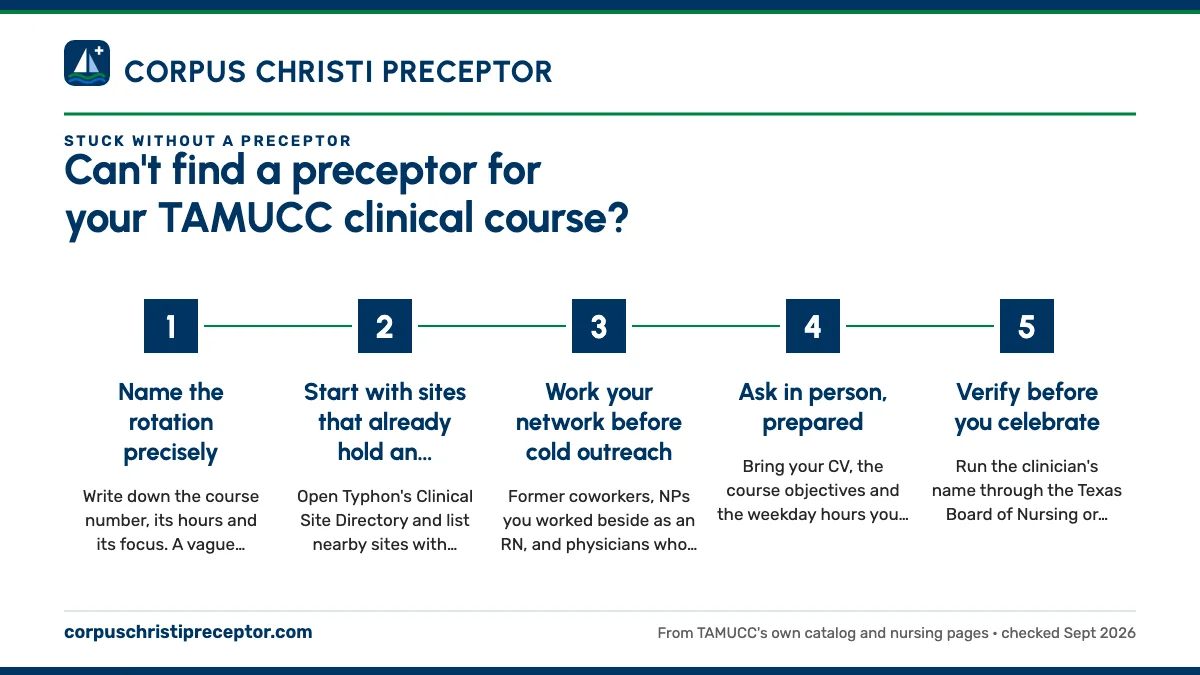
Can't find a preceptor for your TAMUCC clinical course?
Plenty of TAMUCC students reach this point after weeks of unanswered requests, and the way out is a sharper search, not a longer one. This page explains why Texas searches stall, what TAMUCC puts in your hands, and how our placement desk takes the search over when your own leads run dry.
Get your placement plan
Tell us your TAMUCC program and where you live. A placement advisor replies with the preceptor and site options that fit your TAMUCC course.
Why TAMUCC searches stall
Most dead ends come down to fit rather than effort. TAMUCC wants FNP preceptors who are licensed nurse practitioners or physicians (MD or DO), board certified in family practice or a closely allied field, and at least two years into independent practice. That bar rules out many clinicians you already know, and TAMUCC also excludes your supervisor at work and anyone in your family.
Geography narrows the field again. Every MSN clinical hour has to happen in Texas, and your clinical faculty member is assigned by location, so an eager clinician in another state cannot help. Our Texas-only clinicals page covers what that means if you live near a border.
The rotation itself adds a filter. NURS 5644 centers on children and NURS 5645 on women's health, so a practice that sees few children or few prenatal visits may be a poor match for those courses. Large systems add rules of their own: UT Southwestern and CHRISTUS Santa Rosa both expect students to arrive with a preceptor already committed.
What TAMUCC gives you to work with
TAMUCC supplies three tools and one plain expectation. The tools are Typhon, where you can look up sites and preceptors that earlier students used; an assigned clinical faculty member; and the university's affiliation agreements with clinical sites. The expectation, written into the FNP Student Clinical Guide, is that locating the site and the preceptor is your job. Your clinical faculty member reviews and clears what you find, but does not run the search for you.
The guide's advice on how to do it is practical. Most students begin with their personal network, and when that runs out, TAMUCC suggests requesting the preceptorship at an in-person meeting, carrying your CV and the course objectives. The policy side of all this lives on our page about finding your own preceptor; this page is about getting unstuck.
A search plan for this week
- Name the rotation preciselyWrite down the course number, its hours and its focus. A vague request for help gets ignored, while a request for 135 pediatric hours in
NURS 5644gets a real answer. - Start with sites that already hold an agreementOpen Typhon's Clinical Site Directory and list nearby sites with current contract dates. A clinic already under agreement skips the slowest step in TAMUCC's process. Our Typhon directory guide shows how to read the dates.
- Work your network before cold outreachFormer coworkers, NPs you worked beside as an RN, and physicians who know your bedside work. A warm introduction outperforms a pile of unsolicited emails.
- Ask in person, preparedBring your CV, the course objectives and the weekday hours you can offer. Busy clinicians say yes faster when the commitment fits on one page.
- Verify before you celebrateRun the clinician's name through the Texas Board of Nursing or Texas Medical Board look-up, as TAMUCC's guide directs, then confirm board certification and years in practice.
- Keep a second name warmTAMUCC encourages students to line up a backup against last-minute cancellations, so hold one lead in reserve even after you get a yes.
Widen the net without bending TAMUCC's rules
When your first circle is empty, widen by setting and by distance. Community health centers, pediatric clinics, women's health practices and family practices in the next town over can all serve a TAMUCC rotation, provided the preceptor clears the license, certification and experience bar and your clinical faculty agree the setting suits FNP preparation.
Your own employer is possible within limits. TAMUCC allows it only when the clinician plays no role in evaluating you as an employee and your clinical time happens on another unit than the one you staff. The workplace clinicals page covers the details.
Distance is the other lever. A student in a small Coastal Bend town may find a stronger match in Corpus Christi, San Antonio or the Rio Grande Valley, as long as the drive works for weekday clinic days.
Why waiting it out costs more at TAMUCC
Four TAMUCC rules turn a slow search into a lost semester. The FNP guide does not treat an unfilled site or preceptor as an extenuating circumstance, so it will not buy you an extension. Getting a brand-new affiliation agreement signed can eat three months, and bigger health systems often run slower. Hours logged before the agreement is active and the Preceptor Agreement Packet is complete are not counted. And the MSN handbook says each course is taught once a calendar year.
Taken together, a search that drifts past the start of term can push the rotation, and every course that depends on it, back by a year. Our delayed graduation page traces that chain.
Begin well before the semester: collecting every signature on a from-scratch agreement can take a full three months.
How our placement desk takes it from here
When your leads run out, the search is exactly what we do. Built around TAMUCC's process, our placement desk looks for Texas clinicians near you who fit the course in front of you, checks each one against TAMUCC's preceptor standard, and confirms the site's agreement status in the same terms Typhon uses.
You get more than a name. We assemble the documents TAMUCC's forms call for: a CV, a license and proof of board certification, the site signer for an "Initiate Affiliation Agreement" form when one is needed, and the details for the Preceptor Agreement Packet. Your clinical faculty give the final clearance, and our job is handing them a file with nothing missing. See the steps on how it works, or send your details through the form below.
Questions TAMUCC students ask
Will TAMUCC assign me a preceptor if I cannot find one?
TAMUCC's graduate sources contain no placement promise. The FNP Student Clinical Guide and the 2026-27 catalog both put the search on the student, while TAMUCC supplies Typhon, a clinical faculty member and affiliation agreements. Pre-licensure BSN students are the exception, since the program assigns their clinicals in the Corpus Christi area.
Can a physician assistant precept a TAMUCC FNP student?
TAMUCC's qualification list names NP, MD and DO preceptors only. The guide does point to a Texas Medical Board look-up that covers physicians and physician assistants, which confuses some students, but the qualification list is what governs. If a PA offers to precept you, raise it with your clinical faculty before building a rotation around it.
Does a preceptor found in Typhon still need new paperwork?
Yes. A clinician who has taught TAMUCC students before still completes a fresh Preceptor Agreement Packet every term, attaching an up-to-date CV and a license copy no older than 30 days. What Typhon can save you is a new affiliation agreement, provided the site's contract dates cover your whole semester.
I live far from a big Texas city. Is a placement still realistic?
Usually, with some driving. Widening the search to the nearest metro, or to community clinics along a route you already travel, opens up far more options than your own town alone. Tell us your town and the distance you can manage on a clinic day, and we search the Texas areas you can realistically reach for your course.
Can you help DNP or Nurse Educator students who are stuck?
Yes. DNP students need a practice organization that will sign a Letter of Support, plus someone in the community to act as facilitator, and Nurse Educator students need a teaching preceptor for the NURS 5459 practicum. The search looks different for each, and our placement desk runs both alongside FNP rotations.
Related pages
Last checked 2026-09-26
We check these pages against TAMUCC's catalog, FNP clinical guides, MSN and DNP handbooks and college pages. Your course, your clinical faculty member and the handbook for your cohort have the final word.
TAMUCC makes the preceptor search yours. Let us run it for you in Texas.
Tell us your TAMUCC program, your next clinical course and where in Texas you can drive. We find preceptors who fit the course and gather what the affiliation agreement and the Preceptor Agreement Packet need, early enough for both to clear.
- Preceptors matched to the course: pediatrics for
NURS 5644, women's health forNURS 5645, broad primary care forNURS 5746 - CV, license, board certification and the site's agreement status ready for TAMUCC's paperwork
- In Corpus Christi, the Valley, San Antonio, Houston, Austin, Dallas-Fort Worth and across Texas
Start your placement plan
Your program, city and next clinical semester is all we need to begin.