The FNP Post-Master's Certificate at TAMUCC
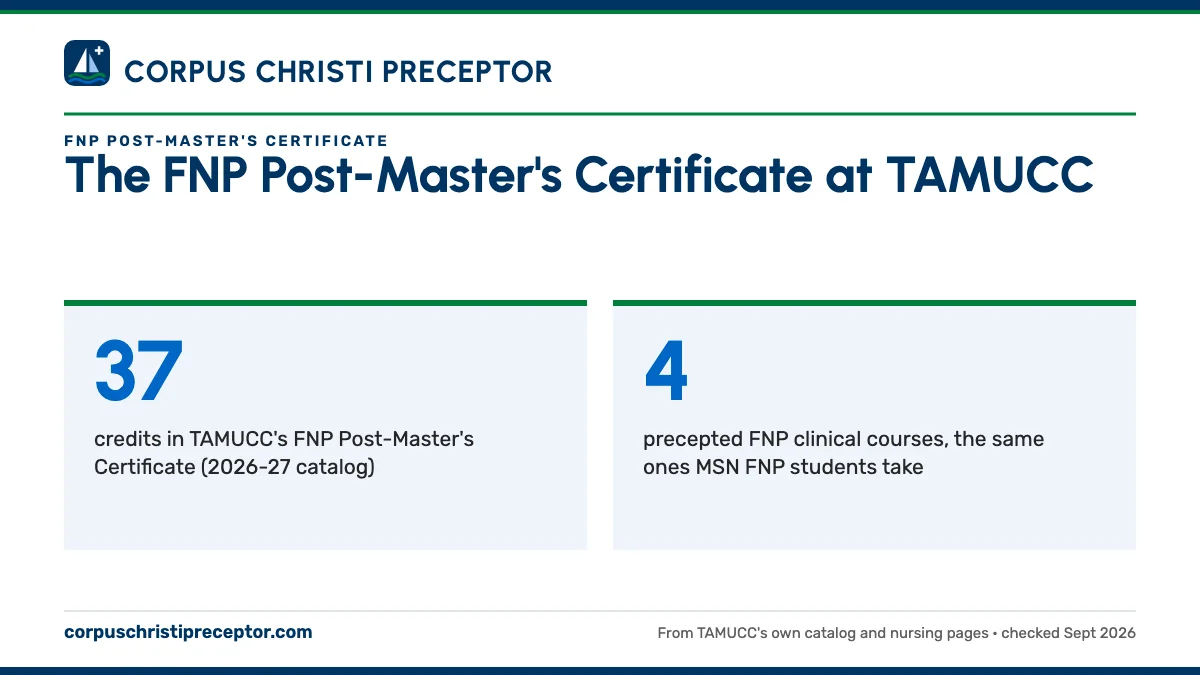
TAMUCC's FNP Post-Master's Certificate gives nurses who already hold an MSN a 37-credit route into family practice, built from the same role courses and the same four clinical courses as the full MSN FNP. The clinical load is the demanding part, and certificate students arrange it exactly as MSN students do: their own Texas preceptors, one course at a time.
Find a Texas preceptor for your certificate
Share the clinical course you are entering and where you live. Your placement advisor takes it from there.
Who the certificate is for
TAMUCC built the certificate for master's-prepared nurses who want to move past the role or population focus they hold now. A nurse educator, a nurse leader or an APRN certified in another population can use it to prepare for family practice without starting a second MSN from scratch.
The 2026-27 graduate catalog lists it as the Family Nurse Practitioner, Post-Masters Certificate, and the tamucc.edu program page calls it Family Nurse Practitioner Certification. It is the only nursing certificate in the catalog, even though the Nursing Practice Department page mentions four graduate-level certificates and then names just this one.
If you are weighing the certificate against the full MSN, the MSN FNP guide covers the 49-credit route, including the core courses a certificate student skips.
37 credits: the FNP role block without the MSN core
The certificate is the MSN FNP minus its 12-credit core. The four shared master's courses, NURS 5310, NURS 5314, NURS 5315 and NURS 5316, fall away because your first master's covered that ground, and the whole family practice block stays.
| Course | Title | Credits |
|---|---|---|
NURS 5326 | Advanced Physiology with Pathophysiological Applications | 3 |
NURS 5322 | Advanced Pharmacological Concepts | 3 |
NURS 5323 | Finance for the Nurse Practitioner | 3 |
NURS 5341 | Wellness and Health Promotion | 3 |
NURS 5624 | Advanced Health Assessment and Differential Diagnosis | 6 |
NURS 5644 | Management of Acute and Chronic Illness I | 6 |
NURS 5645 | Management of Acute and Chronic Illness II | 6 |
NURS 5746 | Integrated Clinical Practice: FNP | 7 (catalog) |
Certificate students meet the same credit mismatch MSN students do: the NURS 5746 syllabi print 6 credits against the catalog's 7. The clinical hours for the capstone are unaffected, and it still needs a B or better, so check the credit figure with your advisor only if the total matters to you.
Clinical hours: the certificate page gives no total
The catalog's certificate page lists the clinical courses but never prints an hour total. Because the four courses are the MSN FNP's own, the published course figures add up to 630: 90 in NURS 5624, 135 each in NURS 5644 and NURS 5645, and 270 in NURS 5746. That sum is worked out from TAMUCC's course numbers rather than stated for the certificate, so confirm it with the FNP Clinical Coordinator as you plan.
The population minimums travel with the courses. Pediatrics, women's health and geriatrics each need 75 hours or 150 encounters logged in Typhon somewhere across the four courses. The 630-hour page explains how students track them.
If you already practice as an APRN in another population, ask the program in writing how your earlier clinical experience is treated. TAMUCC's published certificate sources do not address it, so plan your preceptor search around the full sequence until the program tells you otherwise.
Two labels that conflict: delivery and start term
TAMUCC's own sources disagree on two basics. The catalog calls the certificate an online offering, while the tamucc.edu program page tags it On Campus. TAMUCC's other FNP materials describe online coursework with precepted clinicals, but the label is the university's own, so ask the Nursing Practice Department which format your cohort follows.
The start term has shifted as well. The current program page says Fall intake only. The July 2024 MSN Student Handbook said certificate cohorts start in the Summer, and the July 2026 handbook is silent on it. Treat Fall as the current published answer and confirm it before you set a start date or give notice at work.
Read the program page, the catalog and the handbook for your cohort side by side; where they differ, the Nursing Practice Department has the final word.
Admission items that shape your clinicals
The certificate's admission list is short, and two items on it, the license and the prior MSN, shape everything that follows.
What the certificate page asks for
- A current, valid, unencumbered Texas nursing license (the page does not mention a compact license)
- A master's in nursing, with the aim of widening the role or population focus you hold
- Three letters of recommendation
- A personal statement or essay
- A CV or résumé
- The CONHS Graduate Form
The Texas license matters twice. It is the admission requirement, and TAMUCC's MSN Student Handbook, which has covered certificate cohorts, keeps clinical training inside Texas, so your preceptors and sites will be Texas ones. The Texas-only clinicals page covers the rule. Once you are admitted, CastleBranch compliance comes before any clinical hour, and the CastleBranch guide lists what goes in.
Finding preceptors as a certificate student
Certificate students sit in the same four clinical courses as MSN students and work under the same FNP Student Clinical Guide. The guide makes each FNP student responsible for an approved site and a qualified preceptor, and a missing preceptor does not earn extra time. TAMUCC runs Typhon for post-master's FNP students too, so you can see which sites earlier students used and whether their agreements are current.
Your preceptor must be an NP, MD or DO with an active, unencumbered license, national board certification in family practice or a related specialty, and two or more years of independent practice. Each semester brings a fresh Preceptor Agreement Packet for every preceptor, and your assigned clinical faculty member clears you before the first hour. The preceptor requirements page covers who qualifies.
A nurse who already holds an MSN may have a wider professional network to draw on. Working APRNs should watch TAMUCC's workplace rule: a supervisor cannot precept you, and hours at your employer count only on a different unit, with a preceptor who has no part in your evaluation.
Why certificate students choose our placement desk
If you are working full time while you study, calling clinics one by one is hard to fit in. Your placement advisor takes the search off your desk: a Texas preceptor near you who meets TAMUCC's NP, MD or DO standard, in a setting that fits the course you are entering, from pediatric patients for NURS 5644 to the long family practice stretch of NURS 5746.
We prepare the preceptor's CV, license and board certification details for the Preceptor Agreement Packet, check the site's agreement status, and identify the right signer when an "Initiate Affiliation Agreement" form is needed. TAMUCC's clinical faculty give the final clearance; we make sure what reaches them is complete the first time. If a preceptor withdraws mid-semester, we search for a replacement. Start with how it works or the form below.
Questions TAMUCC students ask
Is TAMUCC's FNP certificate online or on campus?
TAMUCC's sources disagree. The 2026-27 catalog lists the certificate as an online offering, and the tamucc.edu program page labels it On Campus. TAMUCC's other FNP materials describe online coursework with clinicals at Texas sites. Ask the Nursing Practice Department which format applies to your cohort before you plan around either label.
How many clinical hours are in the TAMUCC FNP certificate?
The certificate page gives no total. It uses the MSN FNP's four clinical courses, whose published hours are 90, 135, 135 and 270, which add up to 630. That sum is worked out from TAMUCC's course figures rather than printed for the certificate, so confirm it with the FNP Clinical Coordinator when you plan your semesters.
When does the TAMUCC FNP certificate start?
The current program page says Fall intake only. An older MSN handbook, from July 2024, said certificate cohorts began in the Summer, and the July 2026 handbook does not say. Fall is the current published answer; confirm it with the program before you set a start date, rearrange work or begin contacting preceptors for a specific term.
Can I use a compact nursing license for the FNP certificate?
The certificate page asks for a current, valid, unencumbered Texas nursing license and does not mention a compact license. The MSN pages, by contrast, accept a compact RN license that authorizes practice in Texas. If your license comes from another compact state, ask admissions before applying whether it meets the certificate's requirement.
Does TAMUCC offer a PMHNP or other post-master's nursing certificate?
Not in 2026-27. The graduate catalog lists one nursing certificate, the FNP Post-Master's Certificate, and family practice is TAMUCC's only nurse practitioner specialty. The Nursing Practice Department page mentions four graduate-level certificates but names only the FNP, so treat the catalog as the reliable list.
Related pages
Last checked 2026-09-26
We check these pages against TAMUCC's catalog, FNP clinical guides, MSN and DNP handbooks and college pages. Your course, your clinical faculty member and the handbook for your cohort have the final word.
TAMUCC makes the preceptor search yours. Let us run it for you in Texas.
Tell us your TAMUCC program, your next clinical course and where in Texas you can drive. We find preceptors who fit the course and gather what the affiliation agreement and the Preceptor Agreement Packet need, early enough for both to clear.
- Preceptors matched to the course: pediatrics for
NURS 5644, women's health forNURS 5645, broad primary care forNURS 5746 - CV, license, board certification and the site's agreement status ready for TAMUCC's paperwork
- In Corpus Christi, the Valley, San Antonio, Houston, Austin, Dallas-Fort Worth and across Texas
Start your placement plan
Your program, city and next clinical semester is all we need to begin.