The Texas RN license TAMUCC expects, program by program
TAMUCC's MSN programs admit nurses holding a Texas RN license or a compact RN license that carries authorization to practice in Texas, and that license has to stay current and unencumbered until graduation. Applicants still waiting on a Texas license can be admitted conditionally if they obtain it by the end of their first semester. The DNP Nurse Practitioner track asks for more: a Texas APRN license.
Get your placement plan
Tell us your TAMUCC program and where you live. A placement advisor replies with the preceptor and site options that fit your TAMUCC course.
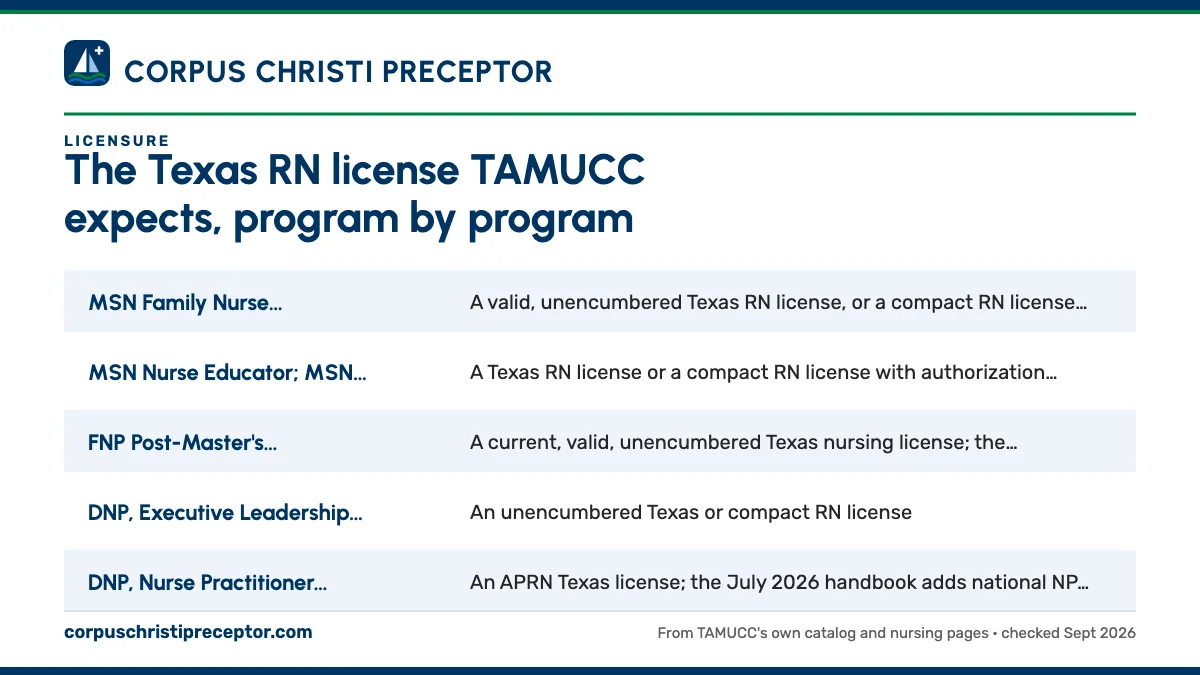
The license rule by program
TAMUCC words its license requirement a little differently from one program and document to the next. The table sets out what each source asks for, so you can see where the wording lines up and where it does not.
| Program | What TAMUCC asks for | Source |
|---|---|---|
| MSN Family Nurse Practitioner | A valid, unencumbered Texas RN license, or a compact RN license with authorization to practice in Texas | Catalog 2026-27; FNP program page |
| MSN Nurse Educator; MSN Leadership in Nursing Systems | A Texas RN license or a compact RN license with authorization to practice in Texas | Catalog 2026-27 |
| FNP Post-Master's Certificate | A current, valid, unencumbered Texas nursing license; the compact is not mentioned | Certificate program page |
| DNP, Executive Leadership track | An unencumbered Texas or compact RN license | Catalog; DNP program page |
| DNP, Nurse Practitioner track | An APRN Texas license; the July 2026 handbook adds national NP certification | Catalog; DNP program page; DNP handbook |
| All MSN and DNP students, after admission | A current, unencumbered license to practice nursing in Texas throughout the program | MSN and DNP handbooks |
RN-MSN and RN-Bridge students enter the MSN and follow its license rule. The Traditional and eLine BSN are the exception, since those students earn their first license after graduating.
Texas license or compact license
For the MSN, the catalog accepts two kinds of RN license. One is a license issued by the Texas Board of Nursing. The other is a multistate license from another Nurse Licensure Compact state, as long as it authorizes you to practice in Texas. Texas implemented the enhanced compact on January 19, 2018, which is what makes the second option possible.
The handbooks read more narrowly. Both the MSN and DNP handbooks call for a current, unencumbered license to practice nursing in the state of Texas throughout the program, verified through the Texas BON or Nursys, and the certificate page asks for a Texas nursing license without mentioning the compact. If your multistate license comes from another state, ask the program which reading applies to your cohort before you rely on it.
Whichever license you hold, TAMUCC wants proof from the source. The FNP compliance checklist asks for a Texas BON verification in CastleBranch and refuses a photocopy of the license. The CastleBranch guide covers the rest of that tracker.
Conditional admission and the first-semester deadline
An applicant without a Texas license can still begin. The MSN Student Handbook (July 2026) allows conditional admission, with a waiver request, on the condition that the Texas license is in hand by the end of the first semester.
Treat that deadline as the latest date, not the target. Your first clinical course, NURS 5624 for FNP students, cannot start until compliance clears, and the compliance checklist needs a Texas BON license verification. TAMUCC does not publish the semester in which each student's first clinical course falls, so check your Degree Planner and aim to have the license long before that term.
Conditional admission also carries an academic condition. The MSN handbook requires conditionally admitted students to earn a B or better in each of their first four MSN courses, and the catalog uses the same waiver route for applicants below the 3.00 GPA on their last 60 hours. The grades and progression guide explains how those grades connect to TAMUCC's other rules.
Keeping the license clear to graduation
Admission is not the last license check. The handbooks require an unencumbered Texas license for the whole program, and your compliance tracker holds a BON verification that has to reflect your current renewal. When your license renews, upload a fresh verification so the record never shows a lapsed date during a clinical term.
The consequences of a lapse are heavy. TAMUCC's MSN handbook names a lapse in RN licensure as a possible ground for dismissal, alongside immunization and compliance lapses, and students dismissed on those grounds are ineligible for the grade appeal process. A license that lapses mid-term also halts clinicals, as any expired compliance item does.
Your license shapes how you appear at the site as well. The FNP guide asks students to wear a school ID badge showing that they are both a Registered Nurse and a CONHS graduate student at TAMUCC. You arrive as a licensed nurse working in a student role, under your preceptor's supervision.
The DNP Nurse Practitioner track: a Texas APRN license
The DNP's Nurse Practitioner track is built for nurse practitioners, and TAMUCC asks for an APRN Texas license at admission. The DNP handbook describes a current, unencumbered license with authority to practice as a nurse practitioner in Texas, and its July 2026 edition adds national certification as a nurse practitioner.
The compact offers no shortcut on this track. An NP licensed in another state needs Texas APRN licensure to meet the requirement, because the Texas APRN license is a separate credential. On the RN side, the catalog accepts a Texas or compact RN license while the handbook says Texas, a difference to settle at admission.
The Executive Leadership track asks only for an unencumbered Texas or compact RN license, since it prepares nurse executives rather than practicing NPs. The DNP Nurse Practitioner track page covers that program's practice hours and project.
After the FNP: the path to a Texas APRN license
Finishing TAMUCC's MSN FNP is a major step toward practicing as an NP in Texas, and licensure is the next. Under 22 TAC §221.4, Texas APRN licensure requires an RN license, a completed graduate program in a nurse practitioner role and national certification. TAMUCC's disclosure confirms the MSN's educational fit for FNP certification in all but four jurisdictions; the licensure disclosure guide names them and explains what that means if you might move. Plan national certification and the BON application together, because Texas requires both before you practice as an APRN.
Texas law then shapes how you practice. AANP classifies Texas as restricted practice, and an APRN's prescribing runs through a prescriptive authority agreement with a delegating physician. Our Texas NP practice guide explains how those rules also shape who can precept you now.
The preceptor's license side, handled by us
Your license gets you into the program; your preceptor's license gets your hours counted. TAMUCC's FNP preceptors must hold an active, unencumbered NP, MD or DO license and national board certification, and every Preceptor Agreement Packet needs a copy of the preceptor's license dated within 30 days. TAMUCC also expects students to look up the preceptor's license through the Texas BON or the Texas Medical Board.
Checking all of that is part of our service. When we match a TAMUCC student with a Texas preceptor, we confirm the license and board certification against TAMUCC's rules first, then prepare the CV, the current license copy and the site details that the Preceptor Agreement Packet and any agreement request need. Your clinical faculty member receives a complete file. Use the form below to start.
Questions TAMUCC students ask
Can I start TAMUCC's MSN while my Texas license application is pending?
Yes, through conditional admission. The MSN handbook lets applicants without a Texas license be admitted conditionally with a waiver request, provided they hold the license by the end of the first semester. Until the Texas BON can verify it, your CastleBranch record stays incomplete and clinical clearance cannot happen, so plan on the license arriving well before your first clinical course.
I live in another compact state. Do I need a Texas license for TAMUCC?
The catalog accepts a compact RN license with authorization to practice in Texas for the MSN, but the handbooks speak of a license to practice nursing in the state of Texas, and the certificate page names a Texas license. Ask the program which applies before you apply. Your clinicals take place in Texas either way; the Texas-only clinicals guide explains that rule.
Do I have to update CastleBranch when my RN license renews?
Yes. TAMUCC's checklist asks for a Texas Board of Nursing verification of your license, and the tracker is brought current every semester. After renewing, upload a fresh verification so the record shows a valid license for the whole clinical term. A license that appears expired pauses clinical attendance in the same way an expired vaccine or CPR card does.
Does the Executive Leadership DNP require an APRN license?
No. The Executive Leadership track asks for an unencumbered Texas or compact RN license and an MSN in administration or an equivalent such as an MBA, MHA or MPA. The APRN license requirement applies only to the Nurse Practitioner track. Both tracks share the same practice-hour requirement, 1,000 hours after the bachelor's, of which the MSN can supply up to 500.
Does the Nurse Licensure Compact cover nurse practitioners?
The compact Texas joined covers registered nurses and licensed vocational nurses only. A Texas APRN license is a separate, single-state credential without multistate privileges. TAMUCC's DNP Nurse Practitioner track therefore names a Texas APRN license specifically, and why FNP graduates who want to practice in Texas apply to the Texas Board of Nursing for APRN licensure.
Related pages
Last checked 2026-09-26
We check these pages against TAMUCC's catalog, FNP clinical guides, MSN and DNP handbooks and college pages. Your course, your clinical faculty member and the handbook for your cohort have the final word.
TAMUCC makes the preceptor search yours. Let us run it for you in Texas.
Tell us your TAMUCC program, your next clinical course and where in Texas you can drive. We find preceptors who fit the course and gather what the affiliation agreement and the Preceptor Agreement Packet need, early enough for both to clear.
- Preceptors matched to the course: pediatrics for
NURS 5644, women's health forNURS 5645, broad primary care forNURS 5746 - CV, license, board certification and the site's agreement status ready for TAMUCC's paperwork
- In Corpus Christi, the Valley, San Antonio, Houston, Austin, Dallas-Fort Worth and across Texas
Start your placement plan
Your program, city and next clinical semester is all we need to begin.