How Texas NP law shapes your TAMUCC preceptorship
Texas NPs practice under physician delegation, and that arrangement follows you into every clinic where you train. This page explains the prescriptive authority agreement, the Board of Nursing's baseline for APRN preceptors in 22 TAC §219.10, and the tighter standard TAMUCC sets for its FNP students.
Get your placement plan
Tell us your TAMUCC program and where you live. A placement advisor replies with the preceptor and site options that fit your TAMUCC course.
State law in the exam room
TAMUCC's FNP guide ties its clinical expectations to professional standards, Board of Nursing rules and Texas law, and the preceptor guide tells preceptors to supervise according to state law and the site's own policies. In practice, Texas rules decide what your preceptor is authorized to do, which in turn shapes what you observe and what you practice under supervision.
Two layers matter. The first is how Texas NPs practice at all: through authority delegated by a physician and written into a prescriptive authority agreement. The second is what the Board expects of anyone precepting an APRN student, a baseline TAMUCC exceeds for its FNP program. Licensing basics, the compact and the state's major health systems are summarized on the Texas guide.
Restricted practice and the prescriptive authority agreement
AANP classifies Texas as a restricted practice state. An NP's authority to order or prescribe drugs and devices is delegated by a physician through a prescriptive authority agreement under 22 TAC §222.5. The signed agreement records both parties' licenses and practice settings, the drug categories covered and excluded, plans for consultation, referral and emergencies, how the two communicate, any alternate physicians, and a quality assurance plan that includes chart review.
The pair meet at least monthly and document it, review the agreement at least yearly, and must produce it within three business days if the Board of Nursing or Texas Medical Board asks.
For a student, the agreement explains much of clinic life. Your preceptor's prescribing reflects the categories it allows, harder cases may move through its consultation and referral plan, and you may see charts pulled for quality review. TAMUCC's preceptor guide is explicit that prescriptions, orders and legal documents are never signed by the student.
Two limits you will notice in practice
Schedule II prescribing by a Texas APRN is confined to hospital facility-based practice, meaning inpatient stays of 24 hours or more or the emergency department, and to hospice patients, under 22 TAC §222.8(c). In an outpatient family practice, hospice care aside, those prescriptions fall outside an NP preceptor's delegated authority, so the way the clinic handles them becomes part of what you learn. In a hospital-based rotation, the picture differs.
Texas also caps supervision: under Occupations Code §157.0512, a single physician can have supervisory agreements with at most seven NPs, APRNs and PAs combined, subject to some exemptions. Because NP and delegating physician work in tandem, either can precept a TAMUCC FNP student if they meet TAMUCC's certification and experience tests below.
The Board's floor: 22 TAC §219.10
The Board's rule on clinical learning in APRN education is broad. A qualified preceptor is either authorized to practice as an advanced practice nurse or else holds a current license in another health profession and can supervise and teach in a setting fit for advanced practice nursing. Written agreements among the program, the preceptor and the clinical facility spell out each party's role, and written clinical objectives go to the preceptor before the rotation begins.
Faculty remain responsible for the student and keep in regular contact with the preceptor; where a site visit is not feasible, phone calls, written contact or simulation can substitute. One faculty member supervises no more than six students in a clinical course, and no more than two when on site.
Chapter 219 formally governs programs seeking Board approval, and TAMUCC does not cite the rule by number, yet its ideas run through TAMUCC's process: the affiliation agreement and Preceptor Agreement Packet are the written agreements, you bring course objectives when you ask a clinician to precept, and faculty visit the site at least once to evaluate you.
Where TAMUCC's FNP rule goes further
TAMUCC's FNP program adds requirements the state leaves open and drops whole categories of clinicians the state accepts.
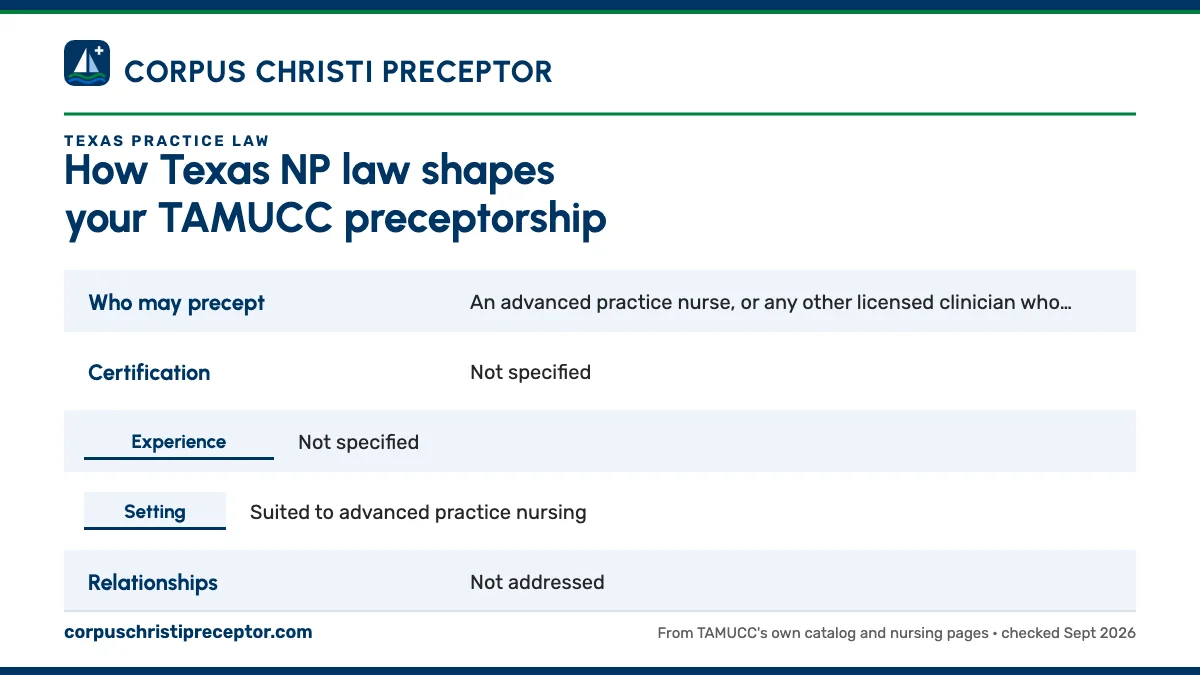
| Point | Texas Board rule | TAMUCC FNP rule |
|---|---|---|
| Who may precept | An advanced practice nurse, or any other licensed clinician who can supervise and teach | NPs, MDs and DOs only, each with a license that is active and unencumbered |
| Certification | Not specified | Board certified nationally in family practice or a related specialty |
| Experience | Not specified | At least two years of independent clinical practice |
| Setting | Suited to advanced practice nursing | Suited to FNP role preparation |
| Relationships | Not addressed | No workplace supervisor or family member; at an employer, a different unit and no role in your evaluation |
| Paperwork | Written agreements among program, preceptor and facility | An affiliation agreement plus a Preceptor Agreement Packet every semester |
Physician assistants show the gap: the state rule could reach them, and a look-up link in TAMUCC's guide is labeled for physicians and PAs alike, but the qualification list stops at NPs, MDs and DOs. Ask the FNP Clinical Coordinator first. The complete TAMUCC standard is on preceptor requirements.
Screen every candidate against TAMUCC's FNP list first, because the state's rule accepts clinicians TAMUCC's FNP program leaves out.
Licenses and look-ups for a Texas preceptor
Texas has been part of the enhanced Nurse Licensure Compact since January 19, 2018, yet the compact stops at RN and LVN licenses. Texas APRN licensure is separate and stays in Texas, so the NP precepting you here holds it whatever state issued their RN license.
To be licensed as an APRN in Texas, a nurse needs an RN license, national certification and a completed graduate program preparing them for an NP role (22 TAC §221.4), so an NP preceptor already holds a national certification; the check is whether it covers family practice or a related specialty. For an MD or DO, board certification needs its own check. TAMUCC's guide sends you to the Board of Nursing's verification tool for nurses and the Texas Medical Board's for physicians.
How we put Texas rules to work in your search
Our placement desk screens every candidate against TAMUCC's FNP list rather than the state's broader rule, checks licenses on the same Texas look-ups TAMUCC names, and confirms board certification and the setting's fit for your course before a name reaches you. We also ask how a practice runs its delegation, since an NP and physician who both teach can give you two possible preceptors under one site agreement.
State projections show Texas NP supply outpacing demand through 2036 while primary care shortage areas persist, so the squeeze is in clinical placements rather than NP numbers. We search where TAMUCC students live: Corpus Christi and the Coastal Bend, the Rio Grande Valley, San Antonio, Houston, Dallas-Fort Worth, Austin and the towns between.
Questions TAMUCC students ask
Do I sign a prescriptive authority agreement as a TAMUCC student?
No. The agreement is between your NP preceptor and their delegating physician, and it governs the NP's prescribing. As a student you work under your preceptor's supervision and leave every prescription and order for a licensed clinician to sign. Your own paperwork is the affiliation agreement and the Preceptor Agreement Packet.
Why does TAMUCC ask more of FNP preceptors than the Texas Board of Nursing does?
TAMUCC does not publish its reasoning. Its guide presents its expectations as aligned with state rules and professional standards, and its FNP list simply sits above the Board's baseline. Since TAMUCC's clinical faculty approve every preceptor, TAMUCC's list is the one to follow.
Can a Texas NP precept my pediatric or women's health rotation?
Yes, if they meet TAMUCC's list. The certification must cover family practice or a related specialty, and the setting has to suit the course: children for NURS 5644 and women's health for NURS 5645. Those rotations also count toward TAMUCC's specialty minimums for pediatrics and women's health, measured in hours or Typhon-logged encounters.
Can my preceptor's delegating physician also precept me?
Yes, provided the physician passes TAMUCC's tests: an MD or DO license in good standing with no encumbrance, national board certification covering family practice or a related specialty, and a minimum of two years in independent practice. Every preceptor needs their own Preceptor Agreement Packet each semester, so plan any split with your placement advisor.
Related pages
Last checked 2026-09-26
We check these pages against TAMUCC's catalog, FNP clinical guides, MSN and DNP handbooks and college pages. Your course, your clinical faculty member and the handbook for your cohort have the final word.
TAMUCC makes the preceptor search yours. Let us run it for you in Texas.
Tell us your TAMUCC program, your next clinical course and where in Texas you can drive. We find preceptors who fit the course and gather what the affiliation agreement and the Preceptor Agreement Packet need, early enough for both to clear.
- Preceptors matched to the course: pediatrics for
NURS 5644, women's health forNURS 5645, broad primary care forNURS 5746 - CV, license, board certification and the site's agreement status ready for TAMUCC's paperwork
- In Corpus Christi, the Valley, San Antonio, Houston, Austin, Dallas-Fort Worth and across Texas
Start your placement plan
Your program, city and next clinical semester is all we need to begin.