Texas: where every TAMUCC MSN clinical hour happens
Texas is TAMUCC's home and the only state where its MSN clinical hours count, so a student in Brownsville, El Paso or Frisco plans around the same rule. This guide covers what each TAMUCC program asks of a Texas resident, how Texas licensing and NP law shape the preceptor you need, and what the big metro health systems expect before a student arrives.
Get your placement plan
Tell us your TAMUCC program and where you live. A placement advisor replies with the preceptor and site options that fit your TAMUCC course.
TAMUCC's programs from a Texas address
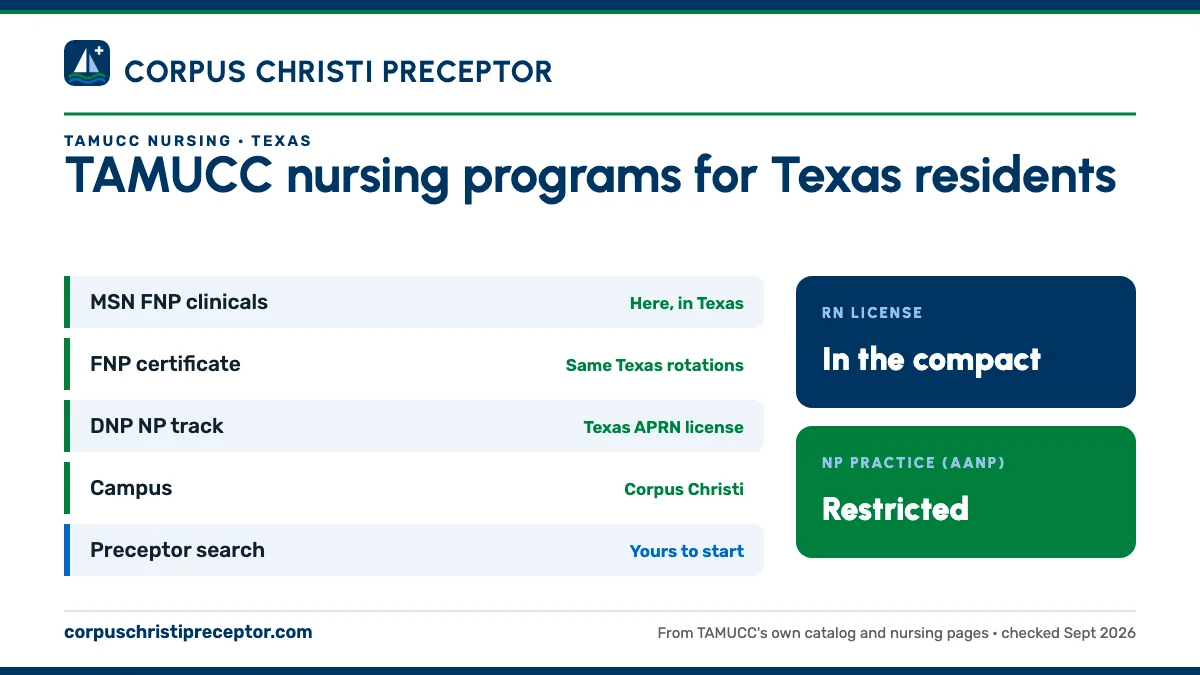
A Texas address clears the hurdle that trips up out-of-state applicants: TAMUCC's MSN Student Handbook requires that clinical education happen in Texas, and you already live here. What still differs by program is the license TAMUCC asks for, the hours you owe and who arranges the site.
| Program | License TAMUCC asks for | Clinical or practice hours | Who arranges the site |
|---|---|---|---|
| MSN Family Nurse Practitioner | Texas RN, or a compact RN license authorized for Texas | 630, at Texas sites near home where possible | The student, then TAMUCC's agreement and faculty clearance |
| FNP Post-Master's Certificate | Texas nursing license (the program page names no compact option) | The same four FNP clinical courses | The student |
| MSN Nurse Educator | Texas or compact RN authorized for Texas | 180 field hours, in Texas | The student |
| MSN Leadership in Nursing Systems | Texas or compact RN authorized for Texas | 180 (catalog) or 225 (handbook), in Texas | The student |
| DNP, Nurse Practitioner track | Texas APRN license plus NP certification | 1,000 post-baccalaureate hours, up to 500 carried from the MSN | The student, with a Letter of Support |
| DNP, Executive Leadership track | Texas or compact RN | The same 1,000-hour total | The student, with a Letter of Support |
| BSN, Traditional or eLine | None yet (pre-licensure) | Set per course by the program | TAMUCC, in the Corpus Christi area |
Two rows need care. The Leadership hours differ between the 2026-27 catalog and the July 2026 handbook, so your program coordinator settles which figure applies to your cohort. No Texas-only line appears in the DNP handbook; every DNP practice experience goes through the Scholarly Project Committee Chair, who approves it before hours begin.
One board, two kinds of nursing license
The Texas Board of Nursing is the sole licensing body for Texas nurses, NPs included. Texas joined the enhanced Nurse Licensure Compact on January 19, 2018, but the compact carries RN and LVN licenses only. A multistate RN license issued by another compact state can meet the MSN admission wording, while the NP license you earn after graduating is a Texas-only credential that no compact moves across state lines.
A Texas APRN license stacks three pieces: RN licensure, a completed graduate program preparing you for an NP role, and national certification. That sequence explains why the DNP Nurse Practitioner track asks for the Texas APRN license at entry. MSN applicants who arrive without a Texas license can be admitted conditionally, provided the Texas license arrives before their first semester ends.
Restricted practice and the clinic you train in
AANP rates Texas as a restricted practice state. Texas NPs prescribe through a prescriptive authority agreement signed with a delegating physician, a document that lists the drug categories allowed, a consultation and referral plan, an emergency plan and a quality assurance plan with chart review. The NP and physician meet at least monthly and review the agreement every year.
Two further limits shape Texas primary care. One physician may hold supervisory agreements with no more than seven NPs, APRNs or PAs, with some exemptions, and Schedule II prescribing is confined to hospital facility-based practice and hospice patients. As a student you will see these rules at work in your preceptor's week, which is part of learning to practice here. The Texas NP practice guide goes deeper on how they bear on precepting.
The state's preceptor rule sits below TAMUCC's
The Board's standard for APRN education, 22 TAC §219.10, is broad. It accepts an advanced practice nurse or any currently licensed health care professional able to supervise and teach in an advanced practice setting, calls for written agreements among program, preceptor and agency, and asks that clinical objectives reach the preceptor before the rotation starts. It also limits one faculty member to six students in a clinical course.
TAMUCC draws a tighter circle for FNP students. The preceptor must be an NP, MD or DO whose license is active and unencumbered, must hold national certification in family practice or a close specialty, and must have practiced independently for two years or more. Workplace supervisors and relatives are excluded. A clinician who passes the state test can still miss TAMUCC's, so screen every candidate against the TAMUCC preceptor requirements before you ask for a commitment.
Qualifying under Texas rules does not make someone a TAMUCC FNP preceptor: confirm the license type, the national certification and the two independent years before you ask.
Six Texas markets and how their systems take NP students
Wherever a Texas health system publishes student rules, one pattern repeats: an affiliation agreement with the school must be active before the first day, and several systems expect the student to arrive with a preceptor already secured. The examples below come from each system's own student pages and describe their processes, not TAMUCC placements.
| Region | Examples from systems' own pages |
|---|---|
| Corpus Christi and the Coastal Bend | CHRISTUS Health wants a signed Clinical Education Affiliation Agreement completed before the term; no Spohn request page was found |
| Rio Grande Valley and Laredo | DHR Health rotates students only from affiliate or partner schools and leaves finding a sponsor to the student |
| San Antonio and the Hill Country | University Health lists Texas A&M University-Corpus Christi among its affiliated schools; CHRISTUS Santa Rosa wants forms four weeks ahead and a preceptor already secured |
| Houston and the Gulf Coast | Houston Methodist accepts graduate NP requests only through its own form, due April 30 for summer, July 15 for fall and November 13 for spring |
| Austin and Central Texas | A regional partnership runs rotation software and bridging modules for nursing students; an NP route at Ascension Seton or St. David's was not found |
| Dallas-Fort Worth and North Texas | UT Southwestern takes APRN requests in set windows months ahead and expects a sponsor in hand; Baylor Scott & White requires an agreement with a Texas-certified school |
The regional guides carry the detail for Houston, Dallas-Fort Worth, San Antonio, Austin, Corpus Christi and the Valley. Students in El Paso, Lubbock, the Panhandle or East Texas follow the same TAMUCC steps with local practices.
An island campus with a statewide reach
The College of Nursing and Health Sciences sits on a 240-acre island ringed by Corpus Christi and Oso Bays, roughly ten miles from downtown. Nursing offices are in Island Hall, whose second floor houses the Simulation & Clinical Learning Center, including a primary care simulation lab named the Islander Regional Care Clinic.
Graduate students seldom need the island for clinicals. Every graduate track is delivered through web-based learning systems, the handbooks mention periodic campus events with dates announced in advance, and no fixed FNP intensive is published. For rotations in the big cities, TAMUCC's FNP guide points to adjunct clinical faculty living in those cities, matched to students by location rather than by request. The college's reach is long-standing: it once ran graduate outreach sites in Laredo and Weslaco.
Access, not headcount: the Texas workforce picture
The state's nursing workforce center projects NP supply roughly doubling between 2022 and 2036, well ahead of demand, while the RN gap widens. The pressure point for patients is access. At the end of June 2026, HRSA's tally stood at 451 primary care shortage designations across Texas, together covering about 8.8 million residents; lifting all of them would take an estimated 1,417 additional practitioners.
For a student, the squeeze sits at the clinic door. Large systems ration student spots, and Houston Methodist describes its NP student spaces as limited in number. State help aimed at NP preceptors is thin: the Texas tuition exemption for clinical preceptors covers RNs who precept undergraduate pre-licensure students, and no Texas NP preceptor tax credit or stipend was found. The Nursing Shortage Reduction Program funds schools, and TAMUCC's college won its largest award from it in 2026, partly to widen access to clinical and simulation learning. TAMUCC recognizes the clinicians who volunteer as its preceptors with a certificate of precepting hours, appreciation letters and university awards.
Why TAMUCC students across Texas choose us
We work the Texas market the way TAMUCC's process requires. We search for a preceptor who clears TAMUCC's FNP bar, not merely the state's, in a practice within reach of your home, and we confirm with you whether the site appears in Typhon's Clinical Site Directory with current agreement dates. Where no agreement exists, we gather the signer and site details for the "Initiate Affiliation Agreement" form early, because TAMUCC asks students to allow up to 3 months.
We also gather your preceptor's CV, current license and proof of certification for the Preceptor Agreement Packet and stay on call if a preceptor drops mid-semester. Clearance belongs to TAMUCC's clinical faculty, and our part is handing them a file with nothing missing. Tell us your county and your next clinical course with the form below.
Questions TAMUCC students ask
Do I need to live near Corpus Christi for TAMUCC's online FNP program?
No. TAMUCC delivers graduate coursework online and places clinicals in students' own communities where possible, with adjunct clinical faculty in Texas's large cities. What the program does expect is attendance at periodic campus events, with dates announced ahead, and every clinical hour logged at a Texas site under a current TAMUCC agreement, with a preceptor on TAMUCC's approved list.
Could a PA serve as my TAMUCC FNP preceptor in Texas?
Texas's APRN education rule would allow other licensed health professionals, but TAMUCC's FNP list stops at nurse practitioners and physicians holding an MD or DO. The FNP guide includes a license look-up that mentions physician assistants, which creates some ambiguity, so ask the FNP Clinical Coordinator before approaching a PA.
Will a Texas hospital system assign me a preceptor?
Usually not. CHRISTUS Santa Rosa's GME office states it does not help find preceptors, UT Southwestern's advanced practice office offers no matching and expects a sponsor before you apply, DHR Health does not assign preceptors, and Parkland refers students back to their school. In practice the preceptor comes first, then the system's forms and TAMUCC's agreement.
How early should a Texas student start looking for a preceptor?
Earlier than the term calendar suggests. Houston Methodist's spring deadline falls in mid-November, UT Southwestern closes spring requests at the end of August, and TAMUCC asks students to allow up to 3 months for a new affiliation agreement. A search that starts one to two semesters before the course leaves room for all three.
Does a compact RN license from another state work for TAMUCC's MSN?
For the MSN, a multistate license usually works: TAMUCC's catalog lists a Texas RN license or a compact license authorized for Texas practice. Certificate applicants read narrower wording, a Texas nursing license with no compact option named, so they check with the program before relying on one. Either way, the compact privilege covers RN work, never NP practice.
Related pages
Last checked 2026-09-26
We check these pages against TAMUCC's catalog, FNP clinical guides, MSN and DNP handbooks and college pages. Your course, your clinical faculty member and the handbook for your cohort have the final word.
TAMUCC makes the preceptor search yours. Let us run it for you in Texas.
Tell us your TAMUCC program, your next clinical course and where in Texas you can drive. We find preceptors who fit the course and gather what the affiliation agreement and the Preceptor Agreement Packet need, early enough for both to clear.
- Preceptors matched to the course: pediatrics for
NURS 5644, women's health forNURS 5645, broad primary care forNURS 5746 - CV, license, board certification and the site's agreement status ready for TAMUCC's paperwork
- In Corpus Christi, the Valley, San Antonio, Houston, Austin, Dallas-Fort Worth and across Texas
Start your placement plan
Your program, city and next clinical semester is all we need to begin.