TAMUCC nursing accreditation and approval
Texas A&M University-Corpus Christi holds institutional accreditation from SACSCOC, and CCNE accredits four of its nursing programs: the BSN, the MSN, the DNP and the post-graduate APRN certificate. The Texas Board of Nursing approves the pre-licensure BSN. TAMUCC's own pages disagree about the date of the latest CCNE review, so this guide shows what each page says and where to confirm the current term.
Get your placement plan
Tell us your TAMUCC program and where you live. A placement advisor replies with the preceptor and site options that fit your TAMUCC course.
The short answer
Three bodies stand behind a TAMUCC nursing program, and each answers a different question.
- The university: accredited by SACSCOC at the associate, baccalaureate, master's and doctoral levels.
- The nursing programs: TAMUCC's CCNE accreditation page lists the BSN, MSN, DNP and post-graduate APRN certificate as accredited by the Commission on Collegiate Nursing Education (CCNE).
- The pre-licensure BSN: approved by the Texas Board of Nursing, which lists it under program code US27500400 in Corpus Christi.
- The graduate APRN programs: the board's APRN program approval is limited to programs seeking initial approval without national accreditation, which points to CCNE as the program review for TAMUCC's MSN and DNP.
Put simply, SACSCOC speaks to the university, CCNE to the nursing curriculum, and the Texas Board of Nursing to the program that prepares new RNs. The sections below take each in turn.
SACSCOC: the university's accreditation
TAMUCC's accreditation page states that the university is accredited by the Southern Association of Colleges and Schools Commission on Colleges at the associate, baccalaureate, master's and doctoral levels. That institutional accreditation covers every program TAMUCC offers, nursing programs included. The same page links to a reaffirmation letter for readers who need the details.
The institution has carried several names on the way to that status. It began as the University of Corpus Christi, became Corpus Christi State University in 1977, joined the Texas A&M University System in 1989 and took its present name, Texas A&M University-Corpus Christi, in 1993. The College of Nursing and Health Sciences works from Island Hall on the Island campus, home of the Islanders. If an application or employer asks for your university's accreditor, SACSCOC is the name to give; for the nursing program itself, the answer is CCNE.
CCNE: accreditation for the nursing programs
The Commission on Collegiate Nursing Education accredits TAMUCC's nursing programs, and TAMUCC's CCNE page names four: the BSN, the MSN, the DNP and the post-graduate APRN certificate. In the 2026-27 graduate catalog, the only nursing certificate is the FNP Post-Master's Certificate, which shares the MSN FNP's four clinical courses.
| Program | CCNE status (TAMUCC page) | How clinical placements work |
|---|---|---|
| BSN, Traditional and eLine tracks | Accredited | Sites assigned by the program in the Corpus Christi area |
| MSN: FNP, Nurse Educator, Leadership in Nursing Systems | Accredited | Texas sites and preceptors the student secures |
| DNP: Nurse Practitioner and Executive Leadership tracks | Accredited | Practice sites the student secures, with a Letter of Support |
| Post-graduate APRN certificate (FNP Post-Master's Certificate) | Accredited | Student-secured sites across the four FNP clinical courses |
Accreditation leaves the search where TAMUCC puts it. For every graduate program, the catalog says students are responsible for identifying and selecting agencies or preceptors for their field experiences; our page on finding your own preceptor explains what that involves.
Review dates: where TAMUCC's pages disagree
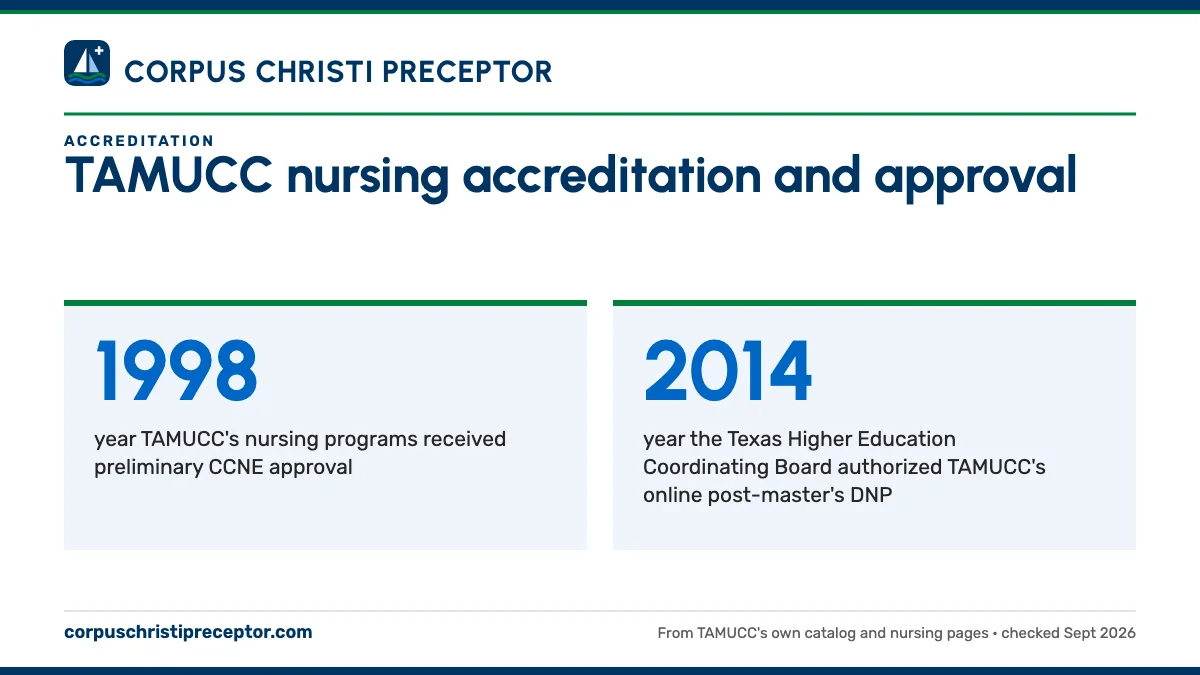
TAMUCC's nursing history page gives the long view. Preliminary CCNE approval came in 1998. The BSN was accredited in 2000 for ten years and the master's program for five, with re-accreditation following in 2005 and 2015. The same page says the next scheduled visit is 2025, with program review again in October 2025.
A second TAMUCC page tells a different story. The Nursing Practice Department's community alert announced that the BSN, MSN, DNP and post-master's APRN programs would take part in an on-site CCNE evaluation on April 3-5, 2023. The history page looks as though it was never updated after that visit.
Neither page gives the current accreditation term or the next review date for each program. CCNE's own directory of accredited programs is the place to confirm both, and it is the source to cite if an employer or certification body asks.
TAMUCC's history page says the next CCNE visit is 2025, while its community alert announced an on-site visit for April 3-5, 2023. Confirm the current term in CCNE's directory.
The Texas Board of Nursing and the state's role
The Texas Board of Nursing approves pre-licensure nursing programs, and TAMUCC's BSN appears in the board's records as program US27500400, Corpus Christi. The board's own program search shows its current approval status.
Graduate programs sit differently. Under 22 TAC §219.1(a)(1), the board's approval of APRN programs is limited to programs seeking initial approval that do not otherwise hold national accreditation. Our reading is that TAMUCC's CCNE-accredited MSN and DNP fall outside that approval process, with CCNE supplying the program review. TAMUCC's FNP Student Clinical Guide still ties its expectations to professional standards, BON rules and state law.
The state's higher education board plays a part as well. The Texas Higher Education Coordinating Board authorized TAMUCC's online post-master's DNP in 2014; the first Nurse Practitioner-focus cohort began in 2016 and the Leadership track in 2019. In May 2026, TAMUCC announced an FY2026 grant from the board's Nursing Shortage Reduction Program aimed at recruitment, retention and expanding access to clinical and simulation-based learning.
What accreditation means for your license and your clinicals
For NP students, the practical questions are certification and licensure. TAMUCC's licensure disclosure says the MSN clears the educational bar for FNP certification everywhere in the U.S. apart from four jurisdictions, and the Texas rule for APRN licensure, 22 TAC §221.4, looks for a completed NP-focused graduate program and national certification on top of the RN license. The licensure disclosure guide covers the exceptions.
An accredited MSN also opens the next step inside TAMUCC. The DNP Nurse Practitioner track admits applicants who hold an MSN from an accredited school, and appropriate clinical hours from that MSN can count toward the DNP's practice-hour total.
Day to day, students meet the program's standards through the structure around clinicals: clinical faculty who approve each site and preceptor, at least one evaluative site visit per FNP rotation, a written agreement with every site and a Preceptor Agreement Packet each semester. The clinical placement process shows how those steps fit together.
Accredited standards, matched by a thorough preceptor search
An accredited program sets the bar, and the student still has to find the preceptor who clears it. For the FNP, that means a nurse practitioner or physician (MD or DO) whose license is active and unencumbered, who holds national board certification in family practice or a related field, and who has practiced independently for two years or more. Clinical faculty approve every one.
Our search is built around that standard. We look for Texas preceptors who meet TAMUCC's criteria in full, check their license and board certification before you make the request, and assemble the documents TAMUCC's process needs, so the file your clinical faculty member reviews is complete on arrival. It is the best way to turn TAMUCC's standard into a confirmed rotation. Our process, step by step shows what happens next, or begin with the form below.
Questions TAMUCC students ask
Is TAMUCC's online FNP program accredited?
Yes. TAMUCC's CCNE accreditation page lists the MSN among its accredited programs, and the FNP is an MSN track. The FNP Post-Master's Certificate falls under the post-graduate APRN certificate category on the same page, and the university as a whole holds SACSCOC accreditation. For the current accreditation term, check CCNE's directory of accredited programs.
When is TAMUCC's next CCNE review?
TAMUCC does not publish a current date. Its history page says the next visit was scheduled for 2025, while a separate Nursing Practice notice announced an on-site CCNE evaluation for April 3-5, 2023. Since the two pages disagree and neither states the current term, CCNE's directory of accredited programs is where to confirm the next evaluation.
Does the Texas Board of Nursing approve TAMUCC's FNP program?
The board's APRN program approval under 22 TAC §219.1(a)(1) is limited to programs seeking initial approval without national accreditation. TAMUCC's MSN holds CCNE accreditation, so our reading is that CCNE provides its program review. The board still matters to you afterward, since it is where you apply for Texas APRN licensure once you graduate and certify.
Is the BSN accredited as well as approved?
Both. TAMUCC's CCNE page lists the BSN as accredited, and the Texas Board of Nursing approves it as a pre-licensure program under code US27500400. The Traditional and eLine tracks are both options within that BSN, with clinicals assigned by the program in the Corpus Christi area. The Traditional BSN guide covers the campus track in detail.
Does TAMUCC's DNP require an accredited MSN?
For the Nurse Practitioner track, TAMUCC's DNP program page asks for an MSN from an accredited school together with a Texas APRN license. Up to 500 appropriate clinical hours from that MSN can count toward the DNP's 1,000-hour practice requirement. The Executive Leadership track asks for an MSN focused on administration, or a comparable master's like an MBA, MHA or MPA. See the DNP Nurse Practitioner track.
Related pages
Last checked 2026-09-26
We check these pages against TAMUCC's catalog, FNP clinical guides, MSN and DNP handbooks and college pages. Your course, your clinical faculty member and the handbook for your cohort have the final word.
TAMUCC makes the preceptor search yours. Let us run it for you in Texas.
Tell us your TAMUCC program, your next clinical course and where in Texas you can drive. We find preceptors who fit the course and gather what the affiliation agreement and the Preceptor Agreement Packet need, early enough for both to clear.
- Preceptors matched to the course: pediatrics for
NURS 5644, women's health forNURS 5645, broad primary care forNURS 5746 - CV, license, board certification and the site's agreement status ready for TAMUCC's paperwork
- In Corpus Christi, the Valley, San Antonio, Houston, Austin, Dallas-Fort Worth and across Texas
Start your placement plan
Your program, city and next clinical semester is all we need to begin.