TAMUCC's DNP practice hours: 1,000, with up to 500 from your MSN
TAMUCC's online DNP sets a 1,000-hour post-baccalaureate practice requirement, and appropriate hours from your MSN can supply up to 500 of them. Everything else is earned during the program, at practice organizations you identify, each one backed by the organization's Letter of Support and a local facilitator. This guide covers both the Nurse Practitioner and Executive Leadership tracks.
Plan your DNP practice sites
Share your track, your semester and where you live.
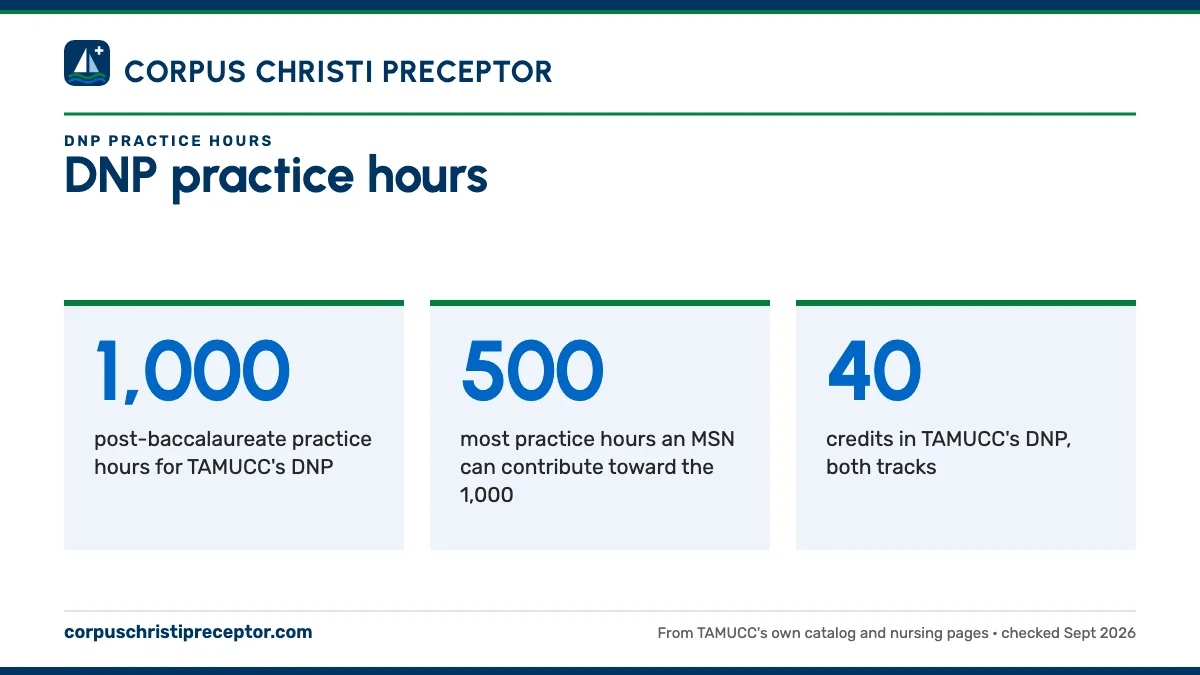
1,000 hours, and how much your MSN covers
The catalog and the DNP Student Handbook (July 2026) set the same target: 1,000 post-baccalaureate practice hours. They also give credit for earlier work: "Appropriate field or clinical hours completed in an MSN program will be counted as part of the 1000 hours (up to 500)." The handbook routes that credit through a Practice Hours Verification Form.
Two phrases in that sentence do the work. "Appropriate" means the program judges which MSN hours qualify, and "up to 500" caps the credit however many hours your MSN required. Because the credit stops at 500, every DNP student completes at least 500 practice hours inside the program itself.
| MSN hours accepted | Credit toward 1,000 | Hours left for the DNP |
|---|---|---|
| 500 or more (for example, a 630-hour FNP) | 500 | 500 |
| 225 | 225 | 775 |
| 180 | 180 | 820 |
| None accepted | 0 | 1,000 |
The rows are illustrations only. The verification form and the program settle your real number, so confirm it in your first semester instead of carrying an assumption into your plan.
Which DNP courses carry practice time
The catalog marks practice or field components course by course, but it publishes no hour target for each one. Those targets sit in an internal hours tool on the DNP course site that only enrolled students see. Here is what the catalog and the Fall 2025 syllabi do say.
| Course | Track | Practice component |
|---|---|---|
NURS 6303 System Behavior and Impact on Health Care | Both | May require field-based activities |
NURS 6304 Application of Evidence in Practice I | Both | Requires field-based activities; the syllabus lists 20 synthesis hours |
NURS 6306 Informatics and Technology for Advanced Practice | Both | May require field-based activities |
NURS 6307 Application of Evidence in Practice II | Both | Clinical practice experiences available |
NURS 6321 Application of Advanced Principles for Clinical Nursing Practice | Nurse Practitioner | Individualized clinical focus on designated populations; the syllabus mentions preceptor attestation |
NURS 6331 Advanced Principles for Executive Practice | Executive Leadership | Clinical experiences required; hours logged in Typhon |
NURS 6195 DNP Project Seminar | Both | 1 credit in each of the last four semesters, graded CR/NC |
That last row matters for planning. The handbook flags that NURS 6195 may have to be repeated to finish the required practice hours, so a shortfall adds a semester of seminar rather than disappearing on its own.
Letters of Support and community facilitators
Under the DNP handbook, you need a Letter of Support from each practice organization you plan to use. It also asks you to identify facilitators in your community who can open doors to sites and resources. A facilitator gives access, not supervision, so this person is different from a preceptor who teaches and signs off on your work.
Approval sits with faculty. The chair of your DNP Scholarly Project Committee must approve every practice experience and make sure it is documented on time. The handbook adds that faculty and the chair may help with the search but are not required to identify a site or topic for you, which leaves the legwork on your side.
For Nurse Practitioner track students, the NURS 6321 syllabus refers to preceptor attestation, so ask early how preceptor sign-off works in that course. The Nurse Practitioner track guide and the Executive Leadership track guide cover the rest of each program.
Logging hours in Typhon and your portfolio
DNP students record practice hours on a clinical-experience platform and build a portfolio from them. The DNP handbook calls it the clinical experience platform; the Fall 2025 NURS 6331 syllabus and the CONHS faculty handbook name it as Typhon. You open your own account there at the start of the program.
Log as you go. The handbook expects timely documentation, the DNP chair oversees hour logging, and falsifying clinical hours is grounds for dismissal. A clean running record also makes the MSN credit, the course targets and your final total easy to reconcile. For logging habits that carry over from FNP courses, see Typhon case logs.
Compare your running total against the course-site targets at the start and the midpoint of each semester. A gap spotted in week six can still be closed with the same organization; a gap spotted after final grades usually means another round of seminar.
Where DNP practice hours can happen
Your own workplace can count. The DNP handbook allows practice hours at your employer when the work serves the course objectives and steers clear of any conflict of interest, a different test from the FNP rule on clinicals where you work. The chair's approval still comes first.
Location is less settled. The MSN handbook's Texas-only sentence does not appear in the DNP handbook, but entry to the Nurse Practitioner track depends on holding a Texas APRN license (the handbook adds national NP certification), and the catalog warns that travel may be part of the program. Before you commit to a site outside Texas, get your DNP chair's answer and keep it with your records.
The program is online and part-time, with cohorts starting each spring and DNP Day held during fall semesters. Hours earned at a site nobody has approved do nothing for your total, so the order is always the same: organization, letter, facilitator, chair approval, then hours.
When a practice site falls through
The DNP handbook is direct about this: if a clinical site becomes unavailable, you are expected to find another. If no alternative turns up within the program sequence, the handbook calls for a leave of absence, which delays every course that follows. It also expects enrollment in 3 or more credits every fall and spring, so pausing while you search is not a simple option.
Protect against that by lining up a second organization while the first is still active, and keep your facilitator contacts current. In the DNP a C must be repeated and blocks the courses that depend on it, as grades and progression explains, so a lost site can ripple through the rest of your plan.
Why DNP students choose us
TAMUCC's clinical process is what we specialize in, and DNP practice hours reward the same thoroughness as an FNP rotation. We start from your track, your project topic and the course you are in, then search near where you live for practice organizations and leaders who fit, including NP preceptors for Nurse Practitioner track clinical time.
We prepare what each approval step needs: the organization contact who can issue the Letter of Support, a facilitator who can open access, and the preceptor's CV and license details where a preceptor applies. Your DNP chair sees a complete, specific plan the first time. If a site closes its doors mid-program, we go straight back to searching while your sequence still has room.
The form below takes your track, semester and city, and the contact page reaches the placement desk for anything longer.
Questions TAMUCC students ask
Do my MSN clinical hours count toward TAMUCC's DNP?
Appropriate MSN field or clinical hours count toward the 1,000, up to a cap of 500, documented through the Practice Hours Verification Form. The program judges which hours qualify. A 630-hour FNP background would reach the cap if accepted, leaving 500 to complete during the DNP.
How many practice hours does each TAMUCC DNP course need?
TAMUCC does not publish per-course targets. They sit in a practice-hours tool on the DNP learning-management site, available once you are enrolled. The catalog only marks which courses require, allow or may require field-based activity. Check the tool at the start of each semester and track your total against it.
What is a community facilitator in the TAMUCC DNP?
A person in your community who helps you reach practice sites and resources. The DNP handbook is clear that facilitators provide access but not supervision, so a facilitator is not a preceptor or an evaluator. You identify them yourself, alongside the Letter of Support from each practice organization.
Can I earn DNP practice hours at my job?
Yes, provided the hours match the course's learning objectives and raise no conflict of interest, per the DNP handbook. Every practice experience, one at your employer included, needs sign-off from the chair of your DNP Scholarly Project Committee, so get that approval before you start counting hours on the job.
Do DNP practice hours have to be completed in Texas?
Nothing in the DNP handbook mirrors the MSN handbook's Texas-only line. The NP track does call for a Texas APRN license, though, and the catalog mentions that travel may be needed. Ask your DNP chair before committing to a site outside Texas, and keep the answer with your records.
Related pages
Last checked 2026-09-26
We check these pages against TAMUCC's catalog, FNP clinical guides, MSN and DNP handbooks and college pages. Your course, your clinical faculty member and the handbook for your cohort have the final word.
TAMUCC makes the preceptor search yours. Let us run it for you in Texas.
Tell us your TAMUCC program, your next clinical course and where in Texas you can drive. We find preceptors who fit the course and gather what the affiliation agreement and the Preceptor Agreement Packet need, early enough for both to clear.
- Preceptors matched to the course: pediatrics for
NURS 5644, women's health forNURS 5645, broad primary care forNURS 5746 - CV, license, board certification and the site's agreement status ready for TAMUCC's paperwork
- In Corpus Christi, the Valley, San Antonio, Houston, Austin, Dallas-Fort Worth and across Texas
Start your placement plan
Your program, city and next clinical semester is all we need to begin.