Site visits and end-of-semester evaluations at TAMUCC
A TAMUCC FNP clinical course is judged twice: while it runs, when your clinical faculty member makes an evaluative visit to your site, and at the close, when four DocuSign forms record your hours and everyone's assessment. Both moments matter, because the clinical portion is graded satisfactory or unsatisfactory and an unsatisfactory result fails the entire course.
Get your placement plan
Tell us your TAMUCC program and where you live. A placement advisor replies with the preceptor and site options that fit your TAMUCC course.
Two checkpoints in every clinical course
Your clinical faculty member owns the clinical grade, and TAMUCC builds two checkpoints into it alongside your coursework. During the semester comes the evaluative site visit. At the end comes a bundle of DocuSign forms that confirm your hours and collect three evaluations: your preceptor's view of you, and your view of the preceptor and of the site.
The stakes come from TAMUCC's grading rule. The clinical portion is marked satisfactory or unsatisfactory, and an unsatisfactory clinical overrides strong didactic grades and fails the course. For the capstone, NURS 5746, a B or better is also required for credit. The grades and progression guide covers what follows a failed course.
Faculty also keep the power to act between checkpoints. TAMUCC's FNP guide lets them remove a student from the clinical setting at any time for unsafe care or conduct, and if the concern cannot be put right in the clinical time left, the clinical grade becomes unsatisfactory.
The evaluative site visit
The FNP Student Clinical Guide states that "The Clinical Faculty will complete at least one evaluative clinical site visit." An older source set the range a little higher: a Fall 2023 NURS 5645 syllabus described "one to two evaluative clinical site visits." Take the guide's figure as the minimum and your current course syllabus as the word on how many visits your course plans.
The visit is how TAMUCC sees your work first-hand at a site it approved but does not run. Your faculty member knows where and when to find you because you submitted an intended schedule at the start of the course, built to fit their availability as well as your preceptor's.
Preparation is straightforward. Keep your Typhon encounter logs current so what you describe matches the record, tell your preceptor as soon as you know a visit date, and wear the TAMUCC student ID badge the FNP guide requires. If your preceptor has questions about the visit, the FNP Clinical Coordinator is TAMUCC's main contact for preceptors.
Why a missed visit is serious
The FNP guide deals firmly with an unannounced absence. If faculty arrive at the site and you are not there, and you gave no notice, the guide says "formal disciplinary action will be taken and the student is at risk for dismissal from the program." The wording leaves no room for a mix-up over dates, so treat the schedule you submitted as a commitment rather than a rough plan.
Changes happen, and the remedy is notice. If your preceptor moves clinic days, the office closes unexpectedly or you are ill, tell your clinical faculty member before the day in question. If the change is permanent, such as a new preceptor, a fresh packet and clearance come before the next hour; the backup preceptors guide covers that situation.
The four DocuSign forms at the end of the semester
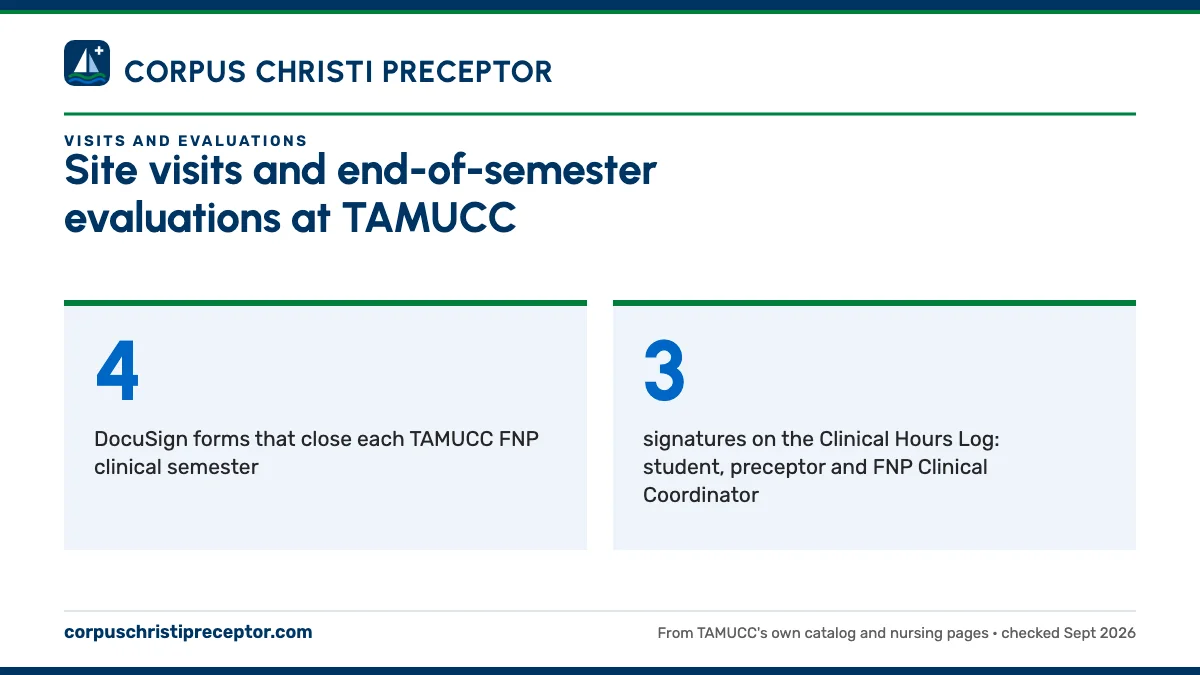
TAMUCC closes each FNP clinical semester with four forms, listed on page 13 of the FNP Student Clinical Guide and routed through DocuSign. Take the due date for each form from your course, and remember that the hours themselves must be complete by the last day of class.
| Form | Completed by | What it does |
|---|---|---|
| Clinical Hours Log | You, your preceptor and the FNP Clinical Coordinator | Confirms your precepted hours and generates the preceptor's hours certificate |
| Preceptor Evaluation of Student | Your preceptor | Records the preceptor's assessment of your clinical performance |
| Student Evaluation of Preceptor | You | Rates the teaching and supervision you received |
| Student Evaluation of Clinical Site | You | Rates the setting as a place for FNP learning |
The totals on the hours log should agree with the encounters you logged in Typhon through the term; the Typhon case logs guide covers that side. Minimum hours cannot be carried into the next semester, so a short log at the end of a course is a gap the forms cannot close.
What your evaluations do for future students
Your two evaluations are more than a formality. TAMUCC's guide says the student's review of preceptor and site "allows faculty to recommend or not recommend their use for future students." Those recommendations matter because later students search Typhon for the sites and preceptors earlier students used, so a candid, specific evaluation helps the next cohort; the Typhon site directory guide explains that search.
Your preceptor's evaluation of you is a separate duty. The FNP Preceptor Guide lists end-of-semester evaluations among a preceptor's responsibilities, together with feedback during the rotation and reviewing and authenticating everything you document. Students, for their part, may not sign prescriptions, orders or legal documents at the site.
What the signed hours log gives your preceptor
TAMUCC's preceptors volunteer, and the end-of-semester paperwork is how the university recognizes them. Once the Clinical Hours Log is signed, it generates an hours certificate that may support continuing education credit, as the preceptor's certifying body allows. TAMUCC also offers letters of appreciation or verification of service and university awards for outstanding service.
Getting the log signed promptly means your preceptor receives that certificate without having to chase it. A preceptor who finishes the semester with clear paperwork is well placed to consider another TAMUCC student later, which is good for your classmates. Preceptors curious about the arrangement can read precepting a TAMUCC student.
Why students choose us before the first visit
Visits and evaluations go best when the placement was right from the beginning. We match TAMUCC students with Texas preceptors who suit the course and TAMUCC's FNP standard, and we brief each preceptor on what TAMUCC will ask of them over the semester: the packet, the evaluative visit, the Preceptor Evaluation of Student and the three-signature hours log.
A preceptor who knows the process in advance makes your semester calmer and your final paperwork quicker. Your clinical faculty member makes every judgment about your clinical work; we make sure the match you bring them fits TAMUCC's rules. Use the form below or read how it works.
Questions TAMUCC students ask
Will my TAMUCC clinical faculty member visit more than once?
Possibly. The FNP Student Clinical Guide sets a floor of at least one evaluative site visit, and a Fall 2023 NURS 5645 syllabus described one to two. Your current syllabus and your clinical faculty member settle the number for your course, so check both when the semester opens.
Can a poor preceptor evaluation affect my clinical grade?
Your clinical faculty member grades the clinical portion satisfactory or unsatisfactory, and your preceptor's evaluation is part of the record TAMUCC collects each semester. Since an unsatisfactory clinical fails the whole course, raise any worrying feedback with your clinical faculty member early, while there is still clinical time left to act on it.
Are the end-of-semester forms on paper?
No, they run online. TAMUCC sends the Clinical Hours Log and the three evaluations through DocuSign, the same service it uses for affiliation agreements and the Preceptor Agreement Packet. Your preceptor signs electronically, so someone at a clinic hundreds of miles from the Island campus can complete their part without any trip.
Can I add hours after the semester ends to fix a short log?
No. TAMUCC requires each course's minimum hours inside that course and does not let them roll into the next semester. Extensions past the last class day are reserved for extreme circumstances such as hospitalization. See no rollover and extensions for the incomplete-grade rules.
What do TAMUCC preceptors receive for precepting?
Preceptors volunteer. At the end of the semester the signed hours log produces a certificate that can count toward continuing education where the certifying body accepts it, and TAMUCC offers letters of appreciation or verification of service plus university awards for outstanding service.
Related pages
Last checked 2026-09-26
We check these pages against TAMUCC's catalog, FNP clinical guides, MSN and DNP handbooks and college pages. Your course, your clinical faculty member and the handbook for your cohort have the final word.
TAMUCC makes the preceptor search yours. Let us run it for you in Texas.
Tell us your TAMUCC program, your next clinical course and where in Texas you can drive. We find preceptors who fit the course and gather what the affiliation agreement and the Preceptor Agreement Packet need, early enough for both to clear.
- Preceptors matched to the course: pediatrics for
NURS 5644, women's health forNURS 5645, broad primary care forNURS 5746 - CV, license, board certification and the site's agreement status ready for TAMUCC's paperwork
- In Corpus Christi, the Valley, San Antonio, Houston, Austin, Dallas-Fort Worth and across Texas
Start your placement plan
Your program, city and next clinical semester is all we need to begin.