Liability coverage and health insurance for TAMUCC nursing students
TAMUCC covers its nursing students in clinical settings through university professional liability coverage, charged with registration at the start of each academic year. Health insurance is a separate matter. The catalog strongly recommends it, because neither the university nor clinical agencies take responsibility for care arising from a clinical assignment, and DNP students must show proof of coverage for the whole program.
Get your placement plan
Tell us your TAMUCC program and where you live. A placement advisor replies with the preceptor and site options that fit your TAMUCC course.
Two kinds of coverage, two different rules
Students often run these together, but TAMUCC handles them separately. Professional liability coverage concerns you as a student practicing under supervision; TAMUCC requires it and arranges it through the university. Health insurance pays for your own medical care; TAMUCC recommends it for MSN students and requires proof of it from DNP students.
At a glance
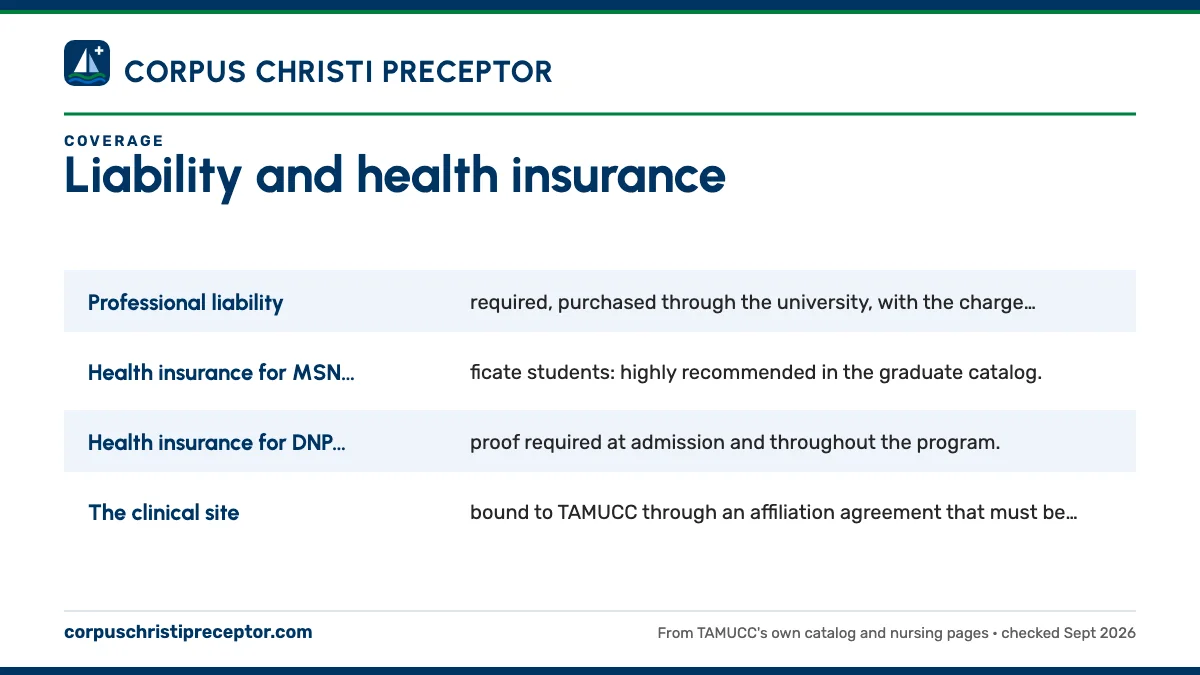
- Professional liability: required, purchased through the university, with the charge included in the fees paid at registration at the start of each academic year.
- Health insurance for MSN and certificate students: highly recommended in the graduate catalog.
- Health insurance for DNP students: proof required at admission and throughout the program.
- The clinical site: bound to TAMUCC through an affiliation agreement that must be active before any hours count.
Professional liability coverage through the university
TAMUCC's MSN and DNP handbooks and its FNP program page all tell students to purchase professional liability coverage through the university, and they spell out the mechanics: the fees for this coverage are included in the fees paid at registration at the beginning of each academic year. The coverage comes with your registration rather than as a separate purchase you arrange yourself.
The FNP catalog and program page list university professional liability coverage with CPR, TB screening, immunizations, the drug screen and the background check among the requirements tied to clinicals. It belongs on the same pre-clinical checklist as those items, and the CastleBranch guide explains how the rest of that list is tracked.
Preceptors hear about the same coverage from their side. TAMUCC's FNP Preceptor Guide tells preceptors that students are covered by university professional liability insurance, in the same list that describes the certificate of verified hours, thank-you letters and university service awards TAMUCC offers them. When you approach a new preceptor, you can point to that line in TAMUCC's own guide.
What liability coverage leaves unchanged
Coverage does not widen what a student may do. TAMUCC's Preceptor Guide bars students from putting their signature on prescriptions, orders or legal documents, and preceptors supervise within the limits of state law and the site's own policies. Your preceptor reviews and authenticates everything you document.
Site rules still govern your conduct. The MSN and DNP handbooks count a violation of agency or clinical site policies that leads to removal from a practice site as a professional-conduct violation, and the FNP guide gives faculty the power to pull a student out of a clinical setting whenever care is unsafe. An unsatisfactory grade in the clinical portion fails the whole course, whatever the didactic grade.
Clinicals at your own workplace raise a related point: your student role and your paid role have to stay distinct. TAMUCC allows hours at your employer only when the rotation sits on another unit and the preceptor has no role in evaluating you as an employee. The workplace clinical rules set out the details.
Health insurance: TAMUCC's advice for MSN students
The graduate catalog calls health insurance highly recommended and gives its reason: neither the university nor clinical agencies are held responsible for emergency or health care arising from a laboratory assignment. In TAMUCC's catalog language, clinical hours are laboratory hours completed in settings approved by clinical faculty, so the warning reaches your precepted rotations.
Put plainly, if you are hurt or become ill because of a clinical shift, the university and the host site are not responsible for your care. Your own health coverage is what stands behind you. A student logging the FNP's 630 clinical hours spends a great many days in clinical settings, which makes the recommendation worth taking seriously.
TAMUCC designed the MSN FNP for part-time study alongside full-time work, and clinical days generally fall on weekdays within business hours, 8 am to 5 pm. If your coverage comes through an employer and you plan to reduce hours or change jobs to make room for clinicals, confirm that your health insurance continues through every clinical semester.
The DNP rule: proof of coverage throughout
DNP students meet a firm requirement rather than advice. TAMUCC's DNP program page lists proof of health insurance throughout the program among the admission requirements for either DNP track, next to a ten-panel drug screen. The requirement runs for the length of the program, so keep your proof current after admission as well.
DNP practice experiences look different from FNP rotations. Students obtain a Letter of Support from the practice organization and name a community facilitator who opens access to sites and resources without supervising. A project can take you into an organization where you are not an employee, so your own coverage matters there as much as it does for an NP student in clinic. The DNP Executive Leadership guide describes those practice experiences.
Coverage and the site agreement
Liability coverage and site contracts work side by side. The Texas BON rule for APRN education, 22 TAC §219.10, calls for written agreements among the program, the clinical preceptor and the affiliating agency that set out each party's functions and responsibilities. At TAMUCC the site side is the affiliation agreement, a university-to-site contract whose dates you check in Typhon's Clinical Site Directory, and the preceptor side is the Preceptor Agreement Packet, signed again every semester.
Health systems set their own terms for those contracts. CHRISTUS Health, for instance, requires a written and signed Clinical Education Affiliation Agreement to be completed before the term begins. TAMUCC tells students to allow up to three months for a new affiliation agreement and warns that larger systems take longer. The affiliation agreements guide walks through that form.
Where our placement service fits
Coverage is settled between you and TAMUCC; the placement is where we come in. We search for a Texas preceptor and clinical site matched to your TAMUCC course, confirm the preceptor meets TAMUCC's license and certification rules, and gather what the Preceptor Agreement Packet and any new affiliation agreement require. When we introduce you, the preceptor also hears what TAMUCC offers in return, from the hours certificate and letters in its Preceptor Guide to the university coverage its students carry.
Your clinical faculty member clears the site and preceptor, and our job is to hand them a file that is complete and fits TAMUCC's rules from the outset. Preceptors can read about precepting a TAMUCC student; students can describe their course and city in the request form on this page.
Questions TAMUCC students ask
Do I need to buy my own malpractice insurance for TAMUCC clinicals?
TAMUCC's handbooks direct students to purchase professional liability coverage through the university, with the charge built into the fees paid at registration at the start of each academic year. That is the coverage TAMUCC's Preceptor Guide means when it tells preceptors students are covered. An additional personal policy is your own choice; if a site asks for more, raise it with the program.
How does coverage work if I do clinicals where I already work?
TAMUCC's rules separate the two roles: a rotation at your employer must sit on another unit, supervised by someone outside your performance reviews. For how the university's coverage applies to a rotation inside your own organization, ask your clinical faculty member before you start, and keep student shifts and paid shifts clearly separate in your records.
Is health insurance required for the MSN FNP?
The catalog stops short of requiring it for the MSN but calls it highly recommended, since neither TAMUCC nor the clinical agencies are responsible for care arising from a clinical or laboratory assignment. The DNP is stricter and requires proof of coverage throughout. For an FNP student completing 630 clinical hours, going without coverage means carrying that risk alone.
What do preceptors receive from TAMUCC for taking a student?
TAMUCC's Preceptor Guide lists continuing education credit as applicable per the preceptor's certifying body, with a certificate generated from verified hours at the end of the semester, plus letters of appreciation, university awards for outstanding service and faculty support. Preceptors volunteer their time. The guide also notes that students are covered by university professional liability insurance. See preceptor requirements.
Will the university's coverage pay for my care if I am injured at a clinical site?
Liability coverage and health insurance answer different risks. TAMUCC's catalog states that neither the university nor clinical agencies are held responsible for emergency or health care arising from an assignment, which is exactly why it recommends health insurance. Treat your own care as your insurer's responsibility, and carry your insurance card with you on clinical days.
Related pages
Last checked 2026-09-26
We check these pages against TAMUCC's catalog, FNP clinical guides, MSN and DNP handbooks and college pages. Your course, your clinical faculty member and the handbook for your cohort have the final word.
TAMUCC makes the preceptor search yours. Let us run it for you in Texas.
Tell us your TAMUCC program, your next clinical course and where in Texas you can drive. We find preceptors who fit the course and gather what the affiliation agreement and the Preceptor Agreement Packet need, early enough for both to clear.
- Preceptors matched to the course: pediatrics for
NURS 5644, women's health forNURS 5645, broad primary care forNURS 5746 - CV, license, board certification and the site's agreement status ready for TAMUCC's paperwork
- In Corpus Christi, the Valley, San Antonio, Houston, Austin, Dallas-Fort Worth and across Texas
Start your placement plan
Your program, city and next clinical semester is all we need to begin.