Studying with TAMUCC from Minnesota
A Twin Cities or Rochester nurse can take TAMUCC's graduate coursework online, but the MSN's clinical hours belong to Texas, start to finish. Minnesota has no compact membership and no bill pending, so the license step also points south. Here is how each program lines up, what Minnesota law says about student practice, and what to ask TAMUCC first.
Get your placement plan
Tell us your TAMUCC program and where you live. A placement advisor replies with the preceptor and site options that fit your TAMUCC course.
Texas rotations, Minnesota home: the short version
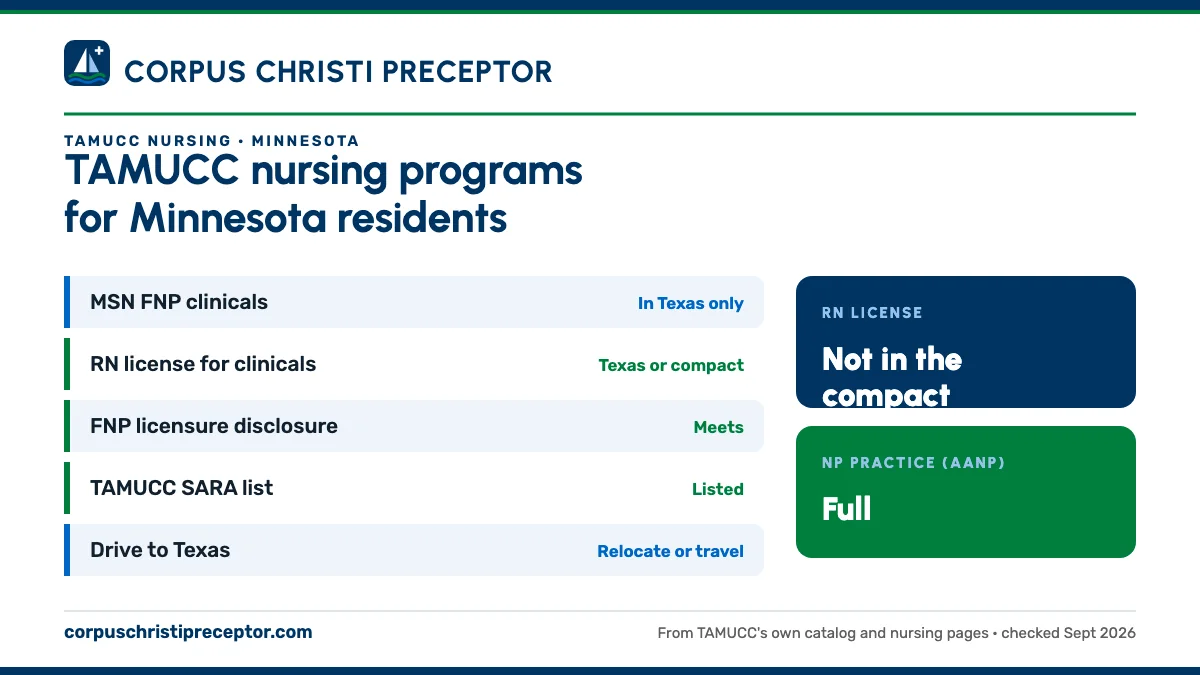
TAMUCC's MSN handbook confines clinical education and training to Texas, and the Nurse Educator and Leadership catalog pages say the same of field experiences. For a Minnesota resident, every rotation means a stay in a Texas city. The rule's sources are gathered on Texas-only clinicals.
| Program | Can a Minnesotan study it? | Clinical setting |
|---|---|---|
| FNP, MSN or Post-Master's Certificate | Coursework online; admission needs a Texas RN license or a Texas-authorized compact license | Texas sites for all 630 hours |
| Nurse Educator or Leadership in Nursing Systems | Coursework online; same license rule | Texas field experiences |
| DNP, both tracks | Online and part-time; the NP track needs a Texas APRN license | No Texas-only rule stated; ask TAMUCC |
TAMUCC does not list which states it enrolls online students from. It asks students pursuing a licensure program outside their home state to check with TAMUCC's College of Nursing and Health Sciences first, and that conversation should come before your application.
Licensing: Minnesota stands apart from the compact
No compact membership here: NCSBN's map lists Minnesota as a non-member with no bill in the legislature. A Minnesota license can't double as the compact license TAMUCC's MSN admission allows, which leaves a Texas RN license as the practical path. Our license page explains what TAMUCC asks for.
Nor does the APRN Compact change anything, since it lacks both Minnesota and the seven-state minimum it needs to open.
Minnesota's rules for student practice and NP independence
Minnesota's NPs reach full practice, AANP's least restrictive category, after a transition period of 2,080 hours spent in collaboration with a physician or an APRN. Texas, where TAMUCC's MSN rotations run, is restricted, with NPs prescribing under agreements with delegating physicians.
On student practice, Minnesota leans open. Under rule 6305.0300, approval by a school's home state satisfies the student exemption; the catch is the supervising instructor, who needs a Minnesota RN license and a current registration. Section 148.271 of the statutes adds a second exemption for RNs from other states: while they pursue advanced study in a formal program, the practice inside that program needs no Minnesota license. Official sources show no extra approval filing for schools based outside the state.
Employers can set a higher bar than the statute. Mayo Clinic, for one, expects four things before an NP student starts: a signed agreement between Mayo and the school, a clean Minnesota nursing license that is currently registered, a Minnesota DHS background study, and a faculty member of record holding an RN or APRN license from the state hosting the rotation. These rules matter only to a DNP student whose practice hours TAMUCC agrees to place in Minnesota; ask the DNP program first.
Systems, metros and the MERC program
Among the state's largest systems are HealthPartners, M Health Fairview, Essentia Health, Allina Health and Mayo Clinic. Most Minnesotans live in the Minneapolis-St. Paul metro, with Duluth, Rochester and St. Cloud next in size. These names sketch the market; they are not offered as TAMUCC sites.
Preceptor money in Minnesota flows to sites, not people. MERC (Medical Education and Research Costs), run by the state health department, partly reimburses clinical training sites, and it counts only students whose teaching program is based in Minnesota. A TAMUCC student, enrolled in a Texas program, would bring a Minnesota site no MERC funding.
Why Minnesota nurses in TAMUCC programs choose us
Pick the Texas metro, and our placement desk takes over the hunt there, matching a preceptor and clinic to your TAMUCC course. Then we pull together what TAMUCC's Preceptor Agreement Packet and affiliation paperwork call for, from the preceptor's CV and board credentials to the site's contract standing. TAMUCC's clinical faculty grant the clearance, and your file reaches them in order. Step-by-step detail lives on how it works.
Questions TAMUCC students ask
Can TAMUCC FNP students do clinicals in Minneapolis or Rochester?
TAMUCC places every MSN clinical hour in Texas, so Minnesota sites fall outside the FNP and certificate programs, including large systems like Mayo Clinic. Online coursework can continue from home, but each rotation means living in a Texas city. Austin and San Antonio are two markets our guides cover.
Why can't my Minnesota RN license meet TAMUCC's compact option?
Minnesota sits outside the compact, with no bill moving to bring it in. A license from the Minnesota Board of Nursing is good only inside Minnesota, so it carries no privilege into Texas. TAMUCC's MSN admission accepts a Texas RN license or a compact license authorized for Texas, which points most Minnesota applicants toward a Texas license.
Could a TAMUCC DNP student do practice hours in Minnesota?
TAMUCC's DNP materials state no Texas-only rule but name no other states either. Minnesota generally accepts students from programs approved at home so long as a Minnesota-licensed instructor supervises, and a large employer like Mayo Clinic layers its own conditions on top. The DNP program must approve the experience first. See DNP practice hours.
Does TAMUCC's FNP program lead to NP practice in Minnesota?
TAMUCC's licensure disclosure counts Minnesota among the states where its MSN meets the educational requirements for FNP certification. After certification and licensing, Minnesota's 2,080 collaborative hours apply before full practice. The licensure disclosure page explains the rest.
Related pages
Last checked 2026-09-26
We check these pages against TAMUCC's catalog, FNP clinical guides, MSN and DNP handbooks and college pages. Your course, your clinical faculty member and the handbook for your cohort have the final word.
TAMUCC makes the preceptor search yours. Let us run it for you in Texas.
Tell us your TAMUCC program, your next clinical course and where in Texas you can drive. We find preceptors who fit the course and gather what the affiliation agreement and the Preceptor Agreement Packet need, early enough for both to clear.
- Preceptors matched to the course: pediatrics for
NURS 5644, women's health forNURS 5645, broad primary care forNURS 5746 - CV, license, board certification and the site's agreement status ready for TAMUCC's paperwork
- In Corpus Christi, the Valley, San Antonio, Houston, Austin, Dallas-Fort Worth and across Texas
Start your placement plan
Your program, city and next clinical semester is all we need to begin.