What the best TAMUCC placement service does
A placement is worth something only if TAMUCC's clinical faculty can clear it. The best service for TAMUCC students works from TAMUCC's own rules: Texas sites, a stricter FNP preceptor list, an agreement for every site and a new packet every semester. Here is what to expect, what to ask and what we deliver.
Get your placement plan
Tell us your TAMUCC program and where you live. A placement advisor replies with the preceptor and site options that fit your TAMUCC course.
Start from TAMUCC's rules
A national list of willing clinicians is not the same thing as a TAMUCC placement. Every MSN clinical hour happens in Texas. FNP preceptors must be NPs, MDs or DOs, board certified nationally, with at least two years of practicing independently. Each site needs an active affiliation agreement, each preceptor signs a fresh Preceptor Agreement Packet every semester, and no hour counts until both are in place and your clinical faculty member signs off on your start.
A service that starts from those rules spends its effort on candidates who can actually be approved. One that starts from a generic database can hand you a name that fails at the first check, weeks into a semester whose hours cannot roll forward. The Texas rule itself is explained on Texas-only clinicals.
Seven things a strong TAMUCC placement service does
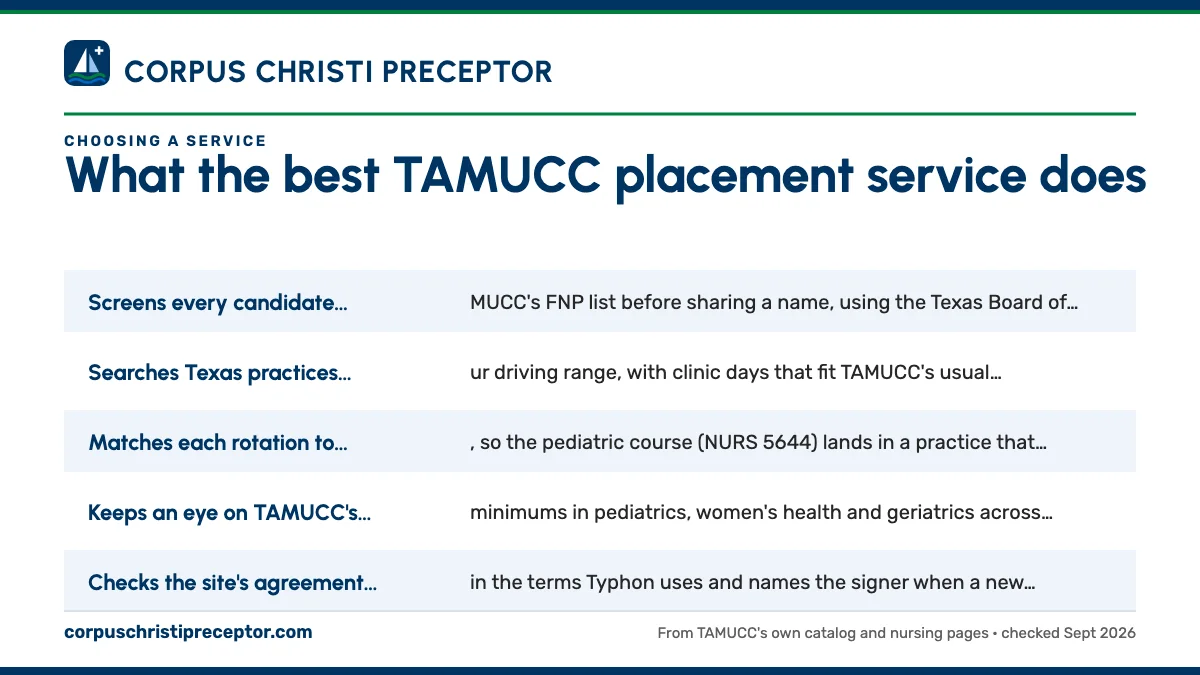
- Screens every candidate against TAMUCC's FNP list before sharing a name, using the Texas Board of Nursing and Texas Medical Board look-ups
- Searches Texas practices within your driving range, with clinic days that fit TAMUCC's usual weekday schedule
- Matches each rotation to its focus, so the pediatric course (
NURS 5644) lands in a practice that sees children, the women's health course (NURS 5645) in one with a steady women's health caseload, and the 270-hourNURS 5746in a full family practice - Keeps an eye on TAMUCC's specialty minimums in pediatrics, women's health and geriatrics across your rotations
- Checks the site's agreement dates in the terms Typhon uses and names the signer when a new agreement is needed
- Hands you the packet paperwork with the name attached: the preceptor's CV, board certification record and a license copy dated inside the past 30 days
- Stays on call all term and restarts the search at once if a preceptor withdraws
More detail on each check is on preceptor requirements and Typhon's site directory.
Questions to ask before you commit
Put these to any service, ours included, and expect specific answers:
- Will this preceptor meet TAMUCC's FNP qualification list, and how was that confirmed?
- Is the site in Texas, and how far is it from where I live?
- Does the site already hold a TAMUCC affiliation agreement covering my semester, and if not, who signs for the site?
- Which documents arrive with the preceptor's name?
- What happens if the preceptor withdraws mid-semester?
- How is the quote built, and what does it cover?
- Does the service understand the DNP's Letter of Support and facilitator model, and the educator and leadership practicums?
Clear, specific answers show that a service knows how TAMUCC works. Vague ones usually mean the checking will land back on you.
Signs a match will stall at TAMUCC
Some offers look complete until they reach your clinical faculty member. Watch for these:
- A preceptor outside Texas for any MSN rotation
- A clinician outside TAMUCC's NP, MD or DO list, or one whose national certification does not cover family practice or a related specialty
- Your own supervisor or a relative offered as the preceptor
- A start date promised before anyone has checked the site's agreement
- Advice to start logging before the site's contract is in force and the packet is signed
- Any promise of approval, which only TAMUCC's clinical faculty can give
Each of these costs time that is hard to win back, because a missing preceptor does not earn an extension at TAMUCC. The backup preceptors page covers how to protect a semester when plans shift.
What stays with TAMUCC
A good service knows where its work ends. TAMUCC assigns your clinical faculty member by location, and that faculty member approves the site and preceptor, reviews your intended schedule and clears your start. Faculty also visit you on site at least once to evaluate, and they assign the clinical grade, and the FNP Clinical Coordinator signs the hours log at the end of the semester. At semester's end the preceptor evaluates you, and you evaluate the preceptor and the site, all through DocuSign forms.
The best service prepares you for each of those moments: a file ready for approval, a schedule that suits both the preceptor and your faculty member, and a preceptor who knows TAMUCC's evaluations are coming. Clinical faculty and clearance explains the review in full.
Why TAMUCC students choose us
We built our placement desk around TAMUCC's process from the start. Your placement advisor works in TAMUCC's terms, from Typhon's Clinical Site Directory to the "Initiate Affiliation Agreement" form, and searches every region where TAMUCC's online students live, from Nueces County and the Valley up the I-35 corridor to Dallas-Fort Worth and east to Houston.
Every name we share has already passed TAMUCC's preceptor standard, arrives with the documents the packet needs and comes with a clear read on the site's agreement. The same placement advisor keeps your file from the first message to the signed hours log, so you tell your story once. See the steps on how it works, what shapes a quote on cost, or share your program, course and Texas city using the form on this page.
Questions TAMUCC students ask
Can a placement service get my preceptor approved faster?
Approval belongs to your TAMUCC clinical faculty member, and no outside service controls that review. What a strong service changes is the file: a preceptor who already meets TAMUCC's list, the documents for the packet and a clear read on the site's agreement, so faculty have what they need at the first look.
Should I use a service that offers preceptors in other states?
Not for an MSN rotation. Under the MSN handbook, every clinical hour in TAMUCC's MSN programs has to be earned in Texas, so a preceptor in another state adds nothing toward FNP, Nurse Educator or Leadership hours. The DNP handbook is silent on location, so DNP students should settle the question with their DNP chair.
What should I send a placement service to get started?
Your TAMUCC program, the clinical course you need covered, your Texas city and driving range, the semester it starts and the weekdays you can give to clinic. Add any leads you have already tried and where your CastleBranch tracker stands, since a lapsed tracker item keeps you out of clinical until it is fixed.
Can I use a service for just one rotation?
Yes. Every TAMUCC rotation is searched and papered separately, so you can hand us only the hard one, such as the pediatric course, NURS 5644, and cover the rest through your own network or a site you found in Typhon.
Is a placement service useful for DNP students?
Yes, though the target changes. A DNP search looks for an organization prepared to write a Letter of Support and a local facilitator who gives access to resources without supervising, and your DNP chair signs off on every practice experience. We match those organizations to the focus of your DNP project and your track.
Related pages
Last checked 2026-09-26
We check these pages against TAMUCC's catalog, FNP clinical guides, MSN and DNP handbooks and college pages. Your course, your clinical faculty member and the handbook for your cohort have the final word.
TAMUCC makes the preceptor search yours. Let us run it for you in Texas.
Tell us your TAMUCC program, your next clinical course and where in Texas you can drive. We find preceptors who fit the course and gather what the affiliation agreement and the Preceptor Agreement Packet need, early enough for both to clear.
- Preceptors matched to the course: pediatrics for
NURS 5644, women's health forNURS 5645, broad primary care forNURS 5746 - CV, license, board certification and the site's agreement status ready for TAMUCC's paperwork
- In Corpus Christi, the Valley, San Antonio, Houston, Austin, Dallas-Fort Worth and across Texas
Start your placement plan
Your program, city and next clinical semester is all we need to begin.